

 DEFENCE INDUSTRYBrahMos export orders: Vietnam deal worth about $100 million, Indonesia $200 million as Akash reaches Tajikistan, Turkmenistan
 DEFENCE INDUSTRYMahindra Embraer Nagpur facility to assemble C-390 if IAF picks the aircraft
 DEFENCE INDUSTRYSMPP Drone Manufacturing Push: Firm Shifts From Ammunition to Unmanned Warfare, Targets Integrated Defence Capabilities
 INDIA DEFENCEDhruv NG Helicopter Explained: What HAL Has Actually Put Into Pawan Hans Service
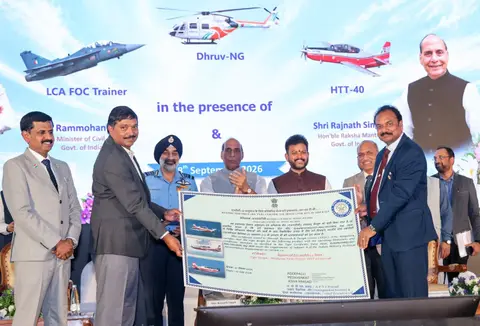 INDIA DEFENCELCA FOC Trainers Delivered With HTT 40 and Dhruv NG as Rajnath Singh Asks Engineers for Technologies That Do Not Exist
BrahMos Indonesia Deal Talks Reach Advanced Stage Ahead of Modi Visit
A wider BrahMos Indonesia deal moved closer on Saturday, when India's Ambassador to Jakarta, Sandeep Chakravorty, said negotiations over the supersonic cruise missile had reached an advanced stage and could be settled soon. He was speaking to news agency IANS days before Prime Minister Narendra Modi lands in Indonesia for a three-day visit beginning July 6.
"There have been discussions which are at an advanced stage. And we hope that very soon these discussions will materialise and there will be movement of defence equipment from India into Indonesia," Ambassador Chakravorty said.
Jakarta already holds a preliminary procurement framework signed in March. What has changed is scope. Indonesian officials now want to move past the single BrahMos system set out in that first understanding and buy in larger numbers, with the missile expected to feature in the talks Prime Minister Modi holds this week.
How the BrahMos Indonesia deal took shape
The two governments first put the sale on the table at the Defence Cooperation Dialogue in New Delhi in November, when Defence Minister Rajnath Singh hosted his Indonesian counterpart Sjafrie Sjamsoeddin. In March, Indonesian Defence Ministry spokesperson Rico Ricardo Sirait placed the agreement inside a broader push to modernise the country's military hardware, with weight given to the maritime side.
Since then the conversation has widened. What began as a one-system plan has grown into talks about a phased buy that scales up numbers over time and carries a full support tail rather than a single delivery. Indonesian planners have made clear they see the missile as part of a longer modernisation cycle, not a standalone purchase, and Indian officials have framed the phased route as a way to match deliveries to Jakarta's own budget cycle.
What the BrahMos Indonesia deal now covers
Sources tracking the negotiations say the package under study runs well beyond the missiles themselves. It is understood to include coastal and mobile launchers, fire-control and surveillance radars, missile rounds, operator training, and long-term logistics and maintenance. Jakarta is weighing how to pay for it, and one option under discussion is financing through an Indonesian state bank, which would spread the cost across the delivery period.
New Delhi has gone a step further and proposed a Joint Defence Industry Cooperation Committee. The aim is to give the relationship an industrial spine, built on technology transfer, joint research and development, local production or assembly, and sustainment worked out together. Handled that way, the sale becomes less a one-off export and more a standing supply line, with know-how and co-production written in from the start. It also gives Indonesian industry a stake in maintaining the systems over their service life.
Officials say the immediate work, should the visit produce agreement, would centre on fixing quantities, delivery timelines and financing, with formal contracts to follow that set out hardware, training and any local-assembly commitments.
The missile on offer
BrahMos is a two-stage supersonic cruise missile built by a joint venture between India's Defence Research and Development Organisation and Russia's NPO Mashinostroyeniya. It flies at close to Mach 3 and runs low, sea-skimming attack profiles against ships and land targets. For export customers the range is held to 290 km to stay within the Missile Technology Control Regime, though the export version keeps the speed and strike behaviour of the missiles carried in Indian service.
In Indian hands the system fires from mobile land platforms and coastal batteries, and is carried on warships and fighter aircraft. The export packages shipped so far have leaned on shore-based coastal-defence batteries and mobile coastal units, which matches what maritime buyers across the region are asking for.
India's growing export list
Indonesia would join a short but growing line of customers. India has already sold BrahMos to the Philippines under a 375 million dollar contract signed in 2022, with deliveries starting in 2024. It is also reported to be deep in talks with Vietnam over a package worth around 620 million dollars covering mobile coastal-defence batteries, training and long-term logistics. Each new buyer thickens an export order book that the government has pushed hard under Aatmanirbhar Bharat, where sales abroad now sit alongside supply to the Indian armed forces as a measure of the programme's health.
Why Indonesia is a different case
There is a pattern that sets Indonesia apart from the other two buyers. The Philippines and Vietnam both sit inside maritime disputes with China in the South China Sea. Indonesia does not claim territory in that contest, and its reasoning runs along a separate line. Jakarta's interest reads instead as sovereign protection of a long archipelagic coastline, deterrence against smuggling and piracy, and a wider upgrade of its naval and coastal-defence forces spread across thousands of islands.


COMMENTS
JOIN THE DISCUSSION