

 INDIA DEFENCEDhruv NG Helicopter Explained: What HAL Has Actually Put Into Pawan Hans Service
 INDIA DEFENCELCA FOC Trainers Delivered With HTT 40 and Dhruv NG as Rajnath Singh Asks Engineers for Technologies That Do Not Exist
 DEFENCE INDUSTRYTata Zorawar light tank clears Army's L1 hurdle for Rs 20,000 crore contract
 DEFENCE INDUSTRYIndia Belgium Defence Deals Sealed As PM De Wever Visits Delhi
 DEFENCE INDUSTRYAero India 2027 Dates Confirmed for February 8 to 12 in Bengaluru
Netra AEW&C future India: where the programme was, is, and can be
The Final Operational Clearance handed to the Indian Air Force is best read not as an ending but as a midpoint. The Netra AEW&C story runs in three movements: a beginning that nearly killed the programme, a present that has taken it to war, and a future already committed on paper.
Where India was: a programme born in a crash
India's first attempt at building its own eyes in the sky began in 1985, under the name Airawat. The idea was plain on paper and punishing in practice, to mount a rotating radar dome on a Hawker Siddeley HS-748, a propeller transport never designed to carry it. By the late 1980s an aircraft was flying with the dome fitted.
Then, on 12 January 1999, it ended. The prototype crashed on a test flight, killing all eight people on board, four of them DRDO scientists and two IAF engineers. The programme was shelved. For a time it looked as though India's airborne radar ambition had gone down with the crew.
The project was revived in 2004 around a Brazilian Embraer EMB-145, with a fixed active array radar replacing the rotating dome that had failed. India signed with Embraer in 2008 and the first modified aircraft flew in December 2011. Almost everything India understands today about integrating a radar, an electronic warfare suite and a battle management system onto a flying platform was learned, at real cost, across those years.
Where India is: three aircraft, combat tested
The handover at Aero India in February 2017 was the first proof the rebuilt programme worked. DRDO gave the IAF a single Embraer jet in Initial Operational Clearance configuration, a system cleared to fly and fight inside defined limits. IOC means useful, not finished.
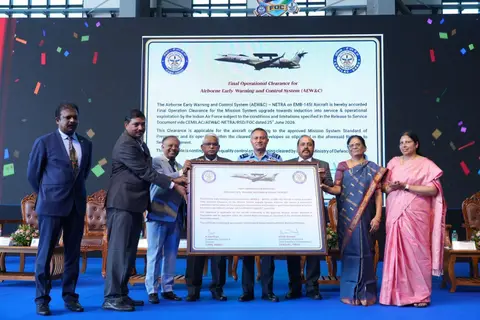
Final Operational Clearance, granted at the Centre for Airborne Systems in Bengaluru, is the harder bar. It certifies that the aircraft meets every Air Staff Qualitative Requirement and can enter a high intensity conflict without the caveats that shadow an IOC machine. Closing that gap took nine years.
The fleet grew quietly in between, the first aircraft to Bathinda in 2017, the second in 2019, the third in 2023. But the real distance between 2017 and now is not paperwork. It is that the Netra has been to war. It flew first during the Balakot operation on 26 February 2019, again through the 2020 standoff with China, and most recently during Operation Sindoor in May 2025, where the Mk1A testbed was pressed into service and, by IAF accounts, performed without fault. Deputy Chief of the Air Staff Air Mshl Awadhesh Kumar Bharti built his remarks at the ceremony around exactly that record.
Three combat-cleared aircraft is where India stands. Stated plainly, that is a thin fleet for a country planning around two active fronts. Which is the whole reason the next movement matters.
Where India can be: the funded leap
For once the plan is committed rather than wished for. The government has cleared twelve more AEW&C aircraft across two tracks. Six Netra Mk1A, on the same Embraer class platform with a gallium nitride-based AESA radar and a stronger electronic warfare suite, were cleared by the Defence Acquisition Council in March 2025. They keep the 240-degree coverage of the current fleet but arrive faster, in roughly five years, a deliberate trade of capability for speed. They sit inside the same Aatmanirbhar Bharat push now running across Indian aerospace, from mission systems to the first Made in India C-295.
The Netra Mk2 is the real leap. Six aircraft, designated AWACS India, approved by the Cabinet Committee on Security in July 2025 at around Rs 19,000 crore, move onto larger Airbus A321 jets bought second hand from Air India. Structural work is carried out at Airbus in Spain, mission systems integrated in India by CABS with Adani Defence and Aerospace as lead partner. The A321 can carry a heavier antenna in a dorsal mount plus a nose array, reaching toward the full circle the Mk1's 240 degrees never managed, with an Uttam-derived radar expected to see past 400 kilometres and to track ballistic missiles. First delivery is due in 2033.
Together the two orders would carry the fleet from six aircraft to eighteen by the middle of the next decade. The IAF, after Operation Sindoor, has asked for closer to 24. Survivability shapes the design now as well, after India reportedly brought down a Pakistani early warning aircraft at long range during the fighting, a reminder that these platforms are themselves the prize the so called AWACS killers are built to take. A combat-tested Netra with a clearance in hand is also, for the first time, a credible export, with Indonesia reported to have asked for a demonstration.
The horizon does not stop at the Mk2. DRDO has spoken of a Netra Mk3 built to deliver true 360-degree coverage on a fully indigenous radar, the point at which India would no longer look to any foreign design for its eyes in the sky. Nothing has been sanctioned yet. But from a rotodome that fell out of the sky in 1999 to a home grown system reaching for all-round vision, the line now runs in one direction.

COMMENTS
JOIN THE DISCUSSION