

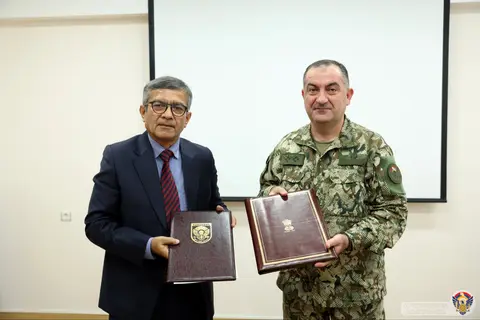
 DEFENCE INDUSTRYBrahMos export orders: Vietnam deal worth about $100 million, Indonesia $200 million as Akash reaches Tajikistan, Turkmenistan
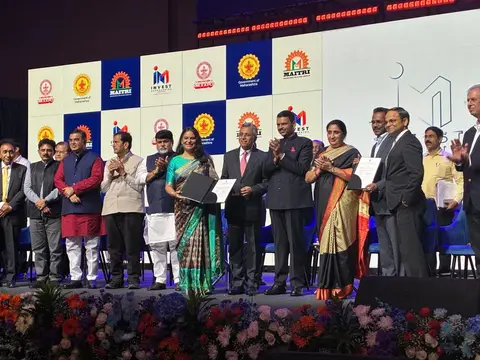 DEFENCE INDUSTRYMahindra Embraer Nagpur facility to assemble C-390 if IAF picks the aircraft
 DEFENCE INDUSTRYSMPP Drone Manufacturing Push: Firm Shifts From Ammunition to Unmanned Warfare, Targets Integrated Defence Capabilities
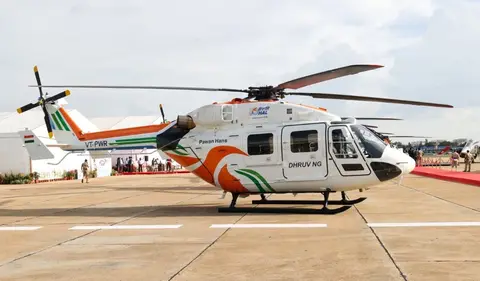 INDIA DEFENCEDhruv NG Helicopter Explained: What HAL Has Actually Put Into Pawan Hans Service
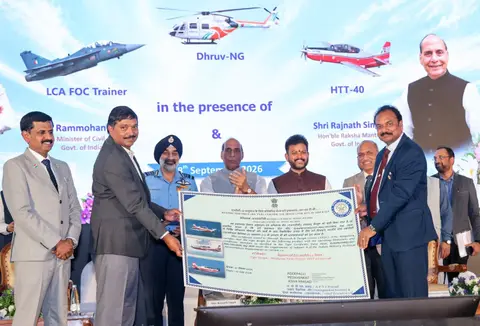 INDIA DEFENCELCA FOC Trainers Delivered With HTT 40 and Dhruv NG as Rajnath Singh Asks Engineers for Technologies That Do Not Exist
BrahMos Missile Deal with Vietnam Confirmed as Indonesia Talks Near Conclusion
The BrahMos missile deal with Vietnam has been formally confirmed by India's Defence Secretary Rajesh Kumar Singh, who revealed at the Shangri-La Dialogue in Singapore on Saturday that the agreement has already been signed, even though it had not been publicly announced until now. Singh added that negotiations with Indonesia for a similar procurement are in their final stages, pointing to a rapid expansion of the BrahMos export programme across Southeast Asia.
Speaking during a session titled "Building Defence Industrial Resilience" at Asia's premier security forum, Singh responded to a question from a Vietnamese delegate by stating: "My understanding is that with both Indonesia and Vietnam, the deal is in the final stages. In fact, for Vietnam, I understand that it has already been signed, probably not publicly announced, but it has already been signed." The remarks constitute the first official confirmation of a deal that had been reported for some time but never formally acknowledged by New Delhi.
A Second ASEAN Nation Joins the BrahMos Export Club
Vietnam becomes the second country in Southeast Asia to secure the BrahMos system, following the Philippines, which signed a USD 375 million agreement with India in January 2022 for three shore-based anti-ship batteries. That deal was the first overseas export order for BrahMos and demonstrated the missile's commercial and strategic viability as an export product. Deliveries to the Philippines commenced in April 2024, with a second battery arriving in April 2025, and training programmes for Filipino personnel have been conducted on Indian soil.
The Vietnam agreement is reported to be worth approximately Rs 60,000 crore, or around USD 629 million, and is understood to include training packages and logistical support alongside the hardware supply. The deal follows a period of intensifying engagement between New Delhi and Hanoi. Vietnamese President To Lam visited India from May 5 to 7 this year, and Defence Minister Rajnath Singh travelled to Hanoi from May 18 to 19, signalling a deepening of bilateral ties that has now translated into a concrete defence procurement.
Indonesia BrahMos Missile Deal Close to Finalisation
Singh's statement on Indonesia confirms that Jakarta is on the verge of becoming the third country, and the third in Southeast Asia, to acquire BrahMos. Negotiations between India and Indonesia have been under way for some time, and the Defence Secretary's public remarks suggest that the outstanding issues are close to being resolved. Should the Indonesian deal conclude in the coming weeks, it would represent a further consolidation of India's position as the dominant supplier of advanced missile systems to the ASEAN region.
The growing appetite for BrahMos among Indo-Pacific nations reflects both the performance credentials of the missile and the broader shift in regional security calculations as countries seek credible deterrence capabilities. BrahMos, jointly developed by India's Defence Research and Development Organisation and Russia's NPO Mashinostroyeniya through the BrahMos Aerospace joint venture, travels at speeds in excess of Mach 2.8 and is capable of sea-skimming flight profiles that make it extremely difficult to intercept. The missile can be launched from land, sea and air platforms, giving operators considerable tactical flexibility.
BrahMos Export as a Pillar of India's Defence Industrial Ambition
The Vietnam and Indonesia developments arrive at a moment when India's defence export ambitions are being realised in increasingly concrete terms. The government has set an ambitious target of reaching Rs 50,000 crore in annual defence exports, and advanced platforms such as BrahMos are central to that objective. India's defence exports have climbed sharply over the past several years, driven by a combination of product quality, competitive pricing, and New Delhi's willingness to offer government-to-government frameworks that simplify procurement for partner nations.
Singh underlined this broader posture at the Shangri-La Dialogue, stating that India sees itself as a dependable defence manufacturing and maintenance hub, pointing to its capacity to produce multiple missile systems, fighter aircraft and main battle tanks. The BrahMos programme in particular has become a flagship of this effort, with its export success lending credibility to India's claim to be a serious defence industrial power rather than merely an aspirant.
The dual-use nature of the BrahMos system, which can be configured for anti-ship and land-attack roles, makes it especially attractive to smaller navies and coastal defence establishments in the Indo-Pacific that require a high-impact deterrent at manageable cost. Countries in the region face an evolving threat environment characterised by contested maritime claims and the rapid modernisation of adversary forces, creating demand for precisely the kind of precision standoff strike capability that BrahMos provides.
Geopolitical Dimensions of the BrahMos Missile Deal
There is a notable geopolitical dimension to every BrahMos export. Because the missile is a joint India-Russia product, any transfer requires both partners to agree that the recipient country qualifies as a friendly foreign nation. Singh addressed this directly at the Shangri-La Dialogue, telling the Vietnamese delegate: "So yes, obviously you are in the category of friendly foreign country with whom we would be happy to share this kind of advanced technology." This public framing confirms that Russia has signed off on Vietnam as a recipient, a significant diplomatic outcome given the complexities of managing a defence partnership with Moscow in the current global environment.
Vietnam's strategic geography makes the acquisition particularly meaningful. Hanoi has long-standing territorial disputes in the South China Sea and has been quietly but steadily modernising its military capabilities. Shore-based BrahMos batteries would give Vietnam a credible coastal defence posture and extend its ability to threaten surface vessels operating in the contested waters off its coastline. For India, placing BrahMos with Vietnam adds another node to a network of capable partners across the Indo-Pacific who share an interest in a rules-based maritime order.
Indonesia's prospective acquisition carries similar implications. As the world's largest archipelagic state, Indonesia's maritime defence requirements are extensive, and a BrahMos purchase would signal a meaningful deepening of the India-Indonesia defence relationship that has developed under the framework of their Comprehensive Strategic Partnership.
What Comes Next for the BrahMos Programme
With Vietnam confirmed and Indonesia expected shortly, attention will turn to which country may be next in the BrahMos export pipeline. Several other nations across the Indo-Pacific, the Middle East and beyond have expressed interest in the system at various points, and the programme's growing operational record with multiple customers strengthens India's hand in those conversations. BrahMos Aerospace has also been working on an extended-range variant with a reach of around 450 kilometres, as well as an air-launched version integrated onto India's Su-30MKI fighters, configurations expected to attract interest from air forces in addition to naval and coastal defence customers.
The BrahMos missile deal with Vietnam marks a milestone for India's defence export industry. Alongside the approaching Indonesia agreement, it confirms that New Delhi has built a genuinely competitive and internationally recognised missile programme capable of winning contracts on merit in a demanding and strategic marketplace. The pace of export success for BrahMos is now among the strongest indicators that India's long-term goal of becoming a top-tier defence exporter is well within reach.
For further details on the BrahMos programme and India's broader defence export ambitions, see the official Department of Defence Production and the BrahMos Aerospace official website. The Shangri-La Dialogue proceedings are available through the International Institute for Strategic Studies.

COMMENTS
JOIN THE DISCUSSION