

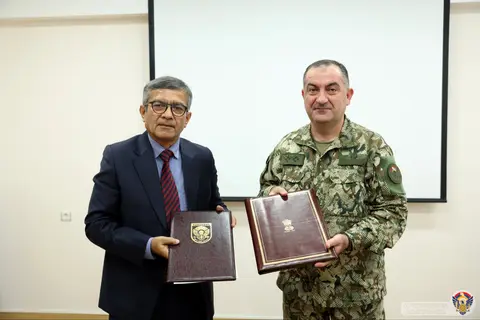
 DEFENCE INDUSTRYBrahMos export orders: Vietnam deal worth about $100 million, Indonesia $200 million as Akash reaches Tajikistan, Turkmenistan
 DEFENCE INDUSTRYMahindra Embraer Nagpur facility to assemble C-390 if IAF picks the aircraft
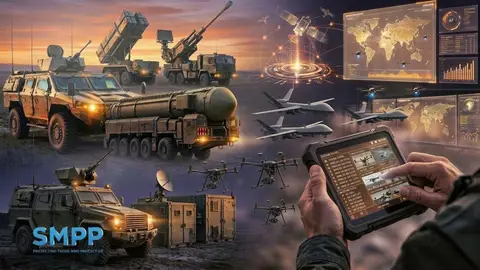 DEFENCE INDUSTRYSMPP Drone Manufacturing Push: Firm Shifts From Ammunition to Unmanned Warfare, Targets Integrated Defence Capabilities
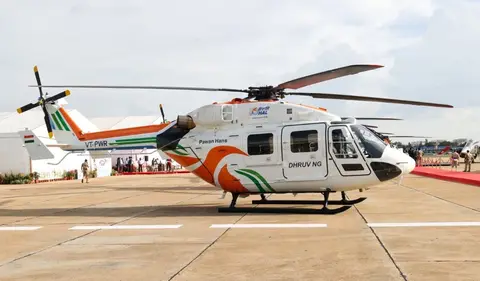 INDIA DEFENCEDhruv NG Helicopter Explained: What HAL Has Actually Put Into Pawan Hans Service
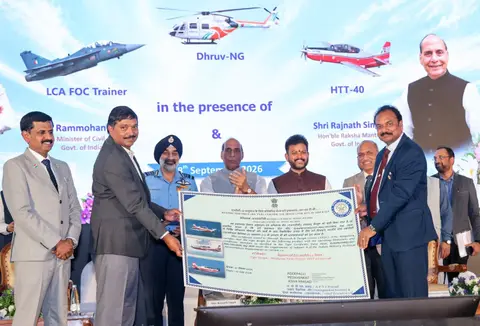 INDIA DEFENCELCA FOC Trainers Delivered With HTT 40 and Dhruv NG as Rajnath Singh Asks Engineers for Technologies That Do Not Exist
Indian Army loitering munition tender sees Tata Advanced Systems emerge as lowest bidder
The Indian Army loitering munition tender for 840 systems of 100 km range has thrown up Tata Advanced Systems as the lowest bidder, with Nibe Limited placed second, defence sources have told news agency ANI. The tender is worth around Rs 1,600 crore. Price bids were opened a few days ago under fast track procedures.
How the Rs 1,600 crore is expected to split
Tata Advanced Systems, as L1, is in line to supply 64 per cent of the 840 munitions the Regiment of Artillery has asked for. That is roughly Rs 1,000 crore. Nibe, at L2, takes the balance of 36 per cent, about Rs 600 crore.
None of it is signed.
The Army will now call L1 and L2 in for price negotiations. That is the stage where the second bidder is asked whether it will come down to the lowest quoted rate, and where quantities are firmed up against what each vendor can actually deliver on schedule. Splits announced at bid opening have moved before. Until the negotiation closes, the 64-36 division is an expectation drawn from the price bids, not a contract that either company can book.
Indian Army loitering munition buy went the fast track route
Fast track procurement is the compressed pathway the Ministry of Defence uses when a capability gap is judged too urgent to survive the standard acquisition timeline. It strips out stages rather than standards. Trials still happen, technical evaluation still happens, and the tender still runs to lowest bidder. What compresses is the calendar.
Three vendors cleared the technical evaluation on this one. Tata Advanced Systems, Nibe Limited fielding its Vayuastra, and A-Vision. Two of them made it to the price stage in contention.
What has not been said
Vayuastra is based on the Skystriker, an Elbit Systems loitering munition that has been supplied to Indian forces before through domestic production arrangements. Neither Nibe nor Tata Advanced Systems has issued a statement on the bid outcome. TASL's published unmanned systems material lists a family of loitering platforms, the ALS 50, the ALS 250 marketed as a long range system, and the ALS Mk II, but the company has not disclosed which of these went into the tender, and the sourcing here does not establish it either. Nor has the Army confirmed the numbers publicly. Everything in the figures above rests on defence sources speaking to a wire agency.
The foreign design lineage inside Vayuastra is worth registering. It does not disqualify anything. India's fast track buys have repeatedly turned on the question of how much of a system is genuinely made here, and it is a question that has been put to Nibe before, when the company answered claims that its Suryastra rocket launcher was assembly work dressed up as indigenous design. Fast track paperwork does not settle that argument. Delivery schedules rarely leave room to have it.
Artillery has been rebuilt around drones
The Regiment of Artillery no longer treats unmanned systems as something bolted onto the gun line. It has raised dedicated drone batteries and drone regiments. Shaktibaan regiments exist to conduct drone warfare on their own, working with Divyastra batteries. Bhairav battalions have been handed drones for strikes against enemy targets.
That structure is the reason a tender of this size moves at this speed. The formations are already standing. What they need is stock.
One lakh drones, and a jet powered tender behind this one
Estimates put the Indian Army's eventual requirement at around one lakh drones across roles. The Artillery Directorate expects to induct systems spanning ranges from 50 km out to 1,000 km within the next twelve to eighteen months, all of it routed through fast track procedures. The 100 km band that Tata Advanced Systems and Nibe have just bid for is one slice of that ladder, and the Indian Army loitering munition requirement runs past it in both directions.
Behind it sits another tender.
The Army is preparing a competition for 36 jet based drones, worth around Rs 1,500 crore, which will also be split between L1 and L2 rather than awarded whole. Two large drone orders inside one procurement cycle, both structured to seed a second supplier, tells you something about how the Department of Defence Production is thinking about capacity. One winner is a bottleneck. Two is an industrial base.
Two Indian names at the top of the sheet
Both firms in contention are Indian. Tata Advanced Systems has spent a decade building out an unmanned portfolio alongside its aerostructures and land systems work. Nibe has moved from engineering fabrication into defence platforms, largely through tie-ups with foreign original equipment manufacturers, and has been pushing hardware in front of the Army, most recently taking its Garudastra mortar system to Mhow for demonstration. Between them the two firms now hold the price advantage on an 840-unit order that, a few procurement cycles ago, would almost certainly have gone abroad as a direct import with an offset clause attached.
That shift shows up in the aggregate numbers too. India's defence production hit a record Rs 1.78 lakh crore in FY 2025-26, with private sector output climbing steadily against the ordnance factory and defence PSU baseline. The build out is physical, not notional.
Loitering munitions sit at the cheap end of that industrial story and the sharp end of the tactical one. A hundred kilometre reach carries an artillery formation's strike option far past its guns, into the depth where headquarters, radars and logistics nodes live. Operation Sindoor taught that faster than paperwork could.
Price negotiations with Tata Advanced Systems and Nibe are the next step.

COMMENTS
JOIN THE DISCUSSION