

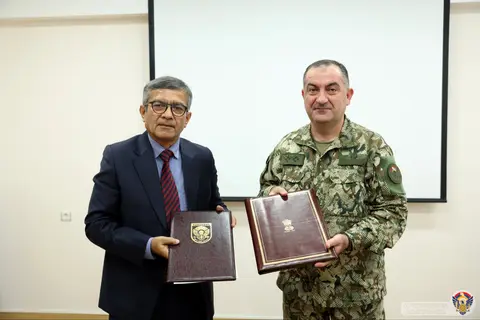
 DEFENCE INDUSTRYBrahMos export orders: Vietnam deal worth about $100 million, Indonesia $200 million as Akash reaches Tajikistan, Turkmenistan
 DEFENCE INDUSTRYMahindra Embraer Nagpur facility to assemble C-390 if IAF picks the aircraft
 DEFENCE INDUSTRYSMPP Drone Manufacturing Push: Firm Shifts From Ammunition to Unmanned Warfare, Targets Integrated Defence Capabilities
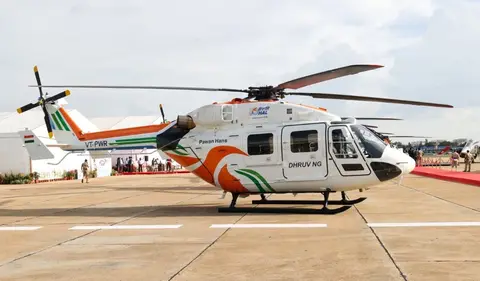 INDIA DEFENCEDhruv NG Helicopter Explained: What HAL Has Actually Put Into Pawan Hans Service
 INDIA DEFENCELCA FOC Trainers Delivered With HTT 40 and Dhruv NG as Rajnath Singh Asks Engineers for Technologies That Do Not Exist
Astra missile programme: where it was, where it is, and where it can go
The Astra missile programme signed up its first export customer on Tuesday, when India and Indonesia concluded an agreement in Jakarta covering the supply of the beyond visual range air-to-air missile alongside an expansion of Jakarta's BrahMos inventory. The deal was sealed during Prime Minister Narendra Modi's visit to Indonesia, the first leg of a three-nation tour, with Reuters-sourced reporting placing the combined missile package at around USD 630 million. For a weapon that began life as a set of ballistic launches off a ground rig at Balasore in 2003, the moment invites a full accounting. This is where the programme was, where it stands, and where it can go.
What a BVRAAM is
Beyond visual range means the missile is built to kill at distances where the pilot cannot see the target, only a radar contact tens of kilometres away. That is the whole point of the class. Older short-range missiles use heat-seeking sensors for the close-in dogfight, but a BVRAAM has to find and hit something far outside eyesight.
The Astra does it in stages. The fighter's radar spots and tracks the target, the missile launches and its rocket motor takes it to roughly Mach 4.5, and for most of the flight it steers by its own internal guidance while the fighter feeds it updates over a secure radio link. Only in the final stretch does the missile's own radar switch on, lock the target and finish the job on its own, letting the pilot turn away. Range on the in-service Mk-1 is a little over 100 km.
Where it was: a seeker problem and a twenty-year climb
DRDO opened discussions on an indigenous beyond visual range air-to-air missile in 2001. The Defence Research and Development Laboratory in Hyderabad was asked to demonstrate basic capability even before formal project sanction, and in May 2003 it conducted three ballistic trials from a ground launcher at the Integrated Test Range, Balasore, to prove safe release before any manned aircraft carried the weapon. The IAF was asked in parallel to draw up the programme standard and quality requirement.
The hard problems were named early. A radio frequency seeker had to be mastered, the missile hardware had to be miniaturised and hardened, and integration on frontline IAF aircraft had to be done without support from the foreign original equipment manufacturer. None of this moved quickly. The first air launch from a Su-30MKI came in May 2014, eleven years after Balasore.
From there the pace changed. Development trials wrapped up in September 2017 and Bharat Dynamics Limited began production at its Bhanur plant in Sangareddy, Telangana, with a first order of 50 missiles. In September 2019 the IAF ran five user trials off Odisha against Jet Banshee target aircraft, three of them in full combat configuration with live warheads, including a direct hit at maximum range. The Defence Acquisition Council sanctioned 248 missiles in 2020, split 200 for the IAF and 48 for the Navy, and on 31 May 2022 the Ministry of Defence signed a Rs 2,971 crore production contract with BDL under the Indian Designed, Developed and Manufactured category. The first production missiles were flagged off to the IAF in January 2024, and full-scale production clearance followed that August.
One dependency took longer to shake. Early Astra rounds flew with a Russian-origin radar seeker, the part in the missile's nose that finds the target in the final seconds, built under licence in India. That has now been replaced by an Indian seeker developed at home. On 11 July 2025, DRDO and the IAF fired two rounds carrying the indigenous seeker from a Su-30 MK-I off Odisha, destroying high-speed unmanned targets, and Defence Minister Rajnath Singh called it a major milestone in critical defence technology. With that, the missile is very nearly all Indian.
Where the Astra missile programme stands today
The Mk-1 in service is a 3.6 metre, 154 kg weapon with a stated range exceeding 100 km, mid-course inertial guidance over a secure datalink and active radar homing in the endgame. It is integrated on the Su-30MKI fleet and has been fired from the LCA Tejas, with the MiG-29 and the Navy's MiG-29K in the integration plan. More than 50 public and private companies, Hindustan Aeronautics Limited among them, feed the production chain that BDL leads as the manufacturing agency.
Two things changed the missile's standing in the last fourteen months. The first was Operation Sindoor in May 2025, during which IAF Su-30MKIs are widely reported to have employed the Astra in live engagements, a combat credential no marketing brochure can substitute. The second came from the test range. In January 2026 a DRDO official said a Tejas had detected a target at 140 km and killed it with an Astra at 110 km under full manoeuvring conditions, with the missile past 50 live firings overall. The same account confirmed that, after feasibility talks between DRDO and the IAF that followed the May 2025 conflict, the range of existing Mk-1 stocks is being stretched to 160 km.
Mk-2: the 200 km class moves to user trials
The Astra Mk-2 is the programme's middle rung, and it is closer than most follow-on Indian systems tend to be. The missile carries an in-house dual-pulse rocket motor, an indigenous AESA seeker made by Bharat Electronics Limited with electronic counter-countermeasures, a laser proximity fuze and a two-way datalink for mid-course updates, with indigenous content put at 90 percent.
The range figure has been a moving target, upward. The original design goal was around 160 km. The Defence Acquisition Council cleared a range extension for the Mk-2 at its meeting on 29 December 2025, part of a Rs 79,000 crore batch of approvals, taking the requirement past 200 km, and in January 2026 a DRDO scientist said the newly developed dual-pulse motor can push the missile to 240 km. The IAF has indicated interest in roughly 700 Mk-2 rounds for its Su-30MKI and Tejas fleets, a number shaped by the PL-15 in Chinese and Pakistani service.
In April 2026 the Mk-2 cleared preliminary trials validating aerodynamics, propulsion and guidance, and moved toward integrated user trials with frontline squadrons. Production is planned on the existing Astra line at BDL, with the Su-30MKI as the first integration platform followed by the Tejas Mk-1A. Reports from December 2025 projected limited series production beginning from mid-2026, though the user trial campaign will decide the actual date.
Gandiva: the ramjet gamble at the top of the family
The Astra Mk-3, formally named Gandiva after Arjuna's bow, abandons the solid rocket motor for a Solid Fuel Ducted Ramjet. An air-breathing sustainer draws oxidiser from the atmosphere, which keeps the missile light at around 220 kg while sustaining speeds up to Mach 4.5, and the throttleable ramjet can modulate thrust in flight, widening the no-escape zone against a manoeuvring target. Open reporting places maximum range around 340 to 350 km from high-altitude launch, dropping to roughly 190 km from lower altitudes. The target set extends beyond fighters to the aircraft that hold an air campaign together, AEW&C platforms, tankers and transports.
The technology base is proven but the packaging is not finished. SFDR ground testing has run since 2017, the Ministry of Defence's year-end review recorded a 2023 flight test of the Mk-3 configuration with a nozzle-less booster and thrust modulation, and by March 2025 the missile had completed flight tests FT-01 and FT-02 validating separation mechanisms. Captive carriage trials on the Su-30MKI are under way ahead of live firings. The seeker will start as a Gallium Arsenide AESA unit, with a Gallium Nitride version in development for better jam resistance. Timelines diverge across accounts, from a DRDO official in January 2026 suggesting readiness within two years to reports projecting production clearance around 2028 and induction in the early 2030s.
The family does not end there. A shorter-range Astra IR with an imaging infrared seeker is planned around the 80 km class, and the VL-SRSAM surface-to-air missile the Navy is inducting is itself an Astra derivative, evidence of how far one airframe and seeker ecosystem can stretch.
The export lane: how the Indonesia deal came together
Tuesday's agreement makes Indonesia the first foreign buyer of the Astra, and the fit is straightforward. The Indonesian Air Force flies Russian-built Su-27 and Su-30 fighters whose ageing R-77 missile stocks are hard to sustain under sanctions on Russian industry. The Astra bolts onto the same jets and comes from a supplier with none of that baggage. Under the arrangement, BDL will handle integration of the missile with Indonesia's Su-30 fleet, with the exact numbers to be settled in the commercial talks that now follow.
The deal did not appear overnight. It was built through a run of high-level defence contacts that gave both sides the confidence to commit.
The groundwork before Jakarta
The Astra file rode on the back of the BrahMos track. Indonesia agreed to buy its first BrahMos battery earlier in 2026, and the relationship deepened from there. In November 2025, Indonesian Defence Minister Sjafrie Sjamsoeddin came to New Delhi for the third India-Indonesia Defence Ministers' Dialogue, co-chaired with Rajnath Singh, where the two reviewed the BrahMos deal and Singh handed his counterpart a model of the missile. That visit, and the earlier presence of Indonesian leadership at India's Republic Day, set the tone. By the time Modi landed in Jakarta this week, the political groundwork was done and the Astra could be added to an expanding BrahMos understanding rather than negotiated cold. IDW tracked those threads as the BrahMos talks reached an advanced stage and as Modi arrived in Jakarta.
A wider export push, and the queue behind Indonesia
Indonesia is one piece of a broader run. India is preparing to deliver the third and final tranche of BrahMos to the Philippines under a USD 375 million contract signed in 2022, and talks are live with Vietnam and Malaysia among others. The Astra has drawn its own early interest, with Brazil having explored the Mk-1 for its Gripen fleet in 2023 and Armenia inquiring for its Su-30s in 2024. Running under all of it is Operation Sindoor in May 2025, when Indian missiles were used in combat for the first time, which did more for buyer confidence than any demonstration.
The sales case is the same in every conversation: a combat-proven weapon at a fraction of the imported Meteor's price, compatible with the large global fleet of Russian-built fighters, from a vendor whose supply lines run through Hyderabad rather than Moscow. For countries flying Russian jets but wary of depending on Russia, that middle path is the selling point. IDW's recent look at the Netra AEW&C programme's past, present and future traced the same arc, an indigenous system growing into a niche imports once held by default.
Capacity is the constraint that will decide how far the Astra missile programme's export lane can open. BDL was reported in 2024 to be approaching a rate of 50 Mk-1 rounds a year at Bhanur, a line that must now serve the IAF, the Navy, the Mk-2 when it arrives, and Indonesia's Su-30 fleet. The user trials of September 2019 proved the missile. The next proof falls on the factory floor.





COMMENTS
JOIN THE DISCUSSION