

 DEFENCE INDUSTRYBrahMos export orders: Vietnam deal worth about $100 million, Indonesia $200 million as Akash reaches Tajikistan, Turkmenistan
 DEFENCE INDUSTRYMahindra Embraer Nagpur facility to assemble C-390 if IAF picks the aircraft
 DEFENCE INDUSTRYSMPP Drone Manufacturing Push: Firm Shifts From Ammunition to Unmanned Warfare, Targets Integrated Defence Capabilities
 INDIA DEFENCEDhruv NG Helicopter Explained: What HAL Has Actually Put Into Pawan Hans Service
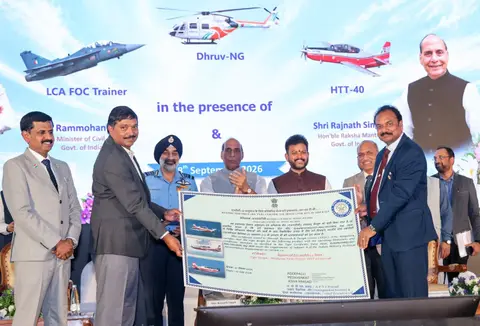 INDIA DEFENCELCA FOC Trainers Delivered With HTT 40 and Dhruv NG as Rajnath Singh Asks Engineers for Technologies That Do Not Exist
BrahMos defence export: the missile that made India a seller
The BrahMos defence export story gained another chapter this week, when Indonesia doubled its order to two batteries during Prime Minister Narendra Modi's Jakarta visit, the latest entry in a pattern that has been building for four years. The Philippines bought the missile in 2022 and is nearly done receiving it. Vietnam signed its own deal this year. The Indonesian file had been moving toward closure for months. Malaysia has evaluated the system for its ships and Su-30s, and interest has been reported at various points from countries as far apart as Greece, Egypt, the UAE and Chile. One weapon has quietly become the face of India's defence export push.
Why this missile, why these countries, and what does India actually get out of it? The answers say as much about the state of the Indo-Pacific as they do about the weapon itself.
Seconds, not minutes
The BrahMos, developed jointly by DRDO and Russia's NPO Mashinostroyeniya, flies at close to three times the speed of sound and stays supersonic all the way to impact. That single fact drives everything else. A subsonic cruise missile of the Tomahawk or Harpoon type gives a warship's defences long minutes to detect, track and engage it. A sea-skimming missile arriving at Mach 2.8 collapses that window to seconds, and its sheer kinetic energy means even a partial intercept may not stop the strike. Very few operational systems anywhere combine that speed with precision, and none of the others are for sale.
Flexibility does the rest. The same basic weapon, built across four Indian plants, fires from mobile land launchers, warships, submarines and the Su-30MKI, follows pre-set waypoints, and needs no guidance from the launch platform once away. A buyer is not acquiring one missile so much as a whole family of strike options.
Then there is the proof. The BrahMos was fired in combat during Operation Sindoor in May 2025, striking Pakistani airbases, and for a prospective buyer that matters more than a decade of test-range successes. A weapon that has worked under real conditions, with a maintenance and logistics chain that held up in a shooting war, is a different proposition from a brochure. Export interest visibly accelerated in the year after the operation.
The South China Sea does the selling
The regional demand is not really about the missile. It is about the South China Sea.
Several Southeast Asian states face overlapping territorial claims and steadily growing military pressure in their own waters, and most of them have chosen not to join formal military blocs. That leaves deterrence to be built at home, and for a middle power with a long coastline and a modest navy, the arithmetic points one way. Matching a larger fleet warship for warship is impossible. A network of mobile coastal missile batteries that can threaten hostile ships hundreds of kilometres offshore is affordable, hard to find, and hard to destroy, and it forces an approaching navy to plan around it. Defence planners call this anti-access and area denial. The BrahMos is one of the few exportable weapons that delivers it convincingly.
That is why the first export went to the Philippines as shore-based anti-ship batteries for its Marine Corps, and why the conversations across the region keep returning to coastal defence rather than fleet expansion.
Jakarta's straits, and a missile it already knows
Geography, first. Indonesia is the world's largest archipelagic state and sits astride some of the most important maritime choke points on earth, the Malacca, Sunda and Lombok Straits among them. A large share of global trade, including most of the energy flowing to East Asia, passes through waters Jakarta is responsible for. Coastal batteries with BrahMos-class range would let Indonesia hold those approaches at risk and police its vast exclusive economic zone without building the far larger surface fleet that task would otherwise demand.
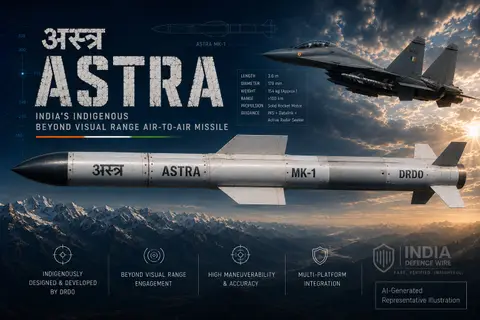
Familiarity, second. The Indonesian Navy already operates the Russian-origin Yakhont anti-ship missile on a small number of warships, and the Yakhont is the BrahMos's direct design sibling, built by the same Russian house that co-owns the Indian joint venture. Jakarta is not adopting an unknown missile family; it is buying a better-supported version of one it already knows, from a supplier untouched by the sanctions squeezing Russian industry, a fit both governments worked through during the visit IDW covered as Modi arrived in Jakarta. Add the Astra air-to-air missile deal signed the same day for Indonesia's Su-30 fleet, and a wider pattern shows: India is becoming the workaround for countries that fly and sail Russian equipment but can no longer rely on Russia to sustain it.
What a BrahMos defence export buys New Delhi
Money is the smallest part of the answer. A missile sale binds two militaries together for decades, through training, spares, maintenance, upgrades and exercises, and that kind of relationship is precisely what Indian diplomacy wants across the Indo-Pacific. Every BrahMos battery in Southeast Asia is also a standing Indian presence in the region's security conversations.
The numbers behind the push
The numbers matter too, at the national level. India's defence exports hit a record Rs 38,424 crore in the financial year just ended, a rise of nearly 63 percent in a single year, with equipment now going to more than 80 countries and an official target of Rs 50,000 crore in exports by 2029. Hitting that target needs flagship, high-value platforms, not just components and small arms, and BrahMos defence export deals are currently the only ones in that class with paying foreign customers.
There is also credibility, which compounds. Selling a complex weapon is one test; sustaining it through delivery, integration and lifecycle support is the harder one, and the production base has been widening to match, most recently with the Lucknow facility that shipped its first missiles last October. Each completed export makes the next customer's decision easier, which is partly why the queue behind Indonesia keeps growing rather than thinning out.



COMMENTS
JOIN THE DISCUSSION