

 DEFENCE INDUSTRYBrahMos export orders: Vietnam deal worth about $100 million, Indonesia $200 million as Akash reaches Tajikistan, Turkmenistan
 DEFENCE INDUSTRYMahindra Embraer Nagpur facility to assemble C-390 if IAF picks the aircraft
 DEFENCE INDUSTRYSMPP Drone Manufacturing Push: Firm Shifts From Ammunition to Unmanned Warfare, Targets Integrated Defence Capabilities
 INDIA DEFENCEDhruv NG Helicopter Explained: What HAL Has Actually Put Into Pawan Hans Service
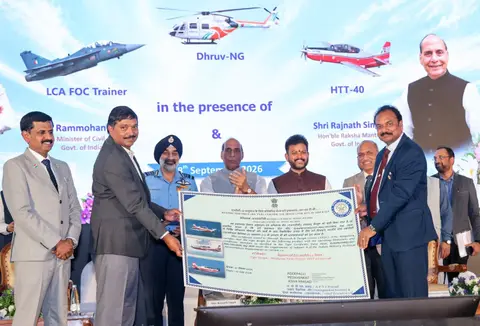 INDIA DEFENCELCA FOC Trainers Delivered With HTT 40 and Dhruv NG as Rajnath Singh Asks Engineers for Technologies That Do Not Exist
Doval Holds Security Talks in Moscow, Meets Shoigu and Myanmar NSA on Forum Sidelines
Doval Moscow security talks dominated the margins of the first International Security Forum held in the Russian capital on May 28, as National Security Adviser Ajit Doval met a string of senior officials including Russian Security Council Secretary Sergei Shoigu, First Deputy Prime Minister Denis Manturov, and Myanmar's NSA Tin Aung San in a packed day of bilateral engagements.
The forum, which Shoigu hosted in his capacity as head of Russia's Security Council, brought together high-ranking security officials from across the world. The 14th Meeting of High Representatives for Security Matters ran alongside it, drawing delegations that deliberated on what several speakers described as a world moving away from a unipolar order toward something more contested and less predictable.
India sent one of its most consequential delegations. Doval's presence and the range of meetings he held made clear that New Delhi is not treating forums like this as ceremonial appearances. The conversations were substantive, and the outcomes are worth examining one by one.
Manturov Meeting: Defence, Energy and Space on the Table
Doval sat down with Denis Manturov, Russia's First Deputy Prime Minister, to review the full sweep of India-Russia cooperation. The three areas that anchored the conversation were defence, energy and space, which have long formed the core of what both governments describe as a special and privileged strategic partnership.
The Russian side arranged a visit for the Indian delegation to the National Space Centre and the Roscosmos Joint Industry Information Centre. That visit was not incidental. Space cooperation between India and Russia has been building in both depth and institutional form, and a facility-level briefing of this kind suggests the two sides are looking at practical collaboration rather than broad declarations. ISRO's ongoing international cooperation programmes have included Russia as a long-standing partner, and the Moscow visit appears to add another layer to that relationship.
The energy dimension of the Manturov talks also carries weight at a time when India's import calculus, particularly for crude oil, continues to draw external attention. New Delhi has consistently maintained that its energy decisions are driven by national interest, and the conversation with Moscow's top economic official would have touched on how that relationship is structured going forward.
Doval and Shoigu: BRICS NSA Meeting in New Delhi in Focus
The meeting between Doval and Shoigu covered ongoing bilateral cooperation but also looked ahead to the BRICS National Security Advisers' meeting that New Delhi is scheduled to host. The preparatory work for that meeting has been building for some time, and having both NSAs in the same room in Moscow gave them the opportunity to align on agenda and format ahead of the New Delhi gathering.
India assumed the BRICS chair for 2025 and hosting the NSA-level meeting is one of the centrepiece events of that chairmanship. The Shoigu meeting in Moscow, in that context, was as much about New Delhi's BRICS calendar as it was about the bilateral relationship.
Myanmar: A Working Relationship That New Delhi Is Keeping Warm
On the sidelines, Doval met Tin Aung San, Myanmar's National Security Adviser. The talks covered security, defence and connectivity, with both sides also exchanging views on where the region is headed. India's engagement with Myanmar has attracted scrutiny given the political situation in Naypyidaw, but New Delhi has continued to maintain a working-level relationship rather than step back.
The Neighbourhood First policy that drives India's approach to its immediate periphery requires a degree of engagement with all neighbours regardless of their internal circumstances, and the Doval-Tin Aung San meeting fits squarely within that logic. The connectivity dimension of the talks is particularly relevant given India's interest in land routes through Myanmar toward Southeast Asia, including infrastructure under the India-Myanmar-Thailand Trilateral Highway project.
The meeting produced a concrete follow-up. Myanmar's NSA is expected to travel to India in July to participate in the fifth National Security Advisers' Meeting of BIMSTEC, the Bay of Bengal Initiative for Multi-Sectoral Technical and Economic Cooperation. That July meeting will bring together NSAs from the BIMSTEC grouping, which includes Bangladesh, Bhutan, India, Myanmar, Nepal, Sri Lanka and Thailand. India has been pushing to give BIMSTEC more institutional heft, and an NSA-level meeting on its soil is part of that effort.
Doval's Address: No Double Standards on Terrorism
Addressing the plenary session of the forum, Doval laid out India's position on terrorism with no ambiguity. He said there can be no double standards in dealing with the threat and that nations which call themselves responsible must make a clear choice: stand against terrorism and those who fund and shelter it, or be seen as part of the problem.
The remarks were directed at no country by name, but the context in which India's NSA makes such statements is well understood internationally. India has faced cross-border terrorism for decades and has repeatedly pushed, on platforms ranging from the United Nations to the Shanghai Cooperation Organisation, for a global framework that closes the space countries use to designate some terrorist groups as strategic assets while condemning others.
The argument Doval made in Moscow was consistent with what India has pressed for in other multilateral settings. What gave it added weight was the venue. A forum attended by security officials from Russia, Central Asia and several other countries that India engages with closely is not a bad place to put that position on record.
Maritime Trade Routes: Hormuz and the Red Sea
Doval also raised the question of maritime security, specifically the need to keep the Strait of Hormuz and the Red Sea open for commercial shipping. Ongoing tensions in West Asia have periodically disrupted movement through both waterways, and for India the consequences are direct. A significant share of India's energy imports and a large portion of its external trade moves through these corridors. Any prolonged disruption raises costs and creates supply uncertainty that hits the broader economy.
India has been vocal about the need to protect these routes and has deployed naval assets to the region as part of broader counter-piracy and maritime security operations. Doval's remarks at the forum put that concern on record at the political level, consistent with what the Indian Navy has been doing operationally in the Arabian Sea and Gulf of Aden.
What the Moscow Visit Adds Up To
Taken together, Doval's engagements in Moscow covered a wide range of ground: bilateral defence and space ties with Russia, groundwork for a major multilateral meeting in New Delhi, a working-level security conversation with Myanmar, a public statement on terrorism, and a flag planted on maritime security. That is a substantial return from a single trip.
India has been careful to maintain functional relationships across a range of major powers and regional groupings without allowing any single alignment to constrain its options. The Moscow visit was consistent with that approach. New Delhi engaged seriously with Russia on matters of mutual interest while also using the forum to advance positions, on terrorism and maritime security, that it argues for across all platforms.
For readers tracking India's security diplomacy, the Moscow meetings are worth filing alongside the broader pattern of Doval's international engagements over the past year. The tempo has been high and the issues covered have been consequential. [Internal link suggestion: anchor text "India's BRICS chairmanship priorities" — search IDW CMS for "BRICS 2025 India chair"] [Internal link suggestion: anchor text "India Myanmar connectivity projects" — search IDW CMS for "India Myanmar Trilateral Highway"]
COMMENTS
JOIN THE DISCUSSION