

 DEFENCE INDUSTRYBrahMos export orders: Vietnam deal worth about $100 million, Indonesia $200 million as Akash reaches Tajikistan, Turkmenistan
 DEFENCE INDUSTRYMahindra Embraer Nagpur facility to assemble C-390 if IAF picks the aircraft
 DEFENCE INDUSTRYSMPP Drone Manufacturing Push: Firm Shifts From Ammunition to Unmanned Warfare, Targets Integrated Defence Capabilities
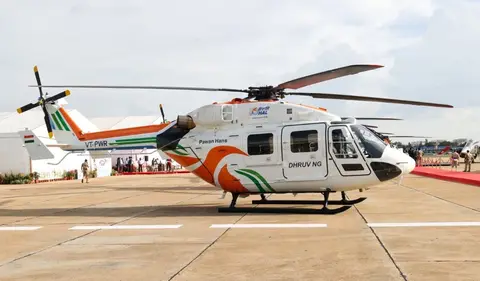 INDIA DEFENCEDhruv NG Helicopter Explained: What HAL Has Actually Put Into Pawan Hans Service
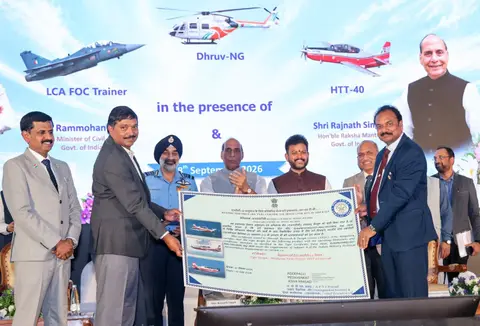 INDIA DEFENCELCA FOC Trainers Delivered With HTT 40 and Dhruv NG as Rajnath Singh Asks Engineers for Technologies That Do Not Exist
Drishti-10 UAV crash off Porbandar is the second loss in the Navy programme
The Drishti-10 UAV crash off Porbandar on Wednesday afternoon took a serving Indian Navy surveillance aircraft out of the fleet. Nobody on the ground was hurt. An investigation is under way.
What the Navy confirmed
Confirmation came on the evening of 8 July from the Navy's official handle. The aircraft went down off Porbandar airfield during a training sortie, the post said, and no injury or loss of life had been reported on the ground. The cause of the incident was being investigated.
Porbandar District Collector S D Dhanani told reporters the vehicle crash landed in an open field at Dharampur village, roughly six kilometres from the coastal city in Saurashtra. Officials said it had taken off from the Naval Air Enclave at Porbandar shortly before it came down. Dhanani said the cause was yet to be ascertained. Footage from the site showed naval personnel and district staff cordoning the wreckage with a crane standing by, and villagers who had walked over after hearing the impact.
Indian Navy statement on X:
https://x.com/indiannavy/status/2074845054255165772?ref_src=twsrc%5Etfw%7Ctwcamp%5Etweetembed%7Ctwterm%5E2074845054255165772%7Ctwgr%5Eea0249719269e9a4e70b4b8e56534fbee613a65b%7Ctwcon%5Es1_c10&ref_url=https%3A%2F%2Fpublish.x.com%2F%3Furl%3Dhttps%3A%2F%2Ftwitter.com%2Findiannavy%2Fstatus%2F2074845054255165772
The aircraft and the squadron
Drishti-10 Starliner is a medium altitude long endurance remotely piloted aircraft, flown from a ground control station. The Navy's aircraft are operated by Indian Naval Air Squadron 343, the Frontier Formidables, based at the Naval Air Enclave in Porbandar. The squadron's beat is the northern Arabian Sea.
Porbandar puts a surveillance aircraft over the western approaches minutes after takeoff. The Indian Navy flies that beat with P-8I Poseidon aircraft and ship borne helicopters, and since 2024 with the Drishti-10, which stays airborne far longer than either.
Endurance, payload, ceiling
Thirty six hours in the air. A payload of about 450 kg. A service ceiling near 30,000 feet. The aircraft carries electro optical sensors and other intelligence, surveillance and reconnaissance equipment, and Adani Defence and Aerospace has said the type holds NATO STANAG 4671 airworthiness certification, which clears it for both segregated and unsegregated airspace.
Adani Defence and Aerospace builds it, Elbit designed it
Drishti-10 is the Indian version of the Hermes 900 Starliner, a design belonging to Elbit Systems. Adani Defence and Aerospace assembles it at its Hyderabad aerospace park under a technology transfer arrangement and puts indigenous content at over 70 percent, counting the carbon aerostructures, the avionics and the electro optical payload built on site. The Ministry of Defence contracted the company in March 2023 for four aircraft, two each for the Navy and the Army, under emergency procurement powers. The first was flagged off in Hyderabad on 10 January 2024 by the then Chief of the Naval Staff, Adm R Hari Kumar, and moved to Porbandar for induction the following month. The same company broke ground on a missile complex at Shivpuri this month.
Drishti-10 UAV crash follows an earlier loss off the same coast
In January 2025 another Drishti-10 went into the Arabian Sea off Porbandar. That aircraft was flying pre acceptance trials by the vendor and had not been handed over to the Navy. The wreckage was recovered.
The difference between the two events is not cosmetic. One aircraft was lost before the Navy took charge of it, on the vendor's clock. The other was in service, with naval crews at the console and a squadron number on the airframe, and it is the one that will be counted against the fleet. Sitting between them is the September 2024 loss of a leased MQ-9B Sea Guardian, which went into the Bay of Bengal after a technical failure. Three long endurance aircraft down in under two years, against a naval inventory that the contracts put at two Drishti-10 bought under emergency powers and two leased Sea Guardians.
The indigenisation argument, again
Within hours the crash had been pulled into a familiar argument on X. Two airframes tied to the same programme gone in roughly eighteen months, the critics wrote, and licensed assembly of a foreign design still being presented as Indian capability. Several of the same accounts were careful to add that no cause has been established and that blaming Adani Defence and Aerospace at this stage would be premature.
The complaint is about design authority rather than screwdrivers. India now has the factories. What it does not yet have, in this segment, is an indigenous MALE platform of its own drawing, and the argument is that licence production defers that day rather than bringing it closer. IDW has reported the same objection in the case of loitering munitions supplied to the Indian Army, where the paperwork trail ran back to Belarus. It sits awkwardly against a year in which defence production touched a record Rs 1.78 lakh crore.
The investigation
Technical teams are going through the wreckage to establish the sequence that ended the sortie. Nothing has been put out on whether a system failure, a lost control link or weather is being looked at.
The Navy said in January that it was in the process of inducting ten Drishti-10 aircraft, and that the first had been fully operationalised, with trained crews flying it to standardise procedures. Neither the Ministry of Defence nor Adani Defence and Aerospace has said anything about Wednesday's loss.


COMMENTS
JOIN THE DISCUSSION