

 INDIA DEFENCEDhruv NG Helicopter Explained: What HAL Has Actually Put Into Pawan Hans Service
 INDIA DEFENCELCA FOC Trainers Delivered With HTT 40 and Dhruv NG as Rajnath Singh Asks Engineers for Technologies That Do Not Exist
 DEFENCE INDUSTRYTata Zorawar light tank clears Army's L1 hurdle for Rs 20,000 crore contract
 DEFENCE INDUSTRYIndia Belgium Defence Deals Sealed As PM De Wever Visits Delhi
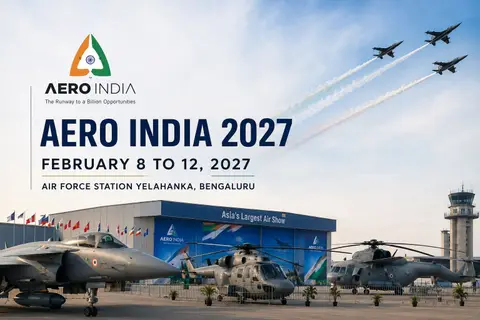 DEFENCE INDUSTRYAero India 2027 Dates Confirmed for February 8 to 12 in Bengaluru
The F-35 at Tarang Shakti will be the first time the American stealth fighter trains with the Indian Air Force on Indian soil, when the second edition of the multinational air exercise opens at Air Force Station Jodhpur on Saturday.
The exercise runs until 12 October. Air forces from eight countries are bringing aircraft, and 32 more will attend as observers.
Vice Chief of the Air Staff Air Marshal Ashutosh Dixit confirmed the F-35's participation at a media briefing on Tuesday. He pointed out that the jet was not new to Indian skies, having appeared at Aero India, and said the IAF may or may not discuss the experience once the drills end.
"For the first time, we are going to exercise with the F-35," Air Mshl Dixit said.
That line explains why the aircraft has become the talking point of the exercise. Seeing an F-35 parked at an air show is one thing. Flying with it, and against it, is another.
What makes the F-35 at Tarang Shakti different
The F-35 is a fifth generation fighter. In simple terms, that label rests on two ideas.
The first is stealth. The aircraft's shape and surface coatings are designed to make it very hard to pick up on radar, so an opponent may not know it is there until late. The second is sensor fusion. Older fighters give the pilot separate screens for radar, infrared sensors and electronic systems, and the pilot has to join the dots. The F-35 does that joining itself and shows one combined picture, which it can also pass to friendly aircraft.
According to the US Air Force fact sheet, the F-35A is a 9g capable multirole fighter built around stealth, sensor fusion and situational awareness, powered by a single engine producing 43,000 lb of thrust. The A model is the conventional take-off and landing version flown by the US Air Force, and it is this variant that is expected in Jodhpur.
None of the other foreign fighters coming to the exercise is a stealth aircraft.
Why training alongside a stealth jet matters to IAF pilots
Exercises like this are where air forces learn things they cannot learn from a manual. A pilot who has only read about stealth has never watched a stealth jet slip in and out of his own radar picture. A mission planner who has never had an F-35 on his side has never worked out how to use the information it shares.
Reports ahead of the exercise suggest the F-35s could fly both with Indian fighters and as part of the opposing force in some scenarios. Either role gives IAF crews something new. The IAF has not publicly detailed the scenarios.
The Vice Chief placed the exercise against lessons from recent conflicts. He said Operation Sindoor had reinforced the value of intelligence-led operations, precision, integrated air and missile defence, counter-drone capability and jointness across domains. The 2026 edition is expected to cover counter-air missions, air defence, reconnaissance, airlift and air-to-air refuelling, along with unmanned systems and space-enabled capabilities.
Defence Minister Rajnath Singh made a similar point during the first edition, telling the Distinguished Visitors' Day event that crews with different work cultures and combat experience learn a lot from each other in an exercise of this size.
What will stay under wraps
Air Mshl Dixit said operational details of the F-35's participation would be kept confidential for operational security. That is standard practice. Countries that fly stealth aircraft guard how the jet appears on radar, how it is flown and how it shares data, and host air forces routinely agree not to publicise what they observe.
The F-35 and India so far
The F-35A first came to India for Aero India in Bengaluru in 2023 and returned for the 2025 edition. Both were display visits. In June 2025 a British Royal Navy F-35B, the short take-off and vertical landing version, made an emergency landing at Thiruvananthapuram and stayed on the ground for several weeks before it was repaired and flown out, the episode the Vice Chief referred to as the jet getting stuck in Trivandrum.
In February 2025, after talks with Prime Minister Narendra Modi in Washington, US President Donald Trump said the United States would pave the way for eventually providing India with the F-35. No purchase has followed. The IAF's own fifth generation plan is built around the indigenous Advanced Medium Combat Aircraft, whose development bids are due by the end of October after the AMCA bid deadline was extended.
Tarang Shakti itself is only in its second edition. The first, in 2024, marked a move away from training with one partner at a time. Air Mshl Dixit described it as the edition that "changed that approach", saying 11 countries brought air assets and flew 867 sorties across two phases.
How many F-35s, and who else is flying
The exact number of F-35s has varied between accounts. Defence officials initially spoke of two to three aircraft, while later figures shared by defence reporters put the US contingent at six F-35s and two KC-135 tankers.
France is bringing seven Rafales, three A400M transports and two MRTT tankers, and the UAE six F-16s and a Global 6000, according to the same figures. Germany is flying in two A400Ms. Bangladesh and Australia are each sending a C-130, and Sri Lanka a King Air 350. Some reports name Greece as the eighth participating country. The line-up was also carried in the Tarang Shakti 2026 curtain-raiser.
Air chiefs or their equivalents from about 10 countries are expected to attend.
The F-35 at Tarang Shakti will share the desert sky with almost the entire front line of the Indian Air Force, which is fielding the Su-30MKI, Rafale, Tejas, Mirage 2000, MiG-29 and Jaguar, backed by AEW&C aircraft, transport planes and air-to-air refuelling tankers. Earlier this month the same base hosted the Japan Air Self-Defense Force, whose chief flew in an India Japan Tejas sortie during Exercise Veer Guardian.
COMMENTS
JOIN THE DISCUSSION