

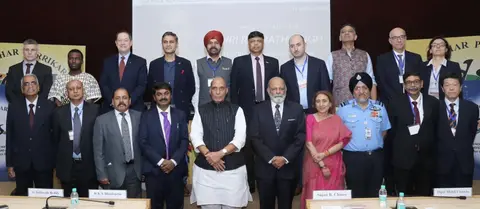
 MINISTRY OF DEFENCEDelhi Defence Dialogue 2026: Self-reliance means no hostage to outside suppliers, says Rajnath Singh
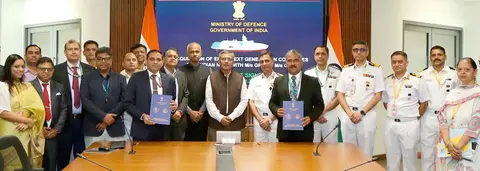 MINISTRY OF DEFENCENext Generation Corvettes contracts worth Rs 53,866.50 crore signed with GRSE and GSL
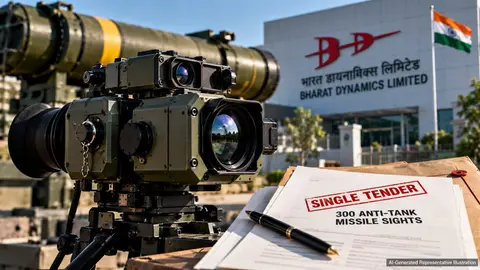 MINISTRY OF DEFENCEBDL single tender for anti-tank missile sights goes to firm set up by former CMD Siddharth Mishra
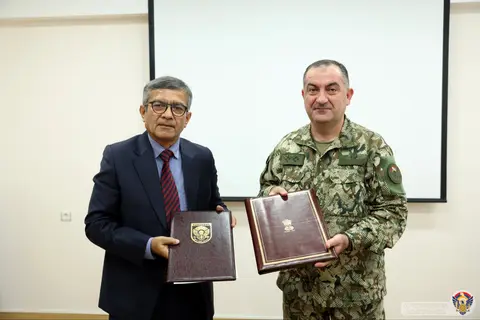 DEFENCE INDUSTRYBrahMos export orders: Vietnam deal worth about $100 million, Indonesia $200 million as Akash reaches Tajikistan, Turkmenistan
 DEFENCE INDUSTRYMahindra Embraer Nagpur facility to assemble C-390 if IAF picks the aircraft
Delhi Defence Dialogue 2026 opened in New Delhi on Tuesday with Defence Minister Rajnath Singh stating that self-reliance means India's critical defence requirements must not hinge on outside suppliers. He called Aatmanirbharta a quest for technological sovereignty, not an attempt to make everything at home.
According to the Ministry of Defence, he described indigenous production and the independent sustenance of critical defence capabilities as key to military preparedness in the 21st century.
"Aatmanirbharta must be understood as a quest for technological sovereignty. It does not mean producing everything ourselves... It means ensuring that our critical defence requirements are not held hostage to external dependencies," the Defence Minister said.
The two-day third edition is hosted by the Manohar Parrikar Institute for Defence Studies and Analyses (MP-IDSA), of which he is President. Its theme is Defence Reforms, Aatmanirbharta, Collaborations and Exports. Delhi Defence Dialogue 2026 brought together senior Ministry of Defence officers, domain experts from India and abroad and representatives from industry. The dialogue began in 2024.
Delhi Defence Dialogue 2026 hears that assembly alone is not self-reliance
Putting a platform together in India does not make it self-reliant, the Defence Minister said. The country must be able to design it, develop its technology, build it and modify it as needs change. It must also hold the technology to maintain and upgrade the equipment through its entire service life.
Self-reliance, he added, does not mean keeping foreign firms away or stopping all imports.
Cheap drones can now challenge costly military platforms
Recent conflicts have shown that war is no longer confined to land, sea and air, he said. Space, cyberspace and the digital domain now play a growing part, and the difference between conventional and unconventional warfare is "becoming increasingly blurred".
Relatively low-cost drones and autonomous systems can threaten expensive equipment. A country's military strength therefore cannot be judged only by the number of modern weapons it holds. The ability to develop new technology, produce it quickly and keep supplies moving during a war counts as well.
Technology slow to leave the laboratory can age before induction
The Ministry of Defence observed 2025 as the Year of Reforms, with attention on jointness, integration, new technology, innovation and domestic industry. Reform, the Defence Minister said, must add to capability and not only change procedures. If a technology takes years to move from the laboratory to the forces, it may be outdated by the time it arrives.
He praised the Defence Research and Development Organisation (DRDO) and said technology leadership is a shared task for DRDO, defence public sector companies, private firms, startups, universities and research laboratories. Not every experiment succeeds, he said, but each one teaches something. Technology that works must reach production and service.
India seeks co-development with foreign partners, not only licensed production
India's pursuit of self-reliance is "not a retreat from world", the Defence Minister said. Self-reliance without collaboration may "limit our technological horizons", he added, and a technologically capable India can work with partners more effectively.
Partnerships so far have rested largely on purchases, licensed manufacture and transfer of technology. The focus now has to move to co-development, co-production and shared innovation, with a real role for Indian firms in design and development, access to critical technology and a fair division of intellectual property. He had taken up a similar theme at Swavlamban 2026 last week.
India's large market, industrial base and pool of scientists and engineers give global companies good reason to partner with Indian industry, he said.
Defence exports reached Rs 38,424 crore in 2025-26
Defence production touched a record Rs 1.78 lakh crore in 2025-26, the Defence Minister said. At a Consultative Committee meeting in Jaisalmer earlier on Tuesday, he put the 2014-15 figure at Rs 46,429 crore. Exports rose from about Rs 686 crore in 2013-14 to Rs 38,424 crore, and Indian defence products now reach more than 80 countries.
The targets for 2029 are Rs 3 lakh crore in production and Rs 50,000 crore in exports, building on the numbers he set out in September. Exports should cover more than weapons, he said, and extend to maintenance, repair, training, logistics and technology cooperation.
He listed the Advanced Medium Combat Aircraft programme, submarine projects, artillery ammunition and warship building among areas open to private firms, MSMEs, startups and academic institutions.
"As we set our eyes on 2047, our aim in the defence sector should be ambitious," he said.
Navy Chief and CISC make the same case at the dialogue
Chief of the Naval Staff Admiral Krishna Swaminathan called Aatmanirbharta a "strategic necessity" in his address earlier in the day. The Navy, he said, must be able to fight, sustain and adapt without being constrained by external dependencies. Self-reliance does not mean isolation, Admiral Swaminathan said, and India should work with friendly countries "from a position of strength, and not from a position of weakness".
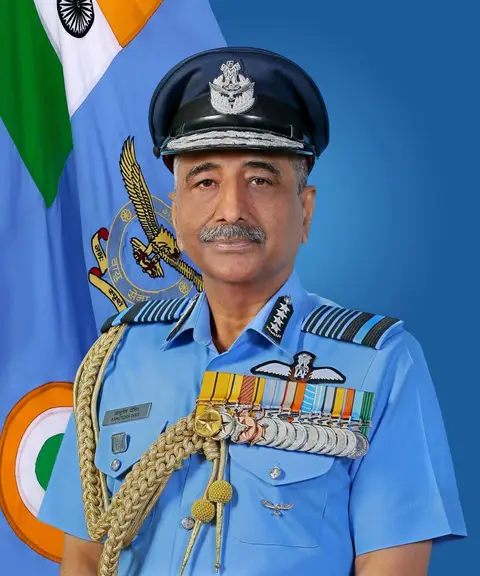
Air Marshal Tejinder Singh, Chief of Integrated Defence Staff to the Chairman Chiefs of Staff Committee (CISC), said "Aatmanirbharta is not just a slogan".
Air Marshal Tejinder Singh said Operation Sindoor saw successful use of many weapons designed and built in India. Fighter engines remain an area of foreign supply, a subject on which the Defence Minister spoke at HAL Koraput last month, and small parts such as chips, special alloys, batteries and actuators need more than one supplier, he said.
The armed forces have prepared a 10-year Integrated Capability Development Plan and sent it to the Ministry of Defence, he said. A roadmap for Mission Sudarshan Chakra has also been drawn up. Drones, counter-drone systems, electronic warfare and conventional missiles are the priorities up to 2030.
On a recent visit to the Philippines, Air Marshal Tejinder Singh said, he heard a request for more BrahMos missiles. Manila has also shown interest in the Akash air defence system.
COMMENTS
JOIN THE DISCUSSION