

 INDIA DEFENCEDhruv NG Helicopter Explained: What HAL Has Actually Put Into Pawan Hans Service
 INDIA DEFENCELCA FOC Trainers Delivered With HTT 40 and Dhruv NG as Rajnath Singh Asks Engineers for Technologies That Do Not Exist
 DEFENCE INDUSTRYTata Zorawar light tank clears Army's L1 hurdle for Rs 20,000 crore contract
 DEFENCE INDUSTRYIndia Belgium Defence Deals Sealed As PM De Wever Visits Delhi
 DEFENCE INDUSTRYAero India 2027 Dates Confirmed for February 8 to 12 in Bengaluru
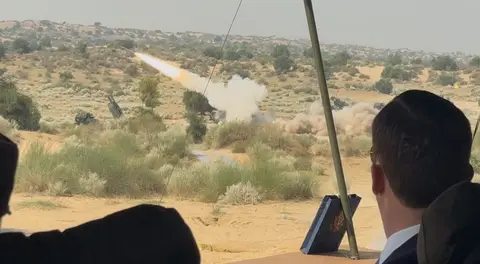
The Yudh Abhyas firepower demonstration at the Mahajan Field Firing Range in Rajasthan on Thursday had US Ambassador to India Sergio Gor on hand, watching Indian and US Army troops fire artillery, rockets, attack helicopters, air defence guns and radars together.
Lieutenant General Vikrant Suresh Deshpande, General Officer Commanding, 10 Corps, watched the joint firing alongside him.
Gor flew into Mahajan earlier in the day. On landing, he described Yudh Abhyas 2026 as India's largest bilateral defence exercise with any nation and said he had come to see the two armies at work.
"Impressive to see US and Indian forces training together at Mahajan Field Firing Range. This exercise reflects the strength of our defence partnership: trust, readiness, interoperability, and shared purpose. Proud of what US Army and Indian Army are achieving together," Gor said in a post on X later on Thursday.
Sergio Gor at the Yudh Abhyas firepower demonstration
Gor has followed the exercise since the start. A day after the opening ceremony, he said soldiers of the two countries would spend the next two weeks sharing skills, building readiness and improving collaboration between their forces.
On September 19, reposting a US Embassy update on the training, he wrote that Yudh Abhyas prepares US and Indian forces to meet present and future challenges. The embassy update listed high-altitude operations, disaster response and countering emerging unmanned threats among the areas the two forces are training in.
Thursday put him at the firing line with Lt Gen Deshpande. The 10 Corps, headquartered at Bathinda, falls under the Army's South Western Command.
What fired at Mahajan
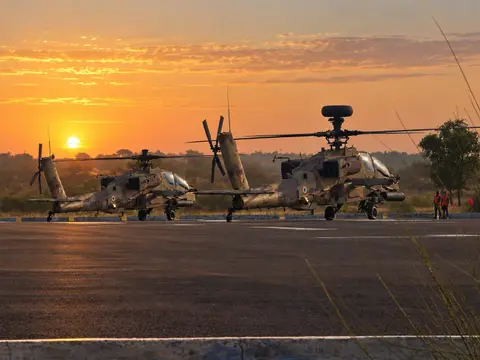
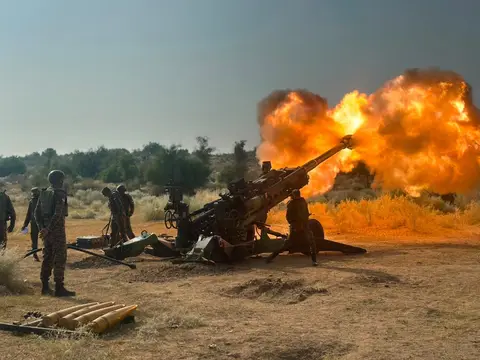
The Indian side put out a wide mix, according to the Army. The Pinaka multi-barrel rocket launcher, the M777 ultra-light howitzer and the Dhanush artillery gun fired alongside AH-64E Apache attack helicopters, L70 air defence guns and Swathi weapon-locating radars.
The US Army fielded HIMARS and M-LIDS.
Together, that put artillery, rockets, attack aviation, air defence and battlefield surveillance to work on one desert range.
The systems in plain words
Pinaka is India's own rocket launcher, designed by DRDO, and fires a salvo of 12 rockets in less than a minute. More on it is in IDW's report on Pinaka at Yudh Abhyas. The M777 is a light 155 mm howitzer that can be lifted by helicopter into mountain positions, and Dhanush is a 155 mm towed gun built in India.
The Apaches belong to the Army's own aviation wing and have been flying integrated drills with troops at Mahajan. The L70 fires rapidly at low-flying aircraft and drones. Swathi picks up incoming shells and rockets, works out where they were fired from and passes that location to own guns. It was developed by DRDO's Electronics and Radar Development Establishment and is built by Bharat Electronics Limited, which received a Ministry of Defence contract worth over Rs 990 crore for 12 Swathi (Plains) radars in March 2023.
On the US side, HIMARS, the High Mobility Artillery Rocket System, is a truck-mounted rocket launcher that fires and moves off quickly. M-LIDS is a vehicle-based counter-drone system built to detect, track and bring down small drones. The US Army had said at the start of the exercise that HIMARS, Stinger and M-LIDS would carry out live firing at Mahajan.
Why the two armies fire together
According to the Army, the Yudh Abhyas firepower demonstration showed that both forces can plan, coordinate and carry out complex activities together, while building interoperability, professional trust and mutual confidence. Training at this scale also helps each side understand the other's systems, procedures and tactical approaches.
The groundwork came earlier in the week. Indian and US gunners carried out joint artillery drills at the same range, with Observation Post parties from both armies practising target identification, passing of fire orders and correction of fire.
Yudh Abhyas 2026 so far
This is the 22nd edition of the annual India-US exercise. It opened on September 15 and is running at the Auli Foreign Training Node in Uttarakhand and at Mahajan at the same time, with around 600 personnel from each side and the US contingent drawn from the 11th Airborne Division. It is scheduled to conclude on September 28, according to the Ministry of Defence.
COMMENTS
JOIN THE DISCUSSION