

 DEFENCE INDUSTRYBrahMos export orders: Vietnam deal worth about $100 million, Indonesia $200 million as Akash reaches Tajikistan, Turkmenistan
 DEFENCE INDUSTRYMahindra Embraer Nagpur facility to assemble C-390 if IAF picks the aircraft
 DEFENCE INDUSTRYSMPP Drone Manufacturing Push: Firm Shifts From Ammunition to Unmanned Warfare, Targets Integrated Defence Capabilities
 INDIA DEFENCEDhruv NG Helicopter Explained: What HAL Has Actually Put Into Pawan Hans Service
 INDIA DEFENCELCA FOC Trainers Delivered With HTT 40 and Dhruv NG as Rajnath Singh Asks Engineers for Technologies That Do Not Exist
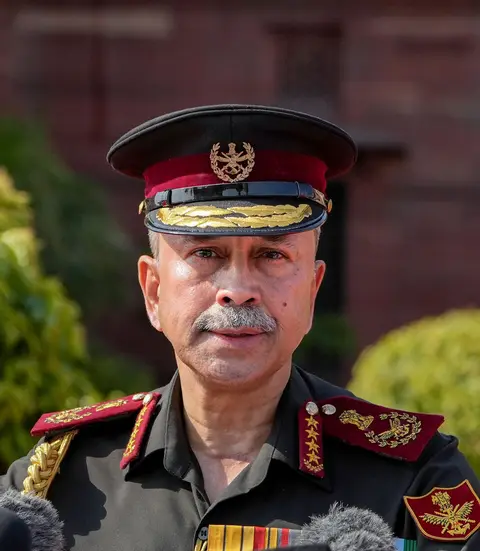
Chief of Defence Staff General N.S. Raja Subramani Assumes Charge, Pledges Tri-Services Reform
India's new Chief of Defence Staff, General N.S. Raja Subramani, assumed office on Sunday at South Block in New Delhi, succeeding General Anil Chauhan and taking command of the country's highest military post at a moment when large-scale defence transformation remains the government's foremost institutional priority. The transition marks the beginning of what military observers expect to be an energetic phase for joint services reform, indigenous capability induction, and the long-pending theatre command project.
General Subramani brings to the office more than four decades of operational and strategic experience, including commands on both the western frontier with Pakistan and the northern frontier with China. Before his appointment, he was serving as Military Advisor at the National Security Council Secretariat, a role that placed him at the intersection of civil-military planning and national security policy. He had retired as Vice Chief of Army Staff on July 31, 2025, before being recalled to take on the advisory position ahead of his elevation to the top post.
New Chief of Defence Staff Outlines Immediate Priorities
Shortly after the assumption of charge ceremony, General Subramani addressed the media and outlined his agenda with directness. Tri-services integration and organisational transformation, he said, would be the primary focus from day one.
"Transformation of the armed forces and organisational reforms to enhance tri-services synergy and integration will be our primary focus," the new CDS stated, signalling that the pace of institutional change is expected to continue rather than pause during the leadership transition.
He also placed self-reliance in defence firmly on the agenda, stating that his tenure would see accelerated efforts to develop, induct and integrate indigenous weapon systems across the Army, Navy and Air Force. This aligns with the broader Aatmanirbhar Bharat push that has reshaped procurement priorities across the Ministry of Defence over the past several years, with domestic platforms increasingly displacing legacy imports across multiple capability categories.
"Our armed forces have consistently demonstrated professionalism and operational decisiveness in safeguarding national interests. We remain fully committed to protecting the sovereignty and territorial integrity of our country," General Subramani said, offering the nation a clear statement of institutional resolve. He added that the armed forces would continue to serve with dedication, courage, honour and professionalism, words that carried particular weight given the security pressures India has been managing along its contested land borders.
The emphasis on indigenous development is not merely rhetorical. India has in recent years cleared domestically produced light combat aircraft, anti-tank guided missiles, artillery systems and naval vessels for induction at a pace that would have seemed ambitious only a decade ago. General Subramani's mandate to accelerate this trajectory places the office of the CDS at the centre of the government's effort to reduce import dependency while simultaneously modernising the force.
The Theatre Command Challenge Awaiting the New CDS
The most consequential structural task now resting with the new Chief of Defence Staff is the operationalisation of India's military theatre command model. The initiative, which has been in planning and consultation phases for several years, aims to integrate the combat capabilities of the Army, Navy and Air Force under unified geographical commands, replacing the existing single-service command architecture that critics have long argued is ill-suited to modern multi-domain warfare.
The theatre command project has moved through multiple consultative rounds and seen considerable debate among the Services regarding jurisdiction, resource allocation, and command arrangements. General Subramani's familiarity with joint planning environments and his tenure at the National Security Council Secretariat are expected to help him navigate the institutional sensitivities that have slowed progress in the past.
India currently maintains separate command structures for the Army, Navy and Air Force, with the Andaman and Nicobar Command serving as the country's only existing tri-services command. The proposed theatre model would create integrated commands for the western, northern, maritime and other operational domains, bringing India in line with the command architectures maintained by major military powers including the United States and China. For India, the urgency is particularly acute given that the People's Liberation Army completed its own theatre command restructuring in 2016, creating an integrated adversary force that the Indian military must be organisationally equipped to match.
The CDS position was itself created in January 2020 with theatre command reform as one of its central mandates. Progress has been deliberate rather than rapid, reflecting both the institutional complexity of merging entrenched single-service cultures and the genuine operational questions that must be resolved before command lines are redrawn. General Subramani inherits a process that is well advanced in conceptual terms and now requires the political and institutional will to move from design to execution.
A Career Forged Across India's Most Demanding Fronts
General Subramani was commissioned into the 8th Battalion of the Garhwal Rifles on December 14, 1985, after completing his officer training at the National Defence Academy and the Indian Military Academy. His regimental roots lie in one of the Indian Army's most celebrated infantry units, with a lineage of service across the highest and most demanding operational terrain in the subcontinent.
His command portfolio is extensive. He commanded 16 Garhwal Rifles during counter-insurgency operations in Assam under Operation Rhino, an assignment that tested tactical leadership under conditions of acute operational complexity in a theatre where intelligence, civil-military relations and small-unit discipline are as important as firepower. He subsequently commanded the 168 Infantry Brigade in Jammu and Kashmir and the 17 Mountain Division in the Central Sector, a command of particular importance given its proximity to the Line of Actual Control with China and the terrain demands unique to high-altitude warfare in that region.
At the corps level, General Subramani commanded two formations, including one of the Indian Army's premier strike corps on the Western Front. This assignment placed him at the command of a force specifically structured for offensive operations, deepening his understanding of large-scale manoeuvre warfare and the operational coordination demands that theatre commands are designed to enhance. Experience at this level of command is relatively rare and provides a perspective on joint warfare that few officers carry into senior appointments.
Staff, Diplomatic and Academic Appointments
Beyond his operational commands, General Subramani accumulated a wide range of staff and diplomatic assignments that distinguish his profile among the Army's senior leadership. He served as Defence Attache in Kazakhstan, a posting that provided direct exposure to the strategic dynamics of Central Asia and to India's defence diplomacy in a region of growing geopolitical importance, particularly as competition between major powers for influence across the former Soviet space has intensified.
His intelligence background includes service as Deputy Director General of Military Intelligence, while his operational staff experience encompasses the role of Brigadier General Staff (Operations) at Eastern Command, one of the Army's most active operational headquarters given its responsibility for the northeastern frontier and the Sino-Indian boundary in Arunachal Pradesh and Sikkim. He also served as Chief Instructor (Army) at the Defence Services Staff College in Wellington and as Chief of Staff at Headquarters Northern Command, which oversees the Jammu and Kashmir theatre.
General Subramani's academic credentials are equally strong. He attended the Joint Services Command and Staff College in Bracknell in the United Kingdom and the National Defence College in New Delhi. He holds a Master of Arts degree from King's College London and an MPhil in Defence Studies from the University of Madras, a combination that reflects both the depth of his professional military education and his sustained engagement with academic defence thinking. His academic formation at King's College London, one of the foremost centres for war studies globally, is a credential shared by a select few among India's senior military leadership.
Decorations and Service Record
In recognition of his distinguished service, General Subramani has been awarded the Param Vishisht Seva Medal, the Ati Vishisht Seva Medal, the Sena Medal and the Vishisht Seva Medal. These awards, spanning meritorious service and distinguished command, reflect a career that has drawn formal recognition across each of its major stages, from regimental duty to the highest levels of the Army's institutional hierarchy.
He served as Vice Chief of Army Staff from July 2024 to July 2025, a role that placed him at the apex of the Army's administrative and operational machinery and brought him into close working contact with the Ministry of Defence, the other Services, and the broader national security apparatus. His subsequent assignment at the National Security Council Secretariat ensured continuity of engagement with the policy environment he now leads from the CDS chair.
Chief of Defence Staff Inherits a Military in Transition
The assumption of charge by the new Chief of Defence Staff comes at a point when India's defence establishment is managing simultaneous pressures across the western and northern frontiers, pursuing an ambitious domestic defence industrial expansion, and attempting to build the institutional architecture of a modern joint force. General Subramani's operational depth, his familiarity with joint planning environments from his time at the National Security Council Secretariat, and his stated commitment to organisational reform place him well to maintain the momentum built over the preceding years.
The security environment that General Subramani now oversees as Chief of Defence Staff is one of the most complex in independent India's history. Managing it effectively will require not only the modernisation of platforms and equipment but the deeper transformation of how the three Services plan, train and fight together. That transformation is the work this office was created to lead, and it is the work to which the new CDS has pledged his tenure.
COMMENTS
JOIN THE DISCUSSION