

 DEFENCE INDUSTRYBrahMos export orders: Vietnam deal worth about $100 million, Indonesia $200 million as Akash reaches Tajikistan, Turkmenistan
 DEFENCE INDUSTRYMahindra Embraer Nagpur facility to assemble C-390 if IAF picks the aircraft
 DEFENCE INDUSTRYSMPP Drone Manufacturing Push: Firm Shifts From Ammunition to Unmanned Warfare, Targets Integrated Defence Capabilities
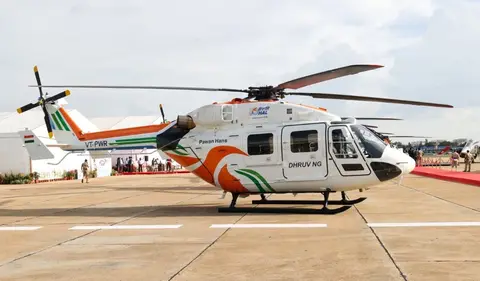 INDIA DEFENCEDhruv NG Helicopter Explained: What HAL Has Actually Put Into Pawan Hans Service
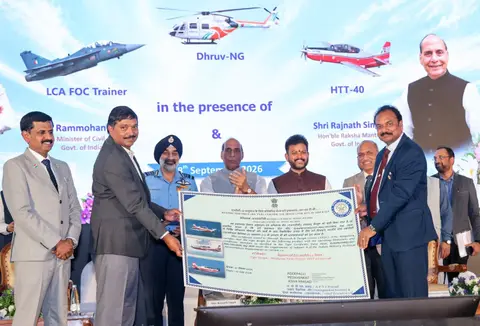 INDIA DEFENCELCA FOC Trainers Delivered With HTT 40 and Dhruv NG as Rajnath Singh Asks Engineers for Technologies That Do Not Exist
India Australia defence declaration commits both sides to harder exercises and closer operations
The India Australia defence declaration issued in Melbourne on Thursday commits New Delhi and Canberra to consult each other on Indo-Pacific developments that affect shared interests, to raise the complexity of their military exercises, and to expand aircraft deployments from each other's territory. Prime Minister Narendra Modi and Prime Minister Anthony Albanese put their names to it during the third annual leaders' summit, the second stop on Modi's three-nation tour after the Jakarta round of agreements earlier this week.
It renews the 2009 India-Australia Joint Declaration on Security Cooperation, which the two prime ministers had undertaken to strengthen.
Modi is the first Indian prime minister to visit Australia three times. The visit runs from 8 to 10 July and is built around the summit process created under the Comprehensive Strategic Partnership of 2020, an apex mechanism fed by the foreign ministers', defence ministers' and trade ministers' dialogues. Twenty numbered paragraphs make up the new text, and the language in them is unusually direct for a document of this kind.
What the two governments actually signed up to
Paragraph eight carries the operational weight. The two sides undertake to consult on defence-related developments in the Indo-Pacific, to increase the complexity of exercises including those run with partners, to accelerate interoperability and information sharing between their forces, to expand aircraft deployments from each other's territory, and to deepen personnel connections through exchanges, education, training and liaison postings. A sixth commitment reads oddly next to the others: the two countries will explore cooperating on recruitment for skilled defence workforces.
Elsewhere the declaration describes the partnership it wants as advanced, integrated and top-tier, and commits both governments to accelerating towards it.
On the regional picture, the text notes geostrategic uncertainty and threats to peace and stability, then calls for disputes to be settled without the threat or use of force or coercion. It names the 1982 United Nations Convention on the Law of the Sea as the basis for an open and secure maritime domain, including freedom of navigation and overflight. Support is restated for the Indian Ocean Rim Association, for ASEAN and ASEAN-centred architecture, and for the Pacific Islands Forum. China is not mentioned anywhere in the document.
A maritime roadmap, at last
Both capitals have been circling a maritime security roadmap for two years. The declaration says it will now be delivered as the India-Australia Maritime Security Collaboration Roadmap, with the two sides increasing the depth, sophistication and regularity of maritime cooperation. No timeline is attached in the text.
India and Australia already co-lead the Indian Ocean Rim Association working group on maritime safety and security. The same instinct runs through New Delhi's island diplomacy, visible in the Seychelles state visit in June.
The declaration also commits both sides to deepening humanitarian assistance and disaster relief work, through information sharing, expert exchanges and joint exercises, naming the Quad Indo-Pacific Logistics Network. A separate paragraph opens the door to shared contingency planning and coordinated evacuation operations in third countries, which is the sort of clause governments write after they have needed it.
Industry, technology and the supply chain question
Defence industry gets a single paragraph and it is a broad one. The two governments will encourage integration between their defence industries, push industry engagement, build supply chain resilience, link their defence innovation ecosystems, and develop arrangements for advanced defence science and technology collaboration. Sensor technologies were flagged as a research area at the ministers' dialogue in June, where Marles invited India to the 2026 Australian Defence Science, Technology and Research Summit. Nothing in the declaration names a co-development project, a platform or a funding line, and the Joint Working Group on Defence Industry, Research and Material remains the vehicle.
India enters this with an export record it did not have in 2009, most recently the first foreign sale of the Astra BVRAAM.
Cyber and emerging technology sit under the Australia-India Partnership on Cyber, Critical Technologies and Supply Chains, or PACTS. The declaration promises to harness the information sharing mechanisms already built under it. Critical minerals and clean energy technologies appear under a broader economic resilience paragraph, alongside critical infrastructure and connectivity.
Terrorism, migration and the softer clauses
Information sharing on terrorist threats is to increase, covering entities and individuals, with collaboration explored across new and emerging technology, terrorism financing, critical infrastructure and crowded spaces, the maritime domain, and online radicalisation. Cooperation continues under the Migration and Mobility Partnership Arrangement signed in 2023, which covers irregular migration, people smuggling and human trafficking. The two sides also commit to advancing the Women, Peace and Security agenda and to gender equality in peacekeeping. Paragraph sixteen restates a shared goal of verifiable nuclear disarmament and non-proliferation.
What the India Australia defence declaration was built on
Defence Minister Rajnath Singh and his Australian counterpart Richard Marles, who is also Deputy Prime Minister, co-chaired the second India-Australia Defence Ministers' Dialogue in New Delhi on 1 June. Their joint statement flagged progress towards renewing the declaration and towards finalising the maritime roadmap. It also set out the exercise calendar that the new text now sits on top of.
Australia took part in Exercise Milan in February. India took part in Exercise Kakadu in March. Exercise Austrahind has shifted to amphibious combat and littoral manoeuvre, India joined Operation Render Safe for the first time this year, and Australia has invited Indian participation in the submarine rescue exercise Black Carillon. The bilateral implementing arrangement on air-to-air refuelling is to be operationalised at Exercise Pitch Black. Indian participation in Exercise Talisman Sabre in 2027 is to expand, and officials were told in June to finalise arrangements for an Indian visiting instructor at the Australian Defence College in 2028-2029.
Inaugural joint staff talks are due later this year.
The first defence ministers' dialogue was held only in October 2025. Eight months separated it from the second, and the renewed declaration followed five weeks after that.
What the declaration covers, and what it leaves out
Australian media reported ahead of the summit that an agreement on uranium exports to India could be concluded during the visit, and Albanese told reporters he would have more to say after his talks with Modi. Indian wire copy carried similar expectations around a critical minerals corridor and a defence innovation corridor, sourced to officials rather than to documents. None of it appears in the declaration text released by the Australian prime minister's office, which is confined to defence and security and makes no mention of uranium.
Cooperation with the United States and Japan is written in, along with trilateral mechanisms and the Indo-Pacific Oceans Initiative. The Quad is named once, in the paragraph on regional forums.


COMMENTS
JOIN THE DISCUSSION