

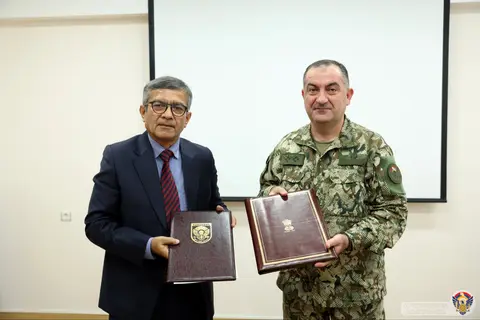
 DEFENCE INDUSTRYBrahMos export orders: Vietnam deal worth about $100 million, Indonesia $200 million as Akash reaches Tajikistan, Turkmenistan
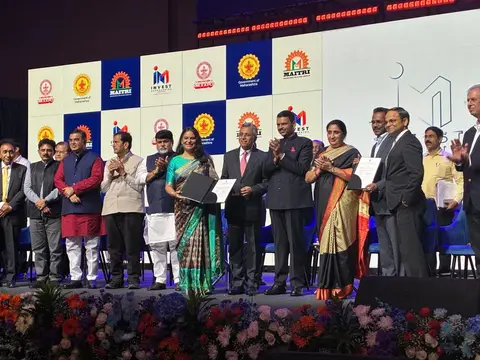 DEFENCE INDUSTRYMahindra Embraer Nagpur facility to assemble C-390 if IAF picks the aircraft
 DEFENCE INDUSTRYSMPP Drone Manufacturing Push: Firm Shifts From Ammunition to Unmanned Warfare, Targets Integrated Defence Capabilities
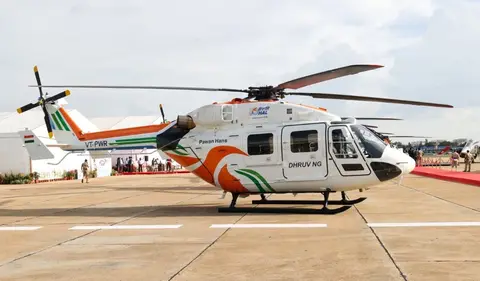 INDIA DEFENCEDhruv NG Helicopter Explained: What HAL Has Actually Put Into Pawan Hans Service
 INDIA DEFENCELCA FOC Trainers Delivered With HTT 40 and Dhruv NG as Rajnath Singh Asks Engineers for Technologies That Do Not Exist
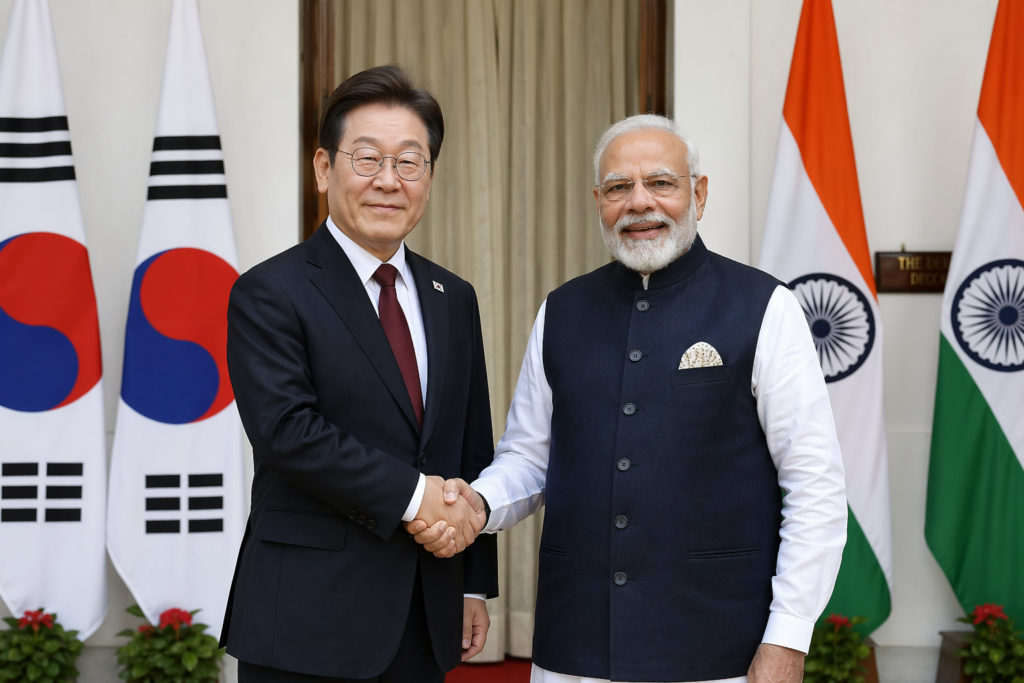
India South Korea defence cooperation received its most comprehensive boost in nearly a decade when South Korean President Lee Jae-myung arrived in New Delhi on 20 April 2026 for a state visit, his first to India and the first by a South Korean head of state in eight years. Talks held at Hyderabad House with Prime Minister Narendra Modi produced a range of outcomes that go well beyond the artillery programme that originally anchored the bilateral defence relationship.
K9 Vajra Blueprint to Drive Next Generation of Joint Platforms
The K9 Vajra-T self-propelled howitzer is the most visible proof point in the India and South Korea industrial story, and both sides have agreed to use it as a template for what comes next. Developed through the Hanwha Aerospace and Larsen & Toubro partnership, the gun system has been manufactured at L&T’s Hazira facility in Gujarat, with the first batch delivered by 2021 and a second batch of 100 guns contracted in December 2024 for approximately $850 million now underway. The second batch targets an indigenisation level of 60 per cent, a meaningful step up from roughly 50 per cent achieved in the first.
Both countries are now exploring whether this model, built on technology transfer, joint manufacturing and progressive indigenisation, can be replicated for Self-Propelled Air Defence Gun-Missile Systems. Discussions are reportedly centred on platforms such as the Hybrid BiHo, a South Korean system combining radar-guided guns with short-range missiles.
For India, which is simultaneously pursuing the replacement of ageing air defence assets and the expansion of domestic manufacturing under Aatmanirbhar Bharat, this is a logical next step. India’s domestic air defence manufacturing push has been gaining pace, as seen in Zen Technologies receiving an arms licence to manufacture rapid-fire cannons across four calibres for short-range air defence roles. A third batch of 200 K9 Vajra howitzers, estimated at $1.2 billion, is also reportedly under discussion.
KIND-X Accelerator to Link Defence Startups Across Both Nations
One of the more forward-looking announcements from the summit is the Korea-India Defence Accelerator, or KIND-X. The platform is intended to create structured connectivity between defence startups, investors, research institutions and established industry players in both countries. India’s iDEX framework, which has already channelled hundreds of crores into domestic defence innovation, provides a natural counterpart to South Korea’s mature defence export ecosystem, making KIND-X a credible vehicle for two-way technology flow rather than a unidirectional arrangement. Specific timelines and funding structures have not yet been disclosed, but the institutional architecture is now formally established.
ISRO and KASA Establish Joint Working Group for Space Collaboration
Space has emerged as a substantive new pillar of India South Korea defence cooperation, and the decisions taken on 20 April reflect how seriously both governments are treating this dimension alongside land systems and maritime platforms. Both governments welcomed the creation of a Joint Working Group between ISRO and the Korea AeroSpace Administration, KASA, South Korea’s newly formed space agency. An India-ROK Space Day, held in Bengaluru on 20 April 2026 in collaboration with IN-SPACe, brought together leading private space firms from both countries and underscored the commercial dimension of the relationship. Mutual support for satellite navigation systems is also under exploration, which carries implications for both civilian and strategic applications.
Maritime and Shipbuilding Cooperation Gains Industrial Depth
The shipbuilding dimension of India South Korea defence cooperation has moved decisively from intent to investment, and the April 2026 summit has given it fresh institutional weight. An MoU signed in December 2025 between BEML Limited, HD Korea Shipbuilding & Offshore Engineering and HD Hyundai Samho Heavy Industries creates a framework for the joint design and manufacture of advanced port and maritime cranes in India. Separately, HD Hyundai has announced plans to establish a shipyard in Tamil Nadu. For India, which is actively working to reduce dependence on Chinese components in port infrastructure and maritime logistics, the South Korean industrial entry offers both capacity and a credible technology alternative.
This maritime push comes at a moment of significant momentum for India’s domestic shipbuilding programme. The Indian Navy recently commissioned INS Taragiri, the fourth Project 17A stealth frigate, while GRSE delivered INS Dunagiri along with INS Sanshodhak and INS Agray in a triple handover that underlines how rapidly India’s indigenous warship pipeline is maturing. Both leaders also signed a Comprehensive Framework for Partnership in Shipbuilding, Shipping and Maritime Logistics, and issued a Joint Strategic Vision document covering the broader bilateral relationship.
Bilateral Ties Widen Across Trade, Technology and Defence Exercises
The defence agreements sit within a wider expansion of ties. India and South Korea have agreed to resume negotiations on upgrading their Comprehensive Economic Partnership Agreement, launched an India-Korea Digital Bridge focused on AI and semiconductor collaboration, and deepened engagement on sustainability and energy security. Bilateral trade presently stands at around $26 to $28 billion, with a stated target of $50 billion by 2030.
At the operational level, the two navies conducted their first bilateral exercise in October 2025 at Busan. South Korea subsequently participated in the International Fleet Review 2026 and Exercise MILAN at Visakhapatnam, markers of a military relationship that is becoming more regular and institutionalised.
What This Means for India’s Defence Industrial Base
Elevated to a Special Strategic Partnership in 2015, the India-South Korea relationship has until recently been driven primarily by trade and commercial technology flows. The K9 Vajra programme was the first real test of India South Korea defence cooperation at the manufacturing level, and it demonstrated that a foreign original equipment manufacturer could successfully adapt to Indian industrial conditions, absorb transfer-of-technology requirements and scale up production inside India. The GE Aerospace and HAL F414 engine co-production deal is a parallel example of the same logic applied in the aerospace domain, with foreign OEMs committing to deep manufacturing partnerships inside India rather than simply selling finished systems.
The proposed air defence collaboration, the KIND-X platform and the ISRO-KASA working group all indicate that both governments see the K9 model as replicable across domains. The practical test will be execution. Air defence systems carry greater integration complexity than artillery, KIND-X will require sustained institutional follow-through beyond a summit announcement, and ISRO-KASA cooperation is still in its early architecture phase. Even so, the sum of the April 2026 outcomes represents the clearest signal yet that India South Korea defence cooperation is shifting from a single-programme story into a multi-domain industrial partnership. The April 2026 summit has moved India South Korea defence cooperation into a new phase, one defined by multiple simultaneous tracks rather than a single flagship programme.
COMMENTS
JOIN THE DISCUSSION