

 DEFENCE INDUSTRYBrahMos export orders: Vietnam deal worth about $100 million, Indonesia $200 million as Akash reaches Tajikistan, Turkmenistan
 DEFENCE INDUSTRYMahindra Embraer Nagpur facility to assemble C-390 if IAF picks the aircraft
 DEFENCE INDUSTRYSMPP Drone Manufacturing Push: Firm Shifts From Ammunition to Unmanned Warfare, Targets Integrated Defence Capabilities
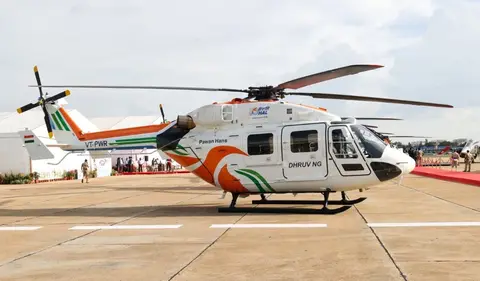 INDIA DEFENCEDhruv NG Helicopter Explained: What HAL Has Actually Put Into Pawan Hans Service
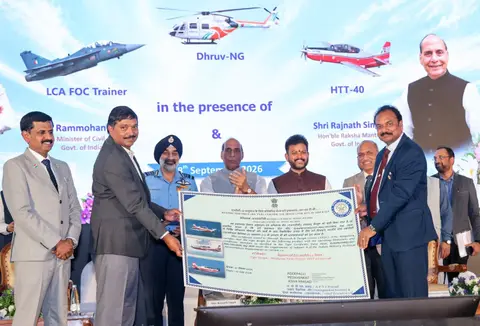 INDIA DEFENCELCA FOC Trainers Delivered With HTT 40 and Dhruv NG as Rajnath Singh Asks Engineers for Technologies That Do Not Exist
India Japan defence cooperation enters co-development phase at Delhi summit
India Japan defence cooperation moved into a co-development phase at the 16th India-Japan Annual Summit in New Delhi, where Prime Minister Narendra Modi and Japanese Prime Minister Sanae Takaichi agreed to convene the fourth 2+2 Ministerial Meeting in Tokyo before the end of the year. The two leaders directed their Foreign and Defence Ministers to meet on that platform, and set an agenda that runs from joint design through to production.
Foreign Secretary Vikram Misri, briefing reporters after the summit, said Tokyo's changing stance on defence exports had opened room for exactly this kind of partnership.
A 2+2 meeting in Tokyo before year-end
The 2+2 format seats the Foreign and Defence Ministers of both countries at one table. Takaichi pressed for stronger institutional mechanisms and named the 2+2 track specifically, Misri said. The third such meeting was held in New Delhi. The fourth returns to Tokyo, at a date both sides have yet to fix.
Misri read Japan's evolving export posture as a welcome shift. He described a considerable and, from India's perspective, positive evolution on the question of defence exports, a change that widens what the two countries can build together.
Modi went further on scope, suggesting the cooperation could cover the full span from designing to production and manufacturing rather than stopping at off-the-shelf purchases. It is an approach India has pushed in other bilateral defence dialogues, where local manufacturing sits at the centre of the pitch.
India Japan defence cooperation to span land, air and sea
The reframing matters because it reorders the relationship. For years the defence strand of the partnership was thin next to the economic one, dwarfed by trade and investment flows. The India Japan defence cooperation agenda now reaches across land, air and naval systems, and takes in unmanned platforms, according to Misri, a spread that would have read as ambitious only a few years ago.
India is one of the few countries with which Japan maintains a formal defence technology cooperation arrangement. That standing, rare for Tokyo, is what turns co-development from an aspiration into something the two navies and armies can actually plan around.
Both leaders agreed to explore further joint projects in defence equipment and technology, work that runs under the Make in India framework.
UNICORN mast and the naval stealth push
The clearest deliverable is the Unified Complex Radio Antenna, or UNICORN. Misri said the two sides had reached an agreement in principle on the remaining technical details of the project, which he described as a naval radio antenna programme already underway between the two countries.
UNICORN, in its NORA-50 form, is in service on Japan's Mogami-class frigates. It was developed by a group of Japanese firms led by NEC, alongside Sampa Kogyo and Yokohama Rubber. The system is being adapted for future Indian Navy warships through joint development and manufacturing, with Bharat Electronics Limited on the Indian side.
What the UNICORN system does
A conventional warship carries a spread of separate antennas bolted across its mast and superstructure. Each one reflects radar energy and adds to the ship's signature. UNICORN pulls those functions into a single enclosed mast, or radome, that houses tactical data links, TACAN navigation aids, communications, identification systems and electronic support measures, grouping equipment that once cluttered the deck.
The payoff is stealth. Consolidating the antennas shrinks the radar cross-section, lowers the electronic signature and makes the vessel harder to detect. It also clears deck space and eases maintenance, because crews service one integrated unit instead of a scattered array spread across the ship.
Misri was careful on one point. Asked about reports that Japan's Mogami-class frigates themselves might be built in India, he said the frigates as such were not discussed at the summit, though talks on shipbuilding cooperation continue.
Exercises, maritime security and the wider deal
The exercise calendar is thickening. Naval drills between the two navies go back years, Misri noted, but army and air force exercises are now being added, some for the first time. The joint statement welcomed the conduct of JAIMEX 25 and Japan's participation in the International Fleet Review 2026 at Visakhapatnam, and it flows from the same Indo-Pacific push behind Indian warship port visits across the region.
On the maritime side, both governments agreed to deepen cooperation through more exercises, sharper maritime domain awareness, and naval maintenance, repair and overhaul work carried out in India. That effort tracks alongside the Indian Navy's anti-piracy patrols in the Gulf of Aden, where its warships have kept a near-continuous presence.
The defence outcomes sat inside a much larger economic package. Modi and Takaichi signed agreements across artificial intelligence, semiconductors, clean energy, healthcare and advanced manufacturing, and launched a Japan-India Artificial Intelligence Cooperation Initiative. At the India-Japan Economic Forum, more than 150 Japanese industry representatives took part, with companies committing close to 12.5 billion dollars through around 120 cooperation agreements. Modi also announced a dedicated Japan Business Week, during which senior Prime Minister's Office officials will meet Japanese firms to work through their concerns and ease the path for investment.


COMMENTS
JOIN THE DISCUSSION