

 INDIA DEFENCEDhruv NG Helicopter Explained: What HAL Has Actually Put Into Pawan Hans Service
 INDIA DEFENCELCA FOC Trainers Delivered With HTT 40 and Dhruv NG as Rajnath Singh Asks Engineers for Technologies That Do Not Exist
 DEFENCE INDUSTRYTata Zorawar light tank clears Army's L1 hurdle for Rs 20,000 crore contract
 DEFENCE INDUSTRYIndia Belgium Defence Deals Sealed As PM De Wever Visits Delhi
 DEFENCE INDUSTRYAero India 2027 Dates Confirmed for February 8 to 12 in Bengaluru
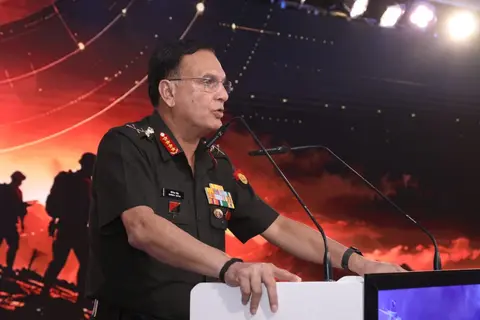
India strategic autonomy sat at the centre of Defence Minister Rajnath Singh's address to a Defence Conclave in New Delhi on Sunday, where he said the country believes in peace and does not seek to occupy any nation's territory, but is fully prepared to defend that peace when tested.
Global stability matters to India, he said, but not at a price that touches its own security or its freedom to act. Peace, in his framing, is a choice New Delhi makes rather than a weakness it can be pushed into.
On terrorism, the Defence Minister left little room for ambiguity. Countries that shelter or arm groups targeting India, he said, cannot expect New Delhi to sit across a table from them, a position he tied to remarks Prime Minister Narendra Modi made at the recent Shanghai Cooperation Organisation meeting.
"Countries that use terrorism as an instrument of state policy or provide shelter and support to terrorists must be firmly reminded that terrorism cannot be a strategic asset for any nation," Rajnath Singh said.
National unity, he added, is not a slogan but a structural requirement for security. Guarding the borders is the job of the armed forces, he said, but keeping the country unified against fault lines of religion, caste, region and language is everybody's task.
A civilisational power that grows without disruption
Rajnath Singh described India as a civilisational power whose rise rests on inclusive development rather than confrontation. He traced the idea to the country's long democratic and civilisational traditions, to the principle of Vasudhaiva Kutumbakam, the world as one family, and to the government's own Sabka Saath, Sabka Vikas formulation.
Five pillars, in his telling, hold that approach together: respect, dialogue, prosperity, security and culture. He described India as a Vishwa Bandhu, a friend to the world, with a particular role toward the Global South.
Vaccine Maitri got a specific mention. More than 30 crore Covid-19 vaccine doses went out to over 100 countries under that programme, he said, alongside support through medicines, digital payment solutions, expertise and resources for developing nations, and platforms such as the Voice of Global South Summits, all offered in a spirit of responsible power that still leaves room for competition.
India strategic autonomy backed by exports past Rs 38,000 crore
Numbers carried the argument forward from there. Defence exports touched an all time high of Rs 38,424 crore in 2025-26, Rajnath Singh said, up from just Rs 686 crore in 2013-14 and now reaching more than 100 countries. Having beaten a Rs 30,000 crore target last year, the government has set its sights on Rs 50,000 crore by 2029. IDW has tracked that growth curve through earlier ministry briefings on India's defence production numbers.
Growing international demand for Indian missiles, radars, ammunition and defence platforms shows confidence in the country's technology, quality and delivery record, he said, calling Made in India less a manufacturing label now than a mark of trust.
Budget crosses Rs 7.85 lakh crore, most of it staying home
The defence budget for 2026-27 stands at Rs 7.85 lakh crore, up from about Rs 2.53 lakh crore in 2013-14. Around 75 percent of the capital acquisition budget, Rs 1.39 lakh crore, has been set aside for the domestic defence industry, a decision meant to feed the MSME supply chains sitting under it.
Warfare itself is changing shape, he said. Modern conflicts now spill into cyber, space, electronic and information domains, alongside emerging fields such as artificial intelligence, drones, autonomous systems, quantum technology and hypersonic systems, and India needs future ready capabilities across all of them. He pointed separately to work under way on semiconductors, critical minerals and energy diversification as ways of shoring up strategic vulnerabilities in technology, data and supply chains.
Indigenisation lists, and a shift in mindset
Five positive indigenisation lists issued by the armed forces now cover 509 equipment items, weapon systems and platforms, Rajnath Singh said. Defence public sector undertakings have released six lists of their own, spanning 5,417 items including line replaceable units, subsystems, spares and components, of which around 3,300 have already been indigenised.
SRIJAN, the corridors and a base of 16,000 MSMEs
The SRIJAN and SRIJAN DEEP portals came up as the mechanism knitting the supply chain together. Around 33,000 imported items have been identified for substitution through SRIJAN, of which roughly 15,700 stand indigenised, while SRIJAN DEEP has built a database covering more than 40,000 manufacturers and sellers and lakhs of products. That effort runs alongside DRDO's own push to widen MSME participation through direct technology transfer, aired most recently at the VIMARSH industry synergy meet in Delhi.
India's defence ecosystem today spans DPSUs, private companies, more than 16,000 MSMEs, startups, universities and research institutions, spread across several regions of the country. Investment proposals worth about Rs 70,000 crore have come in for the Uttar Pradesh and Tamil Nadu Defence Industrial Corridors, with around Rs 10,000 crore of that already on the ground.
DPSUs turn a profit, and missile production opens up
All 16 defence public sector undertakings are now operating without losses, Rajnath Singh said, crediting the corporatisation of the Ordnance Factories for sharper technology focus, output and accountability across the group.
Startups got their own tally. Through Innovations for Defence Excellence and iDEX Prime, 676 startups and innovators had been engaged as of March 2026, with 551 contracts signed. The ministry has approved procurement worth more than Rs 2,400 crore from startups and MSMEs, alongside development projects worth over Rs 1,500 crore, under schemes such as ADITI.
The clearest new step touched missile production. Rajnath Singh confirmed a decision to transfer DRDO-developed technologies for conventional missile systems to eligible Indian industries, letting qualifying private companies take up manufacturing that has largely stayed inside government labs and public sector lines. IDW reported an earlier phase of that opening in August, when DRDO first cleared industry access to a set of missile programmes.
He said the step would strengthen the preparedness of the armed forces and help deliver missiles on time, with DRDO increasingly positioned to concentrate on research and development while industry takes up a larger share of production. Officials at the ministry describe that combination of indigenous production and rising exports as the practical face of India strategic autonomy in the defence sector, tracked further through the full text of Sunday's address and through the Department of Defence Production.

COMMENTS
JOIN THE DISCUSSION