

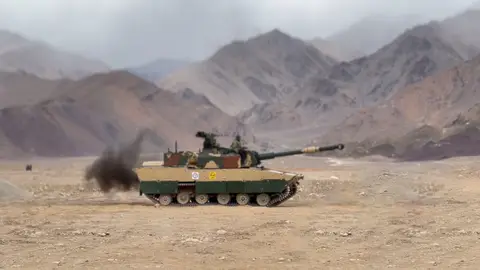
 DEFENCE INDUSTRYTata Zorawar light tank clears Army's L1 hurdle for Rs 20,000 crore contract
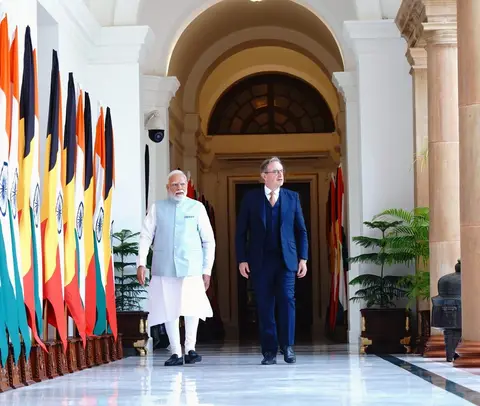 DEFENCE INDUSTRYIndia Belgium Defence Deals Sealed As PM De Wever Visits Delhi
 DEFENCE INDUSTRYAero India 2027 Dates Confirmed for February 8 to 12 in Bengaluru
 DEFENCE INDUSTRYJavelin missile co-production advances as Tata Advanced Systems signs Javelin Joint Venture pact
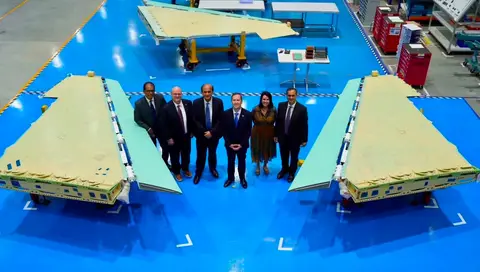 DEFENCE INDUSTRYTata Lockheed Martin MTA push gets a lift from US envoy's Hyderabad visit
India defence production reached a record of about Rs 1.78 lakh crore in 2025-26, Defence Minister Rajnath Singh said on Saturday, holding the number up as evidence that a self-reliant industrial base is now doing real work for the armed forces. He was speaking at an event in New Delhi. The frame he chose for it was Operation Sindoor, the May 2025 strikes against terror targets in Pakistan, which he called a shining example of technological warfare and proof of the government's trust in Indian industry.
Akashteer, the Akash missile system and BrahMos were among the systems used during that operation, according to a Ministry of Defence account of the address. He credited a foundation laid over the past twelve years.
India defence production at a record, exports climbing
The production figure carries weight because of where it started. Rajnath Singh put annual output at roughly Rs 40,000 crore around 2014, so India defence production has, on his numbers, more than quadrupled since then. He set a target of crossing Rs 2 lakh crore this year and Rs 3 lakh crore by 2029.
Exports told a similar story. He said defence exports had crossed an all-time high of about Rs 38,000 crore, up from Rs 686 crore in 2013-14, with a stated goal of Rs 50,000 crore by 2029. On present trends, he said, he was confident the targets would be met. The Department of Defence Production has driven much of the export easing, through the Defence EXIM Portal, online approvals, the Open General Export Licence and a Green Channel policy. IDW has followed how that push plays out in the field, from firm orders to early talks on BrahMos and Akashteer sales to the UAE.
Operation Sindoor as the proof point
His case rested on the operation. Rajnath Singh described Op Sindoor as testimony to defence preparedness that was, in his words, up to date, up to the mark and up to the standard, and tied it to a zero tolerance line on terrorism that he said India was willing to enforce not only at its doorstep but inside the places terror is sheltered.
The systems he named have export histories of their own. BrahMos, used in the closing phase of the operation, is now India's busiest defence export, with orders from the Philippines and a doubled Indonesian order signed during the Prime Minister's Jakarta visit. IDW has traced that expansion of BrahMos exports in earlier coverage.
The indigenisation lists and the mindset shift
Rajnath Singh returned to the positive indigenisation lists as the mechanism behind the numbers. Five such lists issued by the Defence Forces now cover 509 items, he said, with five more from the Defence Public Sector Undertakings covering 5,012, and another list is to be notified soon.
He argued that the harder change was one of attitude. For years, he said, the reflex was to import rather than build, and the effort since 2014 has been to reverse that by producing advanced weapons and technologies at home while cutting import dependence. A country that leans on others for missiles, radars, drones and navigation gives away part of its military autonomy, he said, and that is the situation the government has tried to change. He called self-reliance in defence the foremost initiative of the present government, a move from consumer to producer.
Startups, iDEX and the MSME base
Procurement worth more than Rs 2,400 crore has been approved from startups and MSMEs, Rajnath Singh said, with projects worth over Rs 1,500 crore sanctioned for new technologies. Through Innovations for Defence Excellence, 676 startups and innovators have engaged and 551 contracts signed as of March 2026. From a few dozen defence startups in 2018, the count has crossed 2,000, working on drones, artificial intelligence, quantum, cybersecurity and robotics. DRDO, he added, now works as a national innovation hub linking industry, academia and more than 17,000 MSMEs.
Corridors, acquisition rules and a new DAP
The two defence industrial corridors got their own mention. Investments of about Rs 70,000 crore have been proposed across the Uttar Pradesh and Tamil Nadu corridors, Rajnath Singh said, with around Rs 10,000 crore already committed, and he singled out the Uttar Pradesh corridor as a working example of Aatmanirbhar Bharat.
Procurement rules have been tilted the same way. Seventy-five percent of the modernisation budget is now earmarked for Indian industry, he said, with priority under the Defence Acquisition Procedure for the Buy Indian, Indigenously Designed, Developed and Manufactured route. A revised DAP is to be unveiled this year. The council that clears these purchases has been busy, having recently approved defence acquisition proposals worth about Rs 52,000 crore across the three services.
From buyer to security partner
The last stretch looked outward. India is no longer only building for itself but emerging as a reliable global security partner, Rajnath Singh said, its role reaching from the Indian Ocean into the Indo-Pacific, and by the 2047 centenary the world would see it as a modern, self-reliant defence power rather than only the largest democracy.
He tied that to the Prime Minister's recent visits to Indonesia, Australia and New Zealand: BrahMos cooperation and the restoration of the Prambanan temple in Indonesia, uranium supplies from Australia, trade doubling with New Zealand. Defence diplomacy runs past strategic cooperation into technical work, industrial tie-ups and global supply chains.



COMMENTS
JOIN THE DISCUSSION