

 DEFENCE INDUSTRYBrahMos export orders: Vietnam deal worth about $100 million, Indonesia $200 million as Akash reaches Tajikistan, Turkmenistan
 DEFENCE INDUSTRYMahindra Embraer Nagpur facility to assemble C-390 if IAF picks the aircraft
 DEFENCE INDUSTRYSMPP Drone Manufacturing Push: Firm Shifts From Ammunition to Unmanned Warfare, Targets Integrated Defence Capabilities
 INDIA DEFENCEDhruv NG Helicopter Explained: What HAL Has Actually Put Into Pawan Hans Service
 INDIA DEFENCELCA FOC Trainers Delivered With HTT 40 and Dhruv NG as Rajnath Singh Asks Engineers for Technologies That Do Not Exist
INS Mahendragiri commissioning to add sixth Project 17A stealth frigate to the fleet
The INS Mahendragiri commissioning is scheduled for 11 July 2026 at Visakhapatnam, where the Indian Navy will formally induct the sixth Project 17A indigenous stealth frigate into service under the Eastern Naval Command.
Mahendragiri (F38) joins the fleet as the first Indian naval warship to carry the name.
It takes its name from the Mahendragiri peak in the Eastern Ghats, the second-highest mountain in Odisha, and sails under the motto Mighty, Majestic, Matchless. The Navy calls it a Mission Primed unit.
A last MDL frigate for Project 17A
Mahendragiri is the fourth and final Project 17A ship built by Mazagon Dock Shipbuilders Limited (MDL) in Mumbai. The shipyard delivered the frigate to the Navy on 30 April 2026, roughly seventeen months after the lead ship Nilgiri was handed over in December 2024.
The class runs to seven ships, four from MDL and three from Garden Reach Shipbuilders and Engineers in Kolkata.
The acceptance document was signed at the yard by MDL chairman Capt Jagmohan (Retd) and Rear Adm Gautam Marwaha, Chief Staff Officer (Technical) at the Eastern Naval Command, with MDL directors and senior naval officers present, in a ceremony that formalised the handover.
Sudesh Dhankhar, wife of the then Vice-President, had launched the ship at Mazagon Dock on 1 September 2023. It then moved to the yard's wet basin for outfitting and sea trials alongside others of its class.
The INS Mahendragiri commissioning marks the last of the four MDL-built ships to enter service, leaving only the Garden Reach-built Vindhyagiri still to follow and close the programme.
Design, stealth and propulsion
The Warship Design Bureau, the Navy's in-house design organisation, drew up the Project 17A frigates as a follow-on to the Shivalik-class. Mahendragiri carries the class hallmarks, a reduced radar signature, enhanced survivability, and a high degree of automation across its onboard systems.
The design runs about five per cent larger than the Shivalik ships, with a sleeker hull shaped to trim its radar cross-section.
Power comes from a Combined Diesel or Gas propulsion plant that pairs diesel engines with gas turbines. The arrangement lets the frigate cruise economically on diesel and push hard on gas turbine power when a mission calls for speed.
At roughly 6,670 tonnes, it ranks among the heaviest frigates the Navy has built at home.
INS Mahendragiri commissioning strengthens combat reach
The frigate fields an integrated weapons and sensor suite spanning anti-air, anti-surface and anti-submarine roles. That covers surface-to-surface and surface-to-air missile systems, electronic warfare fits, anti-submarine warfare systems, and an integrated Combat Management System that binds the sensors and weapons into a single picture.
Across the class, that armament is publicly known to centre on BrahMos supersonic surface-to-surface missiles and Barak-8 surface-to-air missiles, the latter developed jointly by India and Israel.
An integrated helicopter facility extends the frigate's reach, letting it embark and operate a naval helicopter for surveillance and anti-submarine work at ranges well beyond the reach of the ship's own hull-mounted sensors.
Beyond warfighting, the ship is set up for maritime security, power projection, humanitarian assistance and disaster relief, search and rescue, and long endurance patrols across the Indian Ocean and its approaches, the kind of tasking the Navy rotates its frigates through in peacetime.
Over 75 per cent indigenous content
Mahendragiri was built with more than 75 per cent indigenous content, which the Navy holds up as a marker of the Aatmanirbhar Bharat push in warship construction. The build drew in a wide network of Indian firms, among them a large number of Micro, Small and Medium Enterprises, generating employment while deepening the domestic defence industrial base.
Mazagon Dock built the ship using an integrated, modular method, pre-outfitting hull blocks before joining them, an approach that shortened the timeline.
Mahendragiri has also been reported as the hundredth warship designed and delivered by the Warship Design Bureau, the organisation whose drawings underpin most of the Indian surface combatants now at sea.
A name from the Eastern Ghats
Naming the frigate after a peak in the Eastern Ghats keeps the class convention of drawing on Indian mountain ranges, from Nilgiri through to Vindhyagiri. Mahendragiri is the first warship of this class to carry the name, and the Navy frames it as a nod to resilience, strength and resolve.
Where Mahendragiri sits in the fleet
The ceremony at Visakhapatnam places the frigate with the Eastern Naval Command. It caps a crowded run of inductions, Nilgiri in January 2025, Udaygiri and Himgiri together in August 2025, Taragiri in April 2026, and Dunagiri in June 2026.
That run brought six Project 17A frigates to the Navy inside about seventeen months.
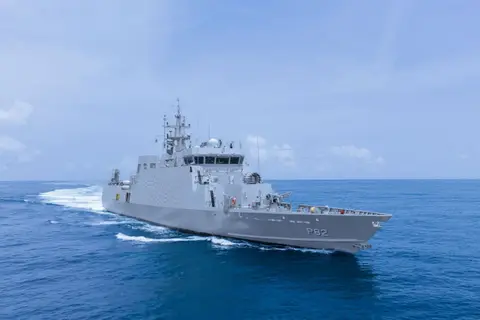
A second warship commissions in the same window, the anti-submarine warfare shallow water craft Malvan at Kochi. Built by Cochin Shipyard, Malvan is the second of eight such craft and carries over 80 per cent indigenous content.




COMMENTS
JOIN THE DISCUSSION