

 MINISTRY OF DEFENCEDelhi Defence Dialogue 2026: Self-reliance means no hostage to outside suppliers, says Rajnath Singh
 MINISTRY OF DEFENCENext Generation Corvettes contracts worth Rs 53,866.50 crore signed with GRSE and GSL
 MINISTRY OF DEFENCEBDL single tender for anti-tank missile sights goes to firm set up by former CMD Siddharth Mishra
 DEFENCE INDUSTRYBrahMos export orders: Vietnam deal worth about $100 million, Indonesia $200 million as Akash reaches Tajikistan, Turkmenistan
 DEFENCE INDUSTRYMahindra Embraer Nagpur facility to assemble C-390 if IAF picks the aircraft
Malabar 2026 concludes for the Indian Navy with INS Sahyadri leaving Yokosuka Naval Base in Japan, after the indigenous guided missile stealth frigate completed the four-nation exercise with the navies of Japan, the United States and Australia.
The ship took part in both halves of the exercise, professional engagements in the Harbour Phase and coordinated maritime operations in the Sea Phase.
Malabar 2026 Sea Phase covered submarine hunting, boarding drills and gunnery
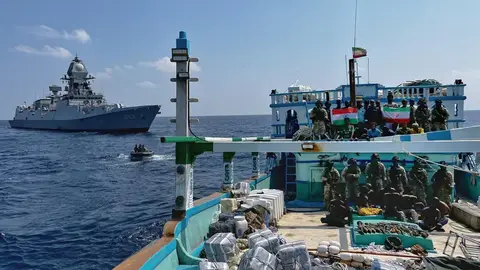
The Sea Phase featured Anti-Submarine Warfare, Visit, Board, Search and Seizure (VBSS) drills, Maritime Interdiction Operations, gunnery exercises, replenishment approaches and cross-deck landings, according to a Ministry of Defence release. In VBSS drills, armed teams board a suspect vessel at sea and search it. Interdiction operations train ships to stop and inspect traffic carrying illegal cargo, and replenishment approaches rehearse closing alongside another ship to take on fuel and stores without entering harbour.
Cross-deck landings put helicopters of one navy on the flight deck of another.
The Japan Maritime Self-Defense Force (JMSDF), which hosted this edition, had announced the sea drills for 5 to 12 November in waters south of the Kanto region on Honshu, with anti-submarine warfare, anti-surface warfare and a photo exercise listed as the main serials.
Japan fielded a helicopter destroyer and a submarine
According to the JMSDF announcement, Japan deployed the helicopter destroyer JS Ise, the frigate JS Mogami, a submarine and a P-1 maritime patrol aircraft. The US Navy sent an amphibious transport dock and a P-8A Poseidon, while Australia was represented by the frigate HMAS Stuart and a Royal Australian Air Force P-8A. INS Sahyadri was the Indian Navy's sole unit in the exercise.
Harbour Phase at Yokosuka brought the four crews together
Alongside at Yokosuka, the participating navies worked on operational synchronisation and held cross-deck visits, sporting engagements and cultural activities. The ministry said these built camaraderie and strengthened bonds among personnel of the four navies.
INS Sahyadri reached Japan after drills in Busan and Vladivostok
The frigate of the Eastern Fleet arrived at Yokosuka on 4 November and was received by the JMSDF with a ceremonial welcome attended by Vice Admiral Yagi Koji, Commandant of the Yokosuka District, and R Madhu Sudan, Deputy Chief of the Indian Mission in Japan. The ship's arrival at Yokosuka for Exercise Malabar 2026 came a day before the exercise opened.
Before Malabar 2026, the ship sailed with the Russian Navy in Exercise INDRA 2026 off Vladivostok and then joined the Republic of Korea Navy for a bilateral exercise at Busan, where it operated with the destroyer ROKS Munmu the Great in coordinated navigation, helicopter operations and joint manoeuvres.
A second straight Malabar for the Shivalik class frigate
INS Sahyadri also represented India at Malabar last year. In November 2025 it sailed in the US-hosted edition, which held its harbour phase in Guam and ran sea drills from 10 to 18 November.
Yokosuka is also familiar ground. The ship berthed there in October 2025 for the harbour phase of JAIMEX-25, the bilateral exercise with the JMSDF.
Malabar began in 1992 as a bilateral exercise between the Indian Navy and the US Navy. Japan became a permanent participant in 2015. Australia returned in 2020, and the exercise has run with all four navies since.
INS Sahyadri is the third ship of the Shivalik class, India's first indigenously designed and built stealth frigates. It was built by Mazagon Dock in Mumbai and commissioned in 2012.
COMMENTS
JOIN THE DISCUSSION