

 INDIA DEFENCEDhruv NG Helicopter Explained: What HAL Has Actually Put Into Pawan Hans Service
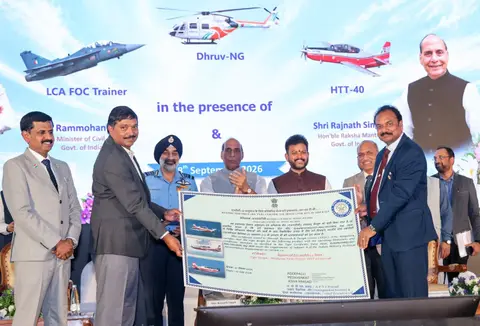 INDIA DEFENCELCA FOC Trainers Delivered With HTT 40 and Dhruv NG as Rajnath Singh Asks Engineers for Technologies That Do Not Exist
 DEFENCE INDUSTRYTata Zorawar light tank clears Army's L1 hurdle for Rs 20,000 crore contract
 DEFENCE INDUSTRYIndia Belgium Defence Deals Sealed As PM De Wever Visits Delhi
 DEFENCE INDUSTRYAero India 2027 Dates Confirmed for February 8 to 12 in Bengaluru
A national security holistic approach is now essential to counter today's fast changing threats, Defence Minister Rajnath Singh said on Thursday, addressing a defence conclave in New Delhi. He said viewing security purely in terms of protecting geographical borders amounts to what he called the Perimeter Fallacy.
Modern challenges extend well beyond the use of arms and artillery by adversaries, Singh said, listing drones and unmanned aerial vehicles, cyber attacks, lone wolf attacks and disinformation campaigns among the threats the country now has to reckon with. National security is also tied to economic and energy security, he added, since hostile actors may try to harm the economy or disrupt energy supply chains.
Strength and peace were never opposites, Singh says
The concepts of strength and peace were never seen as contradictory in Indian tradition, Singh said, arguing that some leaders after independence treated the two as mutually exclusive on the assumption that the rest of the world shared India's preference for peace. That mindset, he said, has changed under Prime Minister Narendra Modi.
"India possesses both the power of argument and the argument of power, and will respond in the language the other party understands best," Singh said.
Events such as the Surgical Strikes, the Balakot air strike and Operation Sindoor, he said, demonstrated that the country has both the capability and the resolve to safeguard its interests, even as it continues to work toward global peace through diplomacy.
The shift to deterrence by punishment
Singh said India's counter terrorism approach has evolved beyond strategic containment and deterrence by denial toward what he termed deterrence by punishment. Any terror attack originating from Pakistani soil, he said, will be treated as an Act of War against India and met with a response those responsible deserve.
Operation Sindoor articulated this shift, Singh said. The message conveyed through it was that no border can prevent India from dismantling terrorist infrastructure, and that no distinction will be made between terrorists and their sponsors, a point that also carries weight for the personnel honoured for their role in the operation. He also cited the suspension of the Indus Waters Treaty as evidence of the same resolve, framing it as a signal that blood and water cannot flow together. Terrorism and talks cannot go hand in hand, he said, nor can terrorism and trade.
Balancing diplomacy and readiness: the national security holistic approach
Military preparedness pursued without diplomacy risks confrontation, Singh said, while diplomacy pursued without adequate capability is read as weakness and works against national security. He called a balance between the two essential. Through QUAD, he said, India is working toward a free, open and rule based Indo-Pacific, while I2U2, grouping India, Israel, the UAE and the United States, has opened cooperation in new areas. Participation in BIMSTEC, BRICS and SCO has also grown, he added, alongside new platforms for strategic partnership.
A wider economy funds a stronger defence budget
National strength rests on two pillars, Singh said: a robust economy and a strong military.
A secure economy widens the resources available for defence, he said, and security in turn creates the conditions for development to advance. Singh pointed to India's economy growing at 7.8 percent and its position among the world's top five economies. On the defence side, he cited a nearly three fold rise in the budget, from around Rs 2.50 lakh crore in FY 2013-14 to a record Rs 7.85 lakh crore in FY 2026-27, on top of the acquisition proposals cleared earlier in the year. Defence production, he said, has climbed to an all time high of around Rs 1.80 lakh crore, with the forces modernising, ordnance factories transformed and defence public sector undertakings turning a profit.
Technology, indigenisation and the three Ts
Singh described Terrain, Technology and Thinking as the three Ts that decide any war, and said the government's technology push spans drones, artificial intelligence, cyber security, electronic warfare, space and quantum technology. He pointed to indigenous unmanned platforms such as Rustom, Ghatak and Nagastra, and said drone warfare capabilities were demonstrated during Operation Sindoor. He also said BrahMos missiles caused heavy damage inside Pakistan during the operation, and that Sudarshan Chakra is being developed with future combat challenges in mind.
The Design in India, Develop in India, Manufacture in India vision underpins this push. Defence R&D allocation has grown more than 112 percent over twelve years, Singh said, from around Rs 13,700 crore in FY 2014-15 to over Rs 29,000 crore now.
A quarter of that R&D budget has been opened to industry, start ups and academia, he said, enabling them to actively contribute to defence innovation alongside the DRDO laboratory network. Very few countries, he added, possess Multiple Independently Targetable Re-entry Vehicle technology, which DRDO has successfully tested on the Agni-5 missile.
Indigenisation lists, technology transfer and MSMEs
Licensing rules in defence production have been simplified, Singh said, with priority given to indigenous systems under the Defence Acquisition Procedure. Over 5,500 items now sit across more than ten Positive Indigenisation Lists, he said, covering equipment and components that were previously imported. DRDO has also transferred technology for conventional missile systems to Indian industry, he added, alongside the creation of 15 Industry Academia Centres of Excellence.
Defence Industrial Corridors have been set up to strengthen the domestic supply chain, Singh said, with start ups and MSMEs drawn into defence innovation alongside larger manufacturers. He pointed to the Srijan Defence Equipment Empowerment Platform, which now lists more than 41,000 vendors and over 2.7 lakh products.
Veteran welfare alongside operational readiness
The national security holistic approach Singh described extends to the welfare of soldiers and veterans as well, not only to operational capability, he told the conclave. ECHS facilities have been expanded under the Ministry of Defence, he said, and the SPARSH platform was launched to ensure Right Pension, Right Pensioner, Right Time. The long pending One Rank One Pension policy has been implemented, he added. Earlier this month, he said, lifetime free train travel was extended to all soldiers awarded the Sena Medal and to selected members of their families.


COMMENTS
JOIN THE DISCUSSION