

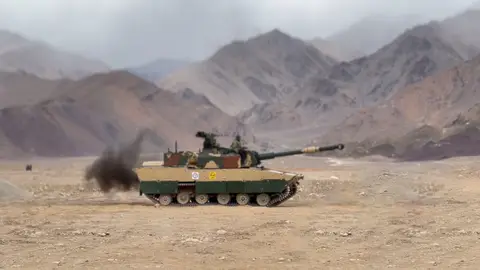
 DEFENCE INDUSTRYTata Zorawar light tank clears Army's L1 hurdle for Rs 20,000 crore contract
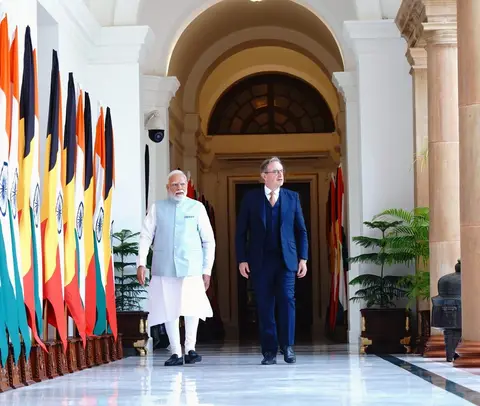 DEFENCE INDUSTRYIndia Belgium Defence Deals Sealed As PM De Wever Visits Delhi
 DEFENCE INDUSTRYAero India 2027 Dates Confirmed for February 8 to 12 in Bengaluru
 DEFENCE INDUSTRYJavelin missile co-production advances as Tata Advanced Systems signs Javelin Joint Venture pact
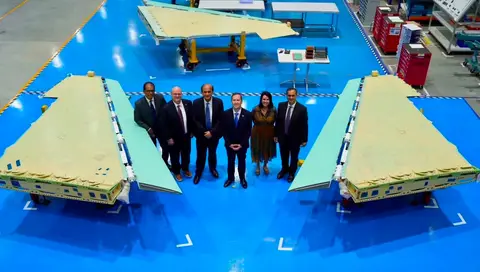 DEFENCE INDUSTRYTata Lockheed Martin MTA push gets a lift from US envoy's Hyderabad visit
Mission Sudarshan Chakra: Rajnath Singh Details India's Multi-Layered Missile Defence Shield at DRDL Hyderabad
Mission Sudarshan Chakra, the government's proposed national missile defence architecture, received its most detailed public articulation to date on Friday when Defence Minister Rajnath Singh inaugurated a new Advanced Weapon System Complex at the Defence Research and Development Organisation's Defence Research and Development Laboratory in Hyderabad and described the initiative as a protective umbrella that would shield military installations, critical infrastructure and civilian establishments from aerial threats.
Speaking at the Dr APJ Abdul Kalam Missile Complex, Singh credited the performance of Indian-developed weapon systems during Operation Sindoor as the clearest demonstration yet of what the country's defence research and development ecosystem is now capable of producing under pressure.
"The exceptional performance of indigenous missile systems during Operation Sindoor is testimony to the growing strength of India's defence R&D ecosystem," the Defence Minister told scientists and senior officials gathered at the Hyderabad facility.
What Mission Sudarshan Chakra Will Deliver
Mission Sudarshan Chakra, first announced by Prime Minister Narendra Modi during his Independence Day address in 2025, is conceived as a multi-layered national missile defence system built around three tiers of protection. Singh described it as a modern national shield capable of intercepting a wide range of aerial threats while causing minimal disruption to civilian life across the country.
"Mission Sudarshan Chakra will be a multi-level missile defence system of modern India. It will not only protect military installations and critical infrastructure but also ensure the safety of civil infrastructure and key establishments," Singh said.
The Defence Minister did not provide specific technical parameters for the proposed architecture on Friday, but the framing of the initiative as a three-tier system covering military, strategic and civilian targets places it in the same category as layered national air defence programmes pursued by other advanced military powers. The announcement follows a period in which the performance of India's integrated air defence network during Operation Sindoor drew considerable attention both within the country and abroad.
Singh was direct about what the air defence network delivered during that operation. "When aerial threats loomed over our borders, our air defence system completely thwarted the enemy's intentions," he said, referencing the role played by systems developed and produced indigenously by DRDO and Indian industry.
Operation Sindoor and the Case for Indigenous Capability
The inauguration at DRDL came with the Sindoor experience still fresh in the minds of India's defence establishment, and Singh used the occasion to draw a direct line between what happened over Indian airspace during that operation and the rationale for accelerating indigenous missile and air defence programmes.
The Akash surface-to-air missile system and the BrahMos supersonic cruise missile, both central to India's current air defence and precision strike inventory, were cited by Singh as proof that Indian-developed platforms can hold their own against systems fielded by leading defence powers. The Akash programme, managed by DRDO in collaboration with Bharat Dynamics Limited and Bharat Electronics Limited, has been in frontline service with the Indian Air Force and the Indian Army for several years. BrahMos, the joint venture between India and Russia, has become one of the most sought-after precision strike systems in the region.
"Strength is essential for peace, and self-reliance is the most reliable foundation for that strength. DRDO has repeatedly demonstrated this fact," Singh said.
For the DRDO scientists and engineers present at the inauguration, the praise carried weight that would have felt different before May 2025. The systems they built and refined over years of sustained work were tested under real operational conditions, and the results shaped the government's confidence in expanding the scope of what DRDO is now being asked to deliver.
https://x.com/SpokespersonMoD/status/2065452234582950336?ref_src=twsrc%5Etfw%7Ctwcamp%5Etweetembed%7Ctwterm%5E2065452234582950336%7Ctwgr%5E9e0e5ded2c1cfe1fad50504012e956c56eca0e86%7Ctwcon%5Es1_c10&ref_url=https%3A%2F%2Fpublish.x.com%2F%3Furl%3Dhttps%3A%2F%2Ftwitter.com%2FSpokespersonMoD%2Fstatus%2F2065452234582950336
Advanced Weapon System Complex: A New Chapter for DRDL
The facility inaugurated on Friday adds significant infrastructure to what is already one of India's most consequential defence research addresses. DRDL, which sits within the larger Dr APJ Abdul Kalam Missile Complex in Hyderabad, has been the birthplace of the Akash, the Nag anti-tank guided missile, the Astra beyond-visual-range air-to-air missile and several classified strategic systems. The new Advanced Weapon System Complex is intended to accelerate the development and integration of next-generation missile platforms, advanced sensors and associated weapon systems.
Director General for Missile and Strategic Systems at DRDO, U Raja Babu, and DRDL Director Dr Ankathi Raju were present at the inauguration alongside senior DRDO officials.
The complex is expected to give DRDO's missile and strategic systems cluster the physical infrastructure to handle more complex integration work and to run more sophisticated test and evaluation cycles without depending on external facilities. That matters for programmes with tight security classifications and for systems where the development-to-production timeline is a strategic variable in its own right.
From Lab to Production Line: The Next Imperative
Singh used the occasion to push DRDO and the broader Indian defence industrial base to close the gap between laboratory achievement and large-scale production. The gap has been a persistent issue in Indian defence procurement, where systems that perform well in development and limited trials can take years to reach full-rate production in the numbers that operational users require.
"Success in future wars will depend not only on advanced technology but also on the ability to manufacture and induct systems rapidly and in sufficient numbers," Singh said, framing the manufacturing challenge as a strategic imperative rather than an administrative one.
He called for closer integration between DRDO, the armed forces and industry to bring development timelines down and indigenous content up. The Defence Minister's emphasis on manufacturability as a core part of the development process reflects a shift in how the government is framing its expectations of DRDO. The organisation has historically been evaluated on whether it can produce a working system. The new expectation is that the system must be producible at scale, at speed, and with an industrial supply chain that can sustain it through a conflict.
Singh pointed to deeper collaboration among DRDO laboratories, defence public sector undertakings, private industry, start-ups, MSMEs and academia as the mechanism through which India's defence innovation ecosystem can translate indigenous ideas into operational capability at a faster tempo. The government's Aatmanirbhar Bharat framework for the defence sector has been the policy architecture through which much of this integration has been encouraged, and Singh linked Friday's inauguration directly to that broader national goal.
Warfare Is Changing: What India Must Prepare For
Singh offered a direct assessment of where warfare is heading and what India must build to remain competitive. Future conflicts, he said, would be shaped by precision-strike weapons, integrated air defence systems, hypersonic technologies, autonomous platforms, artificial intelligence, electronic warfare capabilities and advanced sensor networks. Each of those domains demands investment now, before the next crisis arrives.
He framed India's requirement around two concepts. Resilience, which he defined as the ability to absorb shocks and recover quickly, and deterrence, which he described as the capacity to convince any adversary that aggression will invite a decisive response. Both depend on indigenous capability. A country that relies on imported systems for its most critical defence functions cannot guarantee either, because supply chains can be interrupted and technology transfers can be conditioned on political behaviour.
"Resilience is the ability to absorb shocks and recover quickly, while deterrence is the capacity to convince any adversary that aggression will invite a decisive response," the Defence Minister said, setting out the framework within which Mission Sudarshan Chakra and the broader DRDO missile programme must be understood.
Singh said DRDO's role extends beyond responding to technological change. The organisation must anticipate future battlefield requirements and develop the systems to meet them before those requirements become urgent operational gaps. That is a higher standard than what most national research establishments are held to, and it reflects the government's confidence in what DRDO has shown itself capable of delivering.
Mission Sudarshan Chakra and the Path Ahead
The inauguration of the Advanced Weapon System Complex at DRDL takes place at a moment when India's missile and air defence ambitions have moved beyond aspirational statements into funded programmes and concrete infrastructure. The Akash system is in production and export discussions are advancing. The BrahMos extended-range variant is under development. DRDO's longer-range air defence work continues at pace. The institutional infrastructure being put in place in Hyderabad is designed to accelerate all of it.
Singh described what DRDO has produced in recent years as more than a collection of technological milestones. "These are not merely technological milestones. They reflect India's growing strategic capability, self-confidence and ability to reduce dependence on foreign systems," he said, in terms that will resonate with the service chiefs, procurement officials and private sector partners who are all stakeholders in the Aatmanirbhar Bharat defence ecosystem.
A technical exhibition held at the complex during Singh's visit featured advanced missile systems, indigenous weapon platforms and emerging technologies developed by DRDO. Mission Sudarshan Chakra, as the next major milestone in that story, now has both a policy mandate and the physical infrastructure at DRDL Hyderabad to begin its next phase of development in earnest.
For more on India's nuclear and missile capabilities, see IDW's coverage of India's growing nuclear arsenal reaching 190 warheads per the SIPRI 2026 report. India's wider Aatmanirbhar Bharat push in aviation platforms is tracked in IDW's report on the 114 Rafale deal anchored to Make in India. The security posture that frames demand for systems such as Mission Sudarshan Chakra is covered in IDW's report on the Army Chief's review of Jammu and Kashmir security at Northern Command.
External references: Defence Research and Development Organisation, Ministry of Defence, Government of India, Press Information Bureau.



COMMENTS
JOIN THE DISCUSSION