

 DEFENCE INDUSTRYSMPP Drone Manufacturing Push: Firm Shifts From Ammunition to Unmanned Warfare, Targets Integrated Defence Capabilities
 INDIA DEFENCEDhruv NG Helicopter Explained: What HAL Has Actually Put Into Pawan Hans Service
 INDIA DEFENCELCA FOC Trainers Delivered With HTT 40 and Dhruv NG as Rajnath Singh Asks Engineers for Technologies That Do Not Exist
 DEFENCE INDUSTRYTata Zorawar light tank clears Army's L1 hurdle for Rs 20,000 crore contract
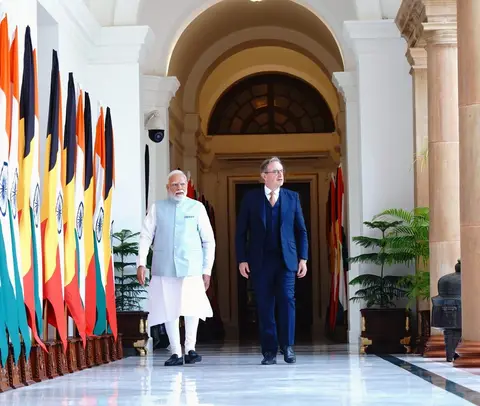 DEFENCE INDUSTRYIndia Belgium Defence Deals Sealed As PM De Wever Visits Delhi
In his Navy Commanders Conference address on Tuesday, Defence Minister Rajnath Singh said India now stands as the first responder and preferred security partner in the Indian Ocean Region. Speaking to the Navy's top leadership at Nausena Bhawan in New Delhi, he said the world is watching both India's strategic position and its strategic responsibility grow in the region.
The sea has also become harder to watch. Congestion, deception and grey-zone activity have made the maritime domain more complex than ever, he said.
"India stands firm as the First Responder, Preferred Security Partner and as a symbol of trust and reliability in the Indian Ocean Region," Singh said, adding that monitoring and response mechanisms must be raised to a new level. He was addressing the second edition of the Navy's biannual Commanders' Conference for 2026, according to the Ministry of Defence.
Navy Commanders Conference address puts the Navy at the centre
Singh tied the Navy directly to the government's long-term national goal. "The Indian Navy serves as a strategic anchor in the vision of 'Viksit Bharat 2047'. Beyond merely guarding maritime boundaries, our Navy strengthens economic protection, regional stability, and power projection," he said.
Indian warships now operate in the South China Sea, the Mediterranean and the Atlantic Ocean. Singh cited this as proof of blue-water capability. The Navy's role, he said, is crucial to strategic depth and regional power projection, and he urged the force to keep up its momentum as it becomes future-ready, combat-ready and globally respected.
He asked commanders to move beyond business as usual. With pressure coming from fast-changing technology, unpredictability and geography, geo-strategic thinking and contingency planning must become part of everyday preparedness. "Our goal is clear, our preparedness must reach the crisis point before the crisis itself reaches our doorstep," Singh said.
https://x.com/SpokespersonMoD/status/2104874016385430002?ref_src=twsrc%5Etfw%7Ctwcamp%5Etweetembed%7Ctwterm%5E2104874016385430002%7Ctwgr%5E6aa05440af4b473a9278ec68887344089038aede%7Ctwcon%5Es1_c10&ref_url=https%3A%2F%2Fpublish.x.com%2F%3Furl%3Dhttps%3A%2F%2Ftwitter.com%2FSpokespersonMoD%2Fstatus%2F2104874016385430002
Operation Urja Suraksha and the Strait of Hormuz
Singh singled out the Navy's work during the crisis in West Asia. Under Operation Urja Suraksha, the Navy has ensured the safe transit of Indian-flagged merchant vessels, particularly LPG tankers, through the Strait of Hormuz. He called it an outstanding achievement.
The import figures explain the priority.
India brings in around 85 to 90 percent of its crude oil and around 50 percent of its natural gas by sea, Singh said, so the safety of sea lanes is tied directly to the economy, energy supplies and defence preparedness. The operation, which is still under way, has once again shown the Navy's professionalism and readiness to protect the country's energy supply lines, he added.
18 warships in a single year
Singh described 2026 as a historic year for the Navy. The induction or commissioning of 18 warships is planned, which would be the largest single-year force accretion in the Navy's history.
Warships commissioned recently carry more than 75 percent indigenous content, and the country's warship production ecosystem now meets global benchmarks, he said. The next step, in his words, is to meet India's own requirements and also export warships to friendly foreign nations. Singh said the pace of inductions shows the growing maturity of domestic naval shipbuilding, while further capability enhancement remains necessary.
He also called for an upgrade of India's maritime surveillance architecture. Existing systems matter, Singh said, but the growing volume and complexity of sea traffic now demand stronger analytical capability, a theme that ran through his Navy Commanders Conference address.
Women on frontline warships
Under the Indian Navy's All Ranks, All Roles approach, women officers now serve on frontline warships and aircraft. Singh also praised women's role in sailing expeditions such as the Navika Sagar Parikrama voyage.
CTF-154, Southern Readiness and Lokayan-26
Singh congratulated the Navy on taking command of Combined Task Force-154 under the Combined Maritime Forces.
He called it an important contribution to regional cooperative security. During that command tenure, India conducted Operation Southern Readiness in Kochi. It drew 276 personnel from 27 countries, along with 76 facilitators and subject-matter experts and four international organisations.
He also commended the Lokayan-26 deployment of INS Sudarshini, which took the sail training ship to the United States and across the Atlantic and Mediterranean, engaging the Indian diaspora and showcasing India's maritime heritage along the way. The Navy's presence in the Indian Ocean Region and beyond continues to strengthen India's MAHASAGAR vision, Singh said.
What the commanders will review
The three-day conference at Nausena Bhawan opened on Tuesday and runs until Thursday. It brings together the Navy's top leadership to review operational preparedness, maritime security and future capability development.
The deliberations cover the use of artificial intelligence, big data, autonomous and uncrewed systems, cyber operations, logistics, training and technology absorption. The aim is a Combat Ready, Credible, Cohesive and Future Ready force, guided by the principles of jointness, Aatmanirbharta and innovation, Singh said.
https://x.com/rajnathsingh/status/2104870598577115364?ref_src=twsrc%5Etfw%7Ctwcamp%5Etweetembed%7Ctwterm%5E2104870598577115364%7Ctwgr%5E9bc4f93184965284523ab67a410ea4d8bf323d1d%7Ctwcon%5Es1_c10&ref_url=https%3A%2F%2Fpublish.x.com%2F%3Furl%3Dhttps%3A%2F%2Ftwitter.com%2Frajnathsingh%2Fstatus%2F2104870598577115364
Singh reaffirmed the government's support for the Navy. India's maritime power, he said, is not only about showing the national flag at sea but about making sure that wherever the Tricolour is seen, it conveys security, trust and confidence. "If the seas are secure, India will be secure; and if India is secure, the resolve for a Viksit Bharat will be further strengthened," he said.
Singh also interacted with the Chief of Defence Staff, Gen NS Raja Subramani, and the Chief of the Army Staff, Gen Dhiraj Seth, during the conference.
COMMENTS
JOIN THE DISCUSSION