

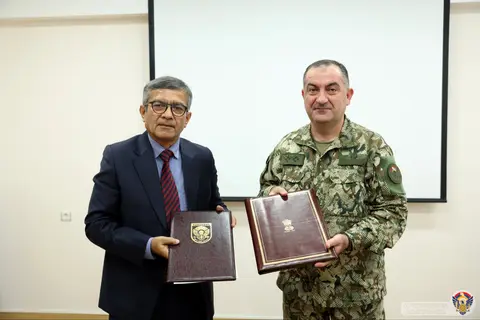
 DEFENCE INDUSTRYBrahMos export orders: Vietnam deal worth about $100 million, Indonesia $200 million as Akash reaches Tajikistan, Turkmenistan
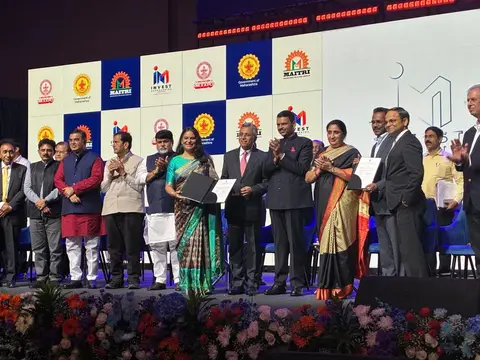 DEFENCE INDUSTRYMahindra Embraer Nagpur facility to assemble C-390 if IAF picks the aircraft
 DEFENCE INDUSTRYSMPP Drone Manufacturing Push: Firm Shifts From Ammunition to Unmanned Warfare, Targets Integrated Defence Capabilities
 INDIA DEFENCEDhruv NG Helicopter Explained: What HAL Has Actually Put Into Pawan Hans Service
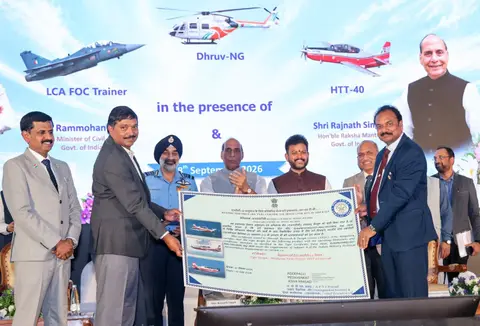 INDIA DEFENCELCA FOC Trainers Delivered With HTT 40 and Dhruv NG as Rajnath Singh Asks Engineers for Technologies That Do Not Exist
POJK resident repatriated at Kaman Aman Setu in Uri sector
A POJK resident repatriated by the Army on Saturday walked back across the Line of Control at the Kaman Aman Setu in Uri, a little over five weeks after troops caught him slipping into Kashmir. Zeeshan Mir, son of Lal Mir, was formally handed to Pakistan Army officials at 1224 hrs on 04 July. He had crossed on 31 May.
The Srinagar based Chinar Corps confirmed the handover in a short post. It said Mir had been treated with dignity, compassion and due care during his stay in India.
https://x.com/ChinarcorpsIA/status/2073403154390306909?ref_src=twsrc%5Etfw%7Ctwcamp%5Etweetembed%7Ctwterm%5E2073403154390306909%7Ctwgr%5E2c5f13bdd86820f24eb5f8eb2be8667539883e74%7Ctwcon%5Es1_c10&ref_url=https%3A%2F%2Fpublish.x.com%2F%3Furl%3Dhttps%3A%2F%2Ftwitter.com%2FChinarcorpsIA%2Fstatus%2F2073403154390306909
Why he crossed
Mir did not come with a weapon or a plan. He came for a woman. The 22 year old from Muzaffarabad had met Irum Bano, a resident of Tulwari village in Baramulla, on social media, and a conversation that started on Snapchat grew into something he was willing to risk the LoC for. Officials familiar with the investigation said his family had been pressing him to earn and carry the household, and that he had sunk into depression under that weight. Investigators who questioned him came away describing a man who looked less like a threat than a casualty of his own circumstances. One more thing pulled him toward that particular stretch of frontier. His ancestors, he told them, came from the very border village where the girl now lives.
Cross LoC family ties are old news in these parts. Families split by the lines of 1947 and 1965 still hold relatives on the other side, and marriages across the divide were once ordinary in the frontier belts of Uri, Karnah and Keran. What has changed is the fence, the sensors and the arithmetic of a militarised boundary, which turns a walk to a neighbouring village into a capital risk. The same belt that Amit Shah keeps under review when he orders a zero tolerance line on infiltration is the one Mir chose to cross for reasons that had nothing to do with any of that.
Apprehension and the legal process
Troops picked Mir up soon after he crossed. The Chinar Corps, describing the May operation, said its soldiers held their fire while challenging the intruder and apprehended him without harm before handing him to the Jammu and Kashmir Police for legal proceedings.
What followed was procedure. Police registered a case, Mir was lodged in Baramulla jail, and the courts worked through the formalities that govern an inadvertent crossing carrying no hostile intent. His repatriation went ahead only once those orders came through, and not a day before, which is the part the Chinar Corps chose to underline when it announced the handover.
Not the first crossing of its kind
The Army has run this drill before. In June it sent back Asad Khan, a man from Khyber Pakhtunkhwa who had strayed across near Simari in Kupwara, through the Aman Setu at Teetwal on much the same terms. These are not rare events. The frontier districts of north Kashmir see them often enough that the handover at a peace bridge has a settled choreography to it, distinct entirely from the security grid that governs an event like the Amarnath Yatra 2026 deeper inside the Valley.
Three minutes before the bridge
Before the handover, Mir was allowed a brief meeting with Bano and her family. Three minutes, by one account. Her relatives had bought him new clothes and shoes while the case wound through the Uri police station. He told them not to cry. He said the Army had treated him as a guest, and that he hoped he and Bano would marry.
None of that changed the outcome. A crossing without papers is a crossing without papers, and once the paperwork was done the file simply moved to the bridge.
POJK resident repatriated under a familiar Army line
The phrasing the Chinar Corps used is one it has repeated across a run of these cases. Mir was treated, the Army said, in a manner reflecting its steadfast commitment to humanitarian values and professional conduct. The same register framed the Khan repatriation weeks earlier, and it is the register the Army reaches for when its people are honoured abroad, as they were when Indian peacekeepers collected United Nations medals in the eastern DRC.
Read plainly, the line works on two audiences at once. To Indian readers it says that soldiers on a hair trigger border can still tell a lovestruck civilian from an infiltrator. It also sets a quiet contrast with the other LoC that planners in Delhi point to, the one they say funnels armed men rather than heartbroken ones.
Mir is back in Muzaffarabad. The case registered against him in Baramulla is closed.



COMMENTS
JOIN THE DISCUSSION