

 MINISTRY OF DEFENCEDelhi Defence Dialogue 2026: Self-reliance means no hostage to outside suppliers, says Rajnath Singh
 MINISTRY OF DEFENCENext Generation Corvettes contracts worth Rs 53,866.50 crore signed with GRSE and GSL
 MINISTRY OF DEFENCEBDL single tender for anti-tank missile sights goes to firm set up by former CMD Siddharth Mishra
 DEFENCE INDUSTRYBrahMos export orders: Vietnam deal worth about $100 million, Indonesia $200 million as Akash reaches Tajikistan, Turkmenistan
 DEFENCE INDUSTRYMahindra Embraer Nagpur facility to assemble C-390 if IAF picks the aircraft
Sagar Suraksha 2026, a two-day national seminar on coastal security, opened in Kolkata on Monday, with the Indian Coast Guard (ICG) and the Ministry of Home Affairs (MHA) bringing together the agencies that share the work of guarding India's coastline.
More than 100 senior officers are taking part.
The ICG is holding the seminar with the Border Management Division of the MHA. Its theme is "Comprehensive Approach to Coastal Security: Strengthening Stakeholder Participation and Community Engagement". According to the Coast Guard, the aim is to strengthen the country's integrated coastal security framework, in which the Centre, the coastal States, the police and the armed forces each hold a part of the task. The event comes in the year the Coast Guard marks five decades since it was raised in 1977.
West Bengal minister opens Sagar Suraksha 2026
Bishal Lama, West Bengal's Minister of State for Home and Hill Affairs, inaugurated the seminar. The Secretary (Border Management) of the MHA and the Director General of the Indian Coast Guard were present.
Participants have come from coastal States and Union Territories, Central Ministries, law enforcement agencies and the armed forces, the ICG said.
Coordination and intelligence sharing top the agenda
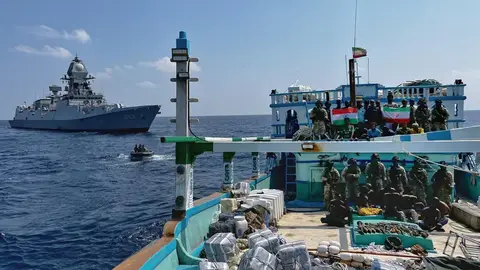
Over the two days, the sessions focus on four areas, the force said. These are smoother coordination between Central and State agencies, stronger institutional mechanisms, faster real-time sharing of intelligence, and closer operational work among all maritime stakeholders. Joint action of this kind already produces results at sea. In September, an ICG operation with the Anti-Terrorism Squad of Gujarat, acting on intelligence inputs, led to a Coast Guard narcotics seizure of around 526 kg of heroin and methamphetamine west of Lakshadweep.
Other sessions take up policy and tactics for coastal surveillance and Maritime Domain Awareness (MDA), the picture of what is moving at sea and along the coast. Community outreach is also on the table, with the ICG seeking to make such programmes a fixed part of the system so that coastal communities share in the watch.
The deliberations are meant to turn policy into action on the ground, the Coast Guard said.
Coast Guard is the lead agency for coastal security
The ICG is the designated lead agency for coordinating coastal security. It carries out that role through sustained surface and air surveillance, coordinated operations, capacity building and community interaction programmes, according to the force. Air surveillance is set to grow, with the Defence Ministry seeking medium altitude long endurance drones for the Coast Guard.
The present arrangement took shape after the November 2008 Mumbai terror attacks, when the attackers came in by sea. In 2009, the Government made the Indian Navy responsible for overall maritime security and gave the Coast Guard charge of coastal security in territorial waters, which extend 12 nautical miles from the shore, including the areas patrolled by the coastal police. The Director General of the Coast Guard also serves as Commander, Coastal Command, and coordinates between Central and State agencies.
The same Centre and State working ties carry over into relief work, as seen during the Coast Guard flood rescue across Daman and South Gujarat in July.
Radar chain along the coast and support for State police
One part of the framework is the Coastal Surveillance Network. It is a chain of static sensors, with radars, Automatic Identification System receivers, day and night cameras and weather sensors at 46 locations, according to the Indian Coast Guard.
The MHA runs the Coastal Security Scheme, which funds coastal police stations, check posts, jetties and interceptor boats for coastal States and Union Territories. Under its first phase, the States and Union Territories received 73 coastal police stations, 97 check posts, 58 outposts and 204 interceptor boats. The Department of Border Management puts India's coastline at 11,098.81 km, including island territories.
Fishers and coastal residents brought into the watch
Sagar Suraksha 2026 places community engagement at the centre of its theme.
The ICG already holds Community Interaction Programmes with fishers and coastal residents at regular intervals. Its teams also carry out boarding operations at sea to check the identity cards and registration documents of those on board fishing vessels, and the force has issued Standard Operating Procedures for coordination among the agencies involved, which are tested through regular exercises.
COMMENTS
JOIN THE DISCUSSION