

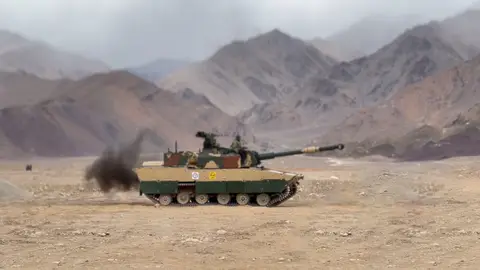
 DEFENCE INDUSTRYTata Zorawar light tank clears Army's L1 hurdle for Rs 20,000 crore contract
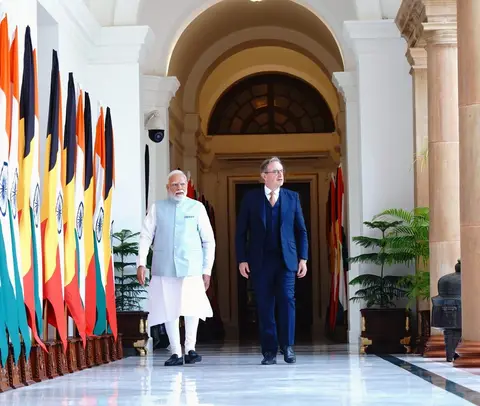 DEFENCE INDUSTRYIndia Belgium Defence Deals Sealed As PM De Wever Visits Delhi
 DEFENCE INDUSTRYAero India 2027 Dates Confirmed for February 8 to 12 in Bengaluru
 DEFENCE INDUSTRYJavelin missile co-production advances as Tata Advanced Systems signs Javelin Joint Venture pact
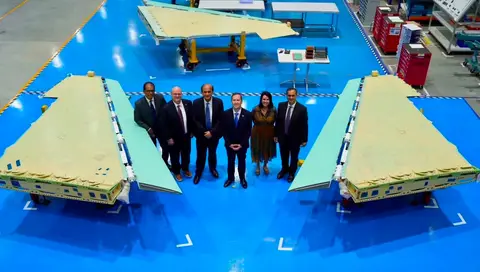 DEFENCE INDUSTRYTata Lockheed Martin MTA push gets a lift from US envoy's Hyderabad visit
The Samudra Pradakshina expedition returned home on 22 July 2026, when Defence Minister Rajnath Singh flagged in the first tri-service all-women circumnavigation over a video link and the Indian Army Sailing Vessel (IASV) Triveni came alongside at Mumbai. Nine women officers drawn from the Army, Navy and Air Force were aboard. Their voyage had run 314 days and covered close to 25,500 nautical miles across four oceans.
Rajnath Singh had flagged the same crew off from Mumbai on 11 September 2025. He watched them come back from Kartavya Bhavan-2 in New Delhi, joining the ceremony through video conferencing, the Ministry of Defence said. Families and veterans gathered at the Gateway of India to receive the crew in person.
https://x.com/SpokespersonMoD/status/2079891497147834461?ref_src=twsrc%5Etfw%7Ctwcamp%5Etweetembed%7Ctwterm%5E2079891497147834461%7Ctwgr%5E2b070f6fc2d119847762a2ca34ca39052e7e4b90%7Ctwcon%5Es1_c10&ref_url=https%3A%2F%2Fpublish.x.com%2F%3Furl%3Dhttps%3A%2F%2Ftwitter.com%2FSpokespersonMoD%2Fstatus%2F2079891497147834461
How the Samudra Pradakshina expedition met the circumnavigation test
A circumnavigation is not a claim a crew can simply assert. IASV Triveni had to cross every meridian of longitude, cross the Equator twice, cross the International Date Line and round the Three Great Capes: Cape Leeuwin, Cape Horn and the Cape of Good Hope. Triveni did all of it, meeting every internationally recognised criterion for a voyage around the world. Four oceans fell behind her before she turned for home, each leg adding to the tally the feat is measured against.
The hardest stretch came at the bottom of the planet. Working Triveni through the Drake Passage and around Cape Horn earned the crew entry into the fraternity of Cape Horners, a distinction kept for sailors who get past one of the most punishing sea routes there is. Rajnath Singh said the expedition had proved that human courage runs deeper than any storm. "Ocean waves may rise high, but the spirit of India's daughters soars higher," he said, adding that the country's women were now leading from the front and writing themselves into the record books.
A tri-service crew on one deck
The expedition put Army, Navy and Air Force officers on a single mission, planned together and run together. For more than ten months the nine lived, trained and sailed as one crew. The preparation behind that stretched to nearly two years of training, backed by a shore support network that stayed on call around the clock and the work of a long list of support agencies.
Rajnath Singh tied the achievement to the wider push for jointness across the services. Capability multiplies when the forces coordinate, he argued, at a time when militaries everywhere are debating joint operations, integrated commands and multi-domain warfare. "Victory paves its own path when the three forces march together," he said. He cast the voyage as a crew united by a single flag and a single objective, carrying a message that India's strength rests on its unity.
IASV त्रिवेणी आत्मनिर्भर भारत की जीवंत पहचान है। इस स्वदेशी पोत ने विश्व भर के समुद्रों में भारत की Technological Capability, Innovation और Strategic Confidence का परिचय दिया है। यह हमारी Engineering Excellence, Indigenous Capability और Strategic Confidence का सशक्त प्रतीक है। pic.twitter.com/aDNI4vwoGQ
— Rajnath Singh (@rajnathsingh) July 22, 2026
IASV Triveni and the Aatmanirbhar Bharat pitch
Triveni is an indigenously built 50-foot sailing vessel, and the Defence Minister held it up as an example of Aatmanirbhar Bharat. He called the boat a mark of the country's engineering, its self-reliance in building such a craft, and the confidence to send it around the world. The vessel is operated by the Indian Army, which runs the sailing programme the crew came through.
A floating ambassador on the port-call circuit
Beyond the sailing, the Samudra Pradakshina expedition worked as an exercise in military diplomacy. At ports across the globe the crew showed off Indian culture, maritime tradition and service professionalism, and built goodwill with host nations. Rajnath Singh described Triveni as a floating ambassador and said the calls had added to the country's soft power, according to the official release. The voyage follows other recent Indian sail deployments overseas, among them INS Sudarshini's transoceanic run through a string of American ports.
Who marked the homecoming
The flag-in at Kartavya Bhavan-2 drew the top of the military. Chief of Defence Staff Gen NS Raja Subramani, Chief of the Naval Staff Adm Krishna Swaminathan, Chief of the Army Staff Gen Dhiraj Seth and Vice Chief of the Air Staff Air Mshl Ashutosh Dixit were present, along with Director General Integrated Training Lt Gen Ajay Ramdev. Defence delegates from Australia, New Zealand, Argentina and South Africa sat in as well. They had joined the Defence Minister for the flag-in over the video link to the ship at Mumbai.
At the Gateway of India the welcome fell to the western establishment. General Officer Commanding-in-Chief, Southern Command Lt Gen Rajesh Pushkar, Air Officer Commanding-in-Chief, South Western Air Command Air Mshl PV Shivanand, Deputy Chief of Army Staff Lt Gen Vipul Singhal and Chief of Staff, Western Naval Command Vice Adm Rahul Vilas Gokhale were among those who met the crew as Triveni came in. Veterans and the officers' families stood on the apron to watch them step ashore.

COMMENTS
JOIN THE DISCUSSION