

 DEFENCE INDUSTRYSMPP Drone Manufacturing Push: Firm Shifts From Ammunition to Unmanned Warfare, Targets Integrated Defence Capabilities
 INDIA DEFENCEDhruv NG Helicopter Explained: What HAL Has Actually Put Into Pawan Hans Service
 INDIA DEFENCELCA FOC Trainers Delivered With HTT 40 and Dhruv NG as Rajnath Singh Asks Engineers for Technologies That Do Not Exist
 DEFENCE INDUSTRYTata Zorawar light tank clears Army's L1 hurdle for Rs 20,000 crore contract
 DEFENCE INDUSTRYIndia Belgium Defence Deals Sealed As PM De Wever Visits Delhi
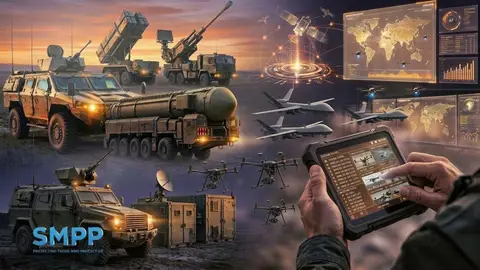
Unmanned platforms will perform missions ranging from border surveillance and reconnaissance to precision strike, electronic warfare and battlefield assessment, said Ashish Kansal, CEO of Indian defence manufacturer SMPP, as the company expands beyond ammunition and ballistic protection into drones, loitering munitions, counter-drone systems and other integrated battlefield capabilities.
Mr. Kansal said long-endurance drones, High Altitude Platforms (HAPs), Remotely Piloted Aircraft (RPAs) and autonomous strike systems would provide commanders greater operational flexibility while reducing risks to personnel.
SMPP drone manufacturing facility in Delhi and Bengaluru
Mr. Kansal also said the company is setting up "a state-of-the-art drone manufacturing facility, which will be split between Delhi and Bengaluru."
The SMPP drone manufacturing expansion comes as the company seeks to build capabilities across what it sees as critical technologies for future warfare and contribute to India's push for self-reliance in defence manufacturing under Aatmanirbhar Bharat.
KNDS partnership on loitering munitions and ISTAR drones
In June 2026, SMPP partnered with European defence major KNDS to manufacture the VELOCE and RODEUR loitering munitions, often referred to as kamikaze drones, and ISTAR (Intelligence, Surveillance, Target Acquisition and Reconnaissance) drone systems in India. The partnership followed a 2025 agreement between the two companies for local manufacture of the KNDS KATANA family of 155 mm precision-guided artillery ammunition.
Mr. Kansal said the company's move into unmanned systems was an extension of capabilities built over several decades. "Ultimately, our aim is to deliver integrated solutions combining protection, surveillance and precision engagement under one ecosystem," he said.
From pulp moulding to defence manufacturing
SMPP, originally incorporated as S.M. Pulp Packaging Private Limited in Sangrur, Punjab, in 1985, was founded by Mr. Kansal's father, Dr. Shiv Chand Kansal. A chemical engineer with an M.Tech and PhD specialising in cellulose technology, Dr. Kansal initially built the business around cellulose pulp moulding, including products such as egg and fruit trays.
The company entered the defence sector after its work on a zero-pollution pulp moulding process attracted the attention of the Defence Research and Development Organisation (DRDO).
The company was subsequently asked to develop combustible cartridge cases for ammunition.
SMPP developed a workable prototype in 15 days against a six-month deadline and became the first private-sector manufacturer of combustible cartridge cases in India. In 1991, it received a licence to manufacture ammunition, bullet-proof vests, vehicle armour and aircraft armour.
A major milestone came in 1998 when the Ministry of Defence awarded the company the National Award for Indigenisation for tank ammunition.
Bullet-resistant jackets and lightweight armour
By 2008, SMPP had developed its own boron carbide ceramic production capability and manufactured its first ballistic plate in-house. The technology subsequently became a key component of its bullet-resistant jackets and lightweight armour systems.
In 2018, the Ministry of Defence awarded the company a multi-year contract for more than 1.86 lakh bullet-resistant jackets. SMPP said it delivered its 1,00,000th jacket four months ahead of schedule in 2021. The company has since extended its lightweight armour technology to protection panels for helicopters and aircraft.
Mr. Kansal said SMPP's expansion into unmanned and precision systems was aimed at building on this existing defence manufacturing base while creating a wider ecosystem spanning protection, surveillance and precision engagement.



COMMENTS
JOIN THE DISCUSSION