

 MINISTRY OF DEFENCEBDL single tender for anti-tank missile sights goes to firm set up by former CMD Siddharth Mishra
 DEFENCE INDUSTRYBrahMos export orders: Vietnam deal worth about $100 million, Indonesia $200 million as Akash reaches Tajikistan, Turkmenistan
 DEFENCE INDUSTRYMahindra Embraer Nagpur facility to assemble C-390 if IAF picks the aircraft
 DEFENCE INDUSTRYSMPP Drone Manufacturing Push: Firm Shifts From Ammunition to Unmanned Warfare, Targets Integrated Defence Capabilities
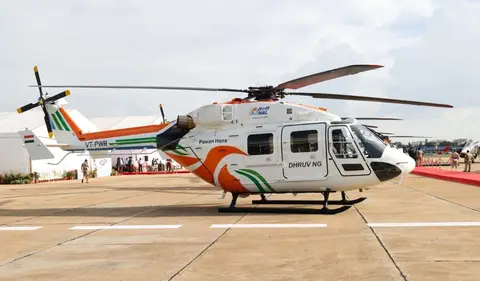 INDIA DEFENCEDhruv NG Helicopter Explained: What HAL Has Actually Put Into Pawan Hans Service
Defence Minister Rajnath Singh at ADMM-Plus in Cebu, Philippines, said on Thursday that India is ready to share its battle-tested counter-terrorism expertise with partner nations to strengthen their joint capabilities.
Addressing the 13th ASEAN Defence Ministers' Meeting-Plus, he said India remains committed to collective regional security and to eradicating terrorism at its roots. According to the Ministry of Defence, the address also carried a proposal for an India-ASEAN Youth Bridge and a reaffirmation of India's support for ASEAN centrality.
Singh said India's counter-terrorism record was built in the field. "India's experience in the field of counter-terrorism is not limited to classroom learning or theoretical knowledge. Rather, it has been gained through decades of confronting cross-border security challenges on the ground," he said.
Rajnath Singh at ADMM-Plus cites Operation Sindoor
Every strategy India employs against terrorism, he added, has been tested and proven in real operations.
Operation Sindoor was the example he chose. "We demonstrated a major example of India's approach to combating terrorism during Operation Sindoor last year, when we destroyed a large number of terrorist infrastructure sites," the Defence Minister said. He described the operation as a clear declaration of India's stance against state-sponsored terrorism.
The offer to partners was practical. Singh named three routes for sharing that experience: joint military exercises, capacity-building programmes and robust intelligence sharing. "Through joint military exercises, capacity-building programmes and robust intelligence sharing, we can further strengthen our collective capabilities," he said. India supports an Indo-Pacific that is secure and resilient, he said, where peace and stability are the outcome of collective efforts rather than mere aspirations.
India co-chairs the ADMM-Plus Experts' Working Group on Counter-Terrorism with Malaysia for the 2024-27 cycle.
Defence Minister opens with condolences to Philippine Air Force
Singh began his address by expressing grief over the 23 October aircraft crash in the Philippines that killed four Philippine Air Force pilots. "In this hour of sorrow, India stands in complete solidarity with the Armed Forces of the Philippines and the bereaved families," he said.
India proposes India-ASEAN Youth Bridge
The second proposal from Rajnath Singh at ADMM-Plus was aimed at young people. He said the India-ASEAN Youth Bridge would foster people-to-people connectivity, digital innovation and capacity building.
"India believes that our greatest strength lies in our young population, in their energy, dynamism, and aspirations," he said. India and the ASEAN nations both have relatively young populations, he noted, and that common feature links the futures of the two sides. He said the aim of empowering the next generation is also reflected in the joint statement of the meeting. Several ASEAN members, including Vietnam, Indonesia, Timor-Leste and the host Philippines, have young populations.
ASEAN centrality stays at the core of Act East Policy
Singh reaffirmed India's commitment to ASEAN centrality, which he called a cornerstone of the Act East Policy and of India's Indo-Pacific vision. "We envision an Indo-Pacific region that is open, inclusive, and based on a rules-based international order," he said, adding that India's long-term engagement with ASEAN rests on shared interests, mutual respect and practical cooperation. He thanked the Philippines for hosting the meeting.
Five bilateral meetings held in Cebu on Wednesday
A day before the address, Singh met defence leaders from five countries on the sidelines.
With the Philippines' Secretary of National Defense Gilberto Teodoro Jr, he reviewed defence cooperation and discussed widening the strategic partnership, with a focus on maritime security and joint defence production. With South Korea's Defence Minister Kang Shin-chul, he discussed ways to co-develop military technologies and improve security in the Indo-Pacific.
His meeting with Japan's Minister of Defense Shinjiro Koizumi reviewed progress since the two last met in August. In his talks with US Secretary of War Pete Hegseth, the two sides reviewed the India-US Major Defence Partnership. According to the ministry, counter-terrorism featured prominently, with Singh calling for a zero-tolerance approach towards nations that support, train or fund terrorist groups, and Hegseth reaffirming US solidarity with India against cross-border terrorism.
With Australia's Deputy Prime Minister and Defence Minister Richard Marles, Singh reviewed cooperation, military interoperability and regional security under the India-Australia Comprehensive Strategic Partnership. He invited Marles to Aero India 2027 in Bengaluru in February 2027.
On Thursday, Singh posted a photograph of himself with Koizumi and Marles, captioned JAI: Japan, Australia, India.
ADMM-Plus brings ASEAN and eight Dialogue Partners together
The ADMM-Plus groups the 11 ASEAN member states with eight Dialogue Partners: India, the United States, China, Russia, Japan, South Korea, Australia and New Zealand. Its first meeting was held in Hanoi in 2010, and the ministers have met every year since 2017. The Philippines holds the chair in 2026, and the Cebu meeting opened on Wednesday with Singh leading the Indian delegation, as announced by the ministry earlier in the week.
At the previous edition in Kuala Lumpur on 1 November 2025, Singh addressed the forum on 15 years of ADMM-Plus.
COMMENTS
JOIN THE DISCUSSION