

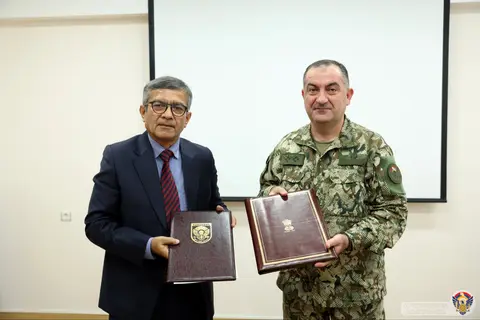
 DEFENCE INDUSTRYBrahMos export orders: Vietnam deal worth about $100 million, Indonesia $200 million as Akash reaches Tajikistan, Turkmenistan
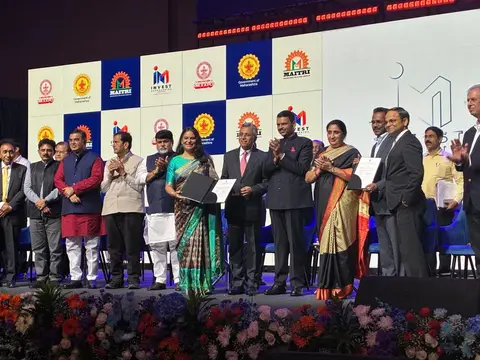 DEFENCE INDUSTRYMahindra Embraer Nagpur facility to assemble C-390 if IAF picks the aircraft
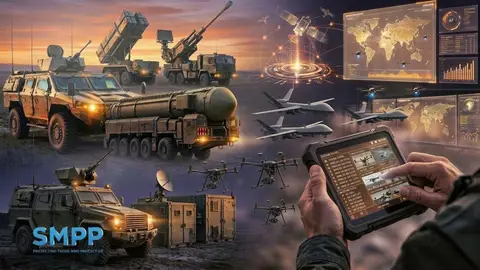 DEFENCE INDUSTRYSMPP Drone Manufacturing Push: Firm Shifts From Ammunition to Unmanned Warfare, Targets Integrated Defence Capabilities
 INDIA DEFENCEDhruv NG Helicopter Explained: What HAL Has Actually Put Into Pawan Hans Service
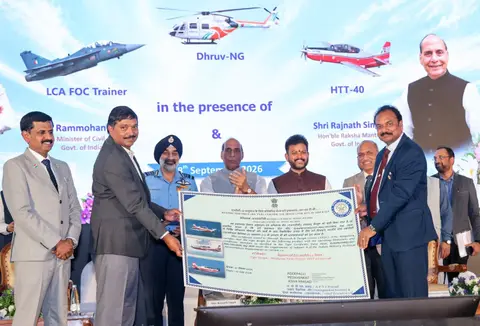 INDIA DEFENCELCA FOC Trainers Delivered With HTT 40 and Dhruv NG as Rajnath Singh Asks Engineers for Technologies That Do Not Exist
Shangri-La Dialogue India 2026: Defence Secretary Singh Holds Talks With USINDOPACOM Chief and NATO Military Committee Chair
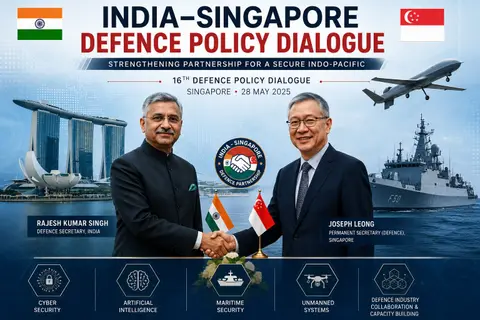
The Shangri-La Dialogue India engagements this year placed New Delhi at the centre of the most consequential defence conversations happening in the Indo-Pacific, with Defence Secretary Rajesh Kumar Singh completing a series of high-level bilateral meetings in Singapore that advanced India's relationships with both the United States military command structure and the senior leadership of the NATO Military Committee. The meetings, held on the sidelines of Asia's premier defence forum, covered military cooperation, emerging security threats and the shared interest in maintaining a stable regional order.
Singh Meets Admiral Paparo as Shangri-La Dialogue India-US Ties Advance
Defence Secretary Singh met Admiral Samuel J. Paparo, Commander of the United States Indo-Pacific Command, with both sides reviewing the current state of military-to-military cooperation and identifying concrete areas for further deepening of defence collaboration across the Indo-Pacific theatre. Admiral Paparo commands the largest of the US combatant commands by area of responsibility, and his engagement with the Indian Defence Secretary at this level reflects the operational seriousness with which Washington now treats the bilateral defence relationship.
India-US defence ties have expanded across multiple tracks in recent years, driven by joint exercises, operational coordination, defence technology initiatives and strategic consultations at senior levels. Programmes such as Tiger Triumph, Yudh Abhyas and the Malabar naval exercise have built practical interoperability between the two countries' armed forces, while foundational agreements covering logistics, communications security and industrial cooperation have created the structural framework for a partnership that goes well beyond occasional exercises. The Singapore discussion built on that foundation, with both sides focused on emerging security challenges and the need for closer coordination to maintain stability across a region that spans from the eastern Indian Ocean through the South China Sea and into the broader Pacific.
India's Ministry of Defence confirmed that the meeting reaffirmed the shared commitment of New Delhi and Washington to deepening strategic defence cooperation and enhancing interoperability between their armed forces. For India, interoperability is no longer an aspirational goal. It is a working reality being built exercise by exercise, deployment by deployment, and the Paparo meeting was one more step in that direction.
India Engages NATO Military Committee on Emerging Threats
Defence Secretary Singh also held talks with Admiral Giuseppe Cavo Dragone, Chair of the NATO Military Committee, in an engagement that drew attention from security analysts watching India's expanding circle of strategic partnerships. The two sides exchanged views on evolving global and regional security developments, covering a range of challenges that now extend well beyond any single region or traditional threat category.
India's engagement with NATO at this level is a product of shifting security realities on both sides. For India, the ability to hold direct, substantive conversations with the NATO Military Committee on questions of maritime security, counter-terrorism, cyber threats and the governance of emerging technologies serves a clear national interest, without requiring any formal alignment or compromise of the independent foreign policy approach that has guided Indian statecraft across decades. For NATO, engaging a country of India's military weight, geographic position and growing industrial capacity is an obvious priority as the alliance broadens its strategic focus beyond the Euro-Atlantic theatre.
The conversation in Singapore comes at a moment when technology-driven threats, grey-zone operations and great power competition are changing the security calculus across multiple regions at the same time. India's decision to engage the NATO Military Committee chair directly at the Shangri-La Dialogue, in full view of the assembled defence community, was a deliberate signal about the range of partnerships New Delhi is willing to cultivate and the confidence with which it now manages those relationships.
India Outlines Indo-Pacific Vision to Singapore's Strategic Community
Beyond the bilateral meetings, Defence Secretary Singh held discussions with leading strategic thinkers, policy experts and academic institutions in Singapore, using the platform to set out India's vision for a stable, secure and inclusive Indo-Pacific. He pointed to the growing importance of defence industrial partnerships, technological cooperation and resilient regional security architectures as pillars of that vision. Singapore functions as one of the most important nodes in the Indo-Pacific's security and diplomatic network, and conversations held at the margins of the Shangri-La Dialogue carry weight in capitals from Jakarta to Tokyo to Canberra. India's sustained presence at the forum over multiple years has built a working understanding of New Delhi's strategic priorities among the analysts, officials and academics who shape policy thinking across the region.
India's Active Role at the IISS Forum Reflects Broader Strategic Direction
The Shangri-La Dialogue, organised annually by the International Institute for Strategic Studies, brought together defence ministers, military commanders and senior security officials from across the world for the 2026 edition. India's participation at Defence Secretary level, combined with the range and quality of the bilateral engagements completed in Singapore, placed New Delhi among the most active participants at this year's forum.
India has worked steadily to establish itself as a net provider of stability in the Indian Ocean Region and a credible partner across the wider Indo-Pacific security framework. The Singapore engagements advance that positioning in operational terms, pairing diplomatic presence with direct conversations on military cooperation, technology and the management of shared security spaces. Both the USINDOPACOM meeting and the NATO Military Committee engagement demonstrate that major powers and leading security institutions now seek out India's participation at the table, not as a courtesy but as a practical requirement for any serious discussion of Indo-Pacific security.
The meetings also track with the Government of India's sustained emphasis on expanding defence diplomacy, strengthening strategic partnerships and advancing national interests through a combination of military capability, economic weight and international engagement. India is simultaneously deepening ties with Washington, engaging NATO institutions, participating in the Quad alongside Australia, Japan and the United States, and maintaining its own bilateral relationships across the Indo-Pacific, the Gulf and Europe. What the Shangri-La Dialogue 2026 engagements make clear is that this approach is producing results, opening doors and earning India the kind of strategic regard that translates into real security outcomes.
COMMENTS
JOIN THE DISCUSSION