

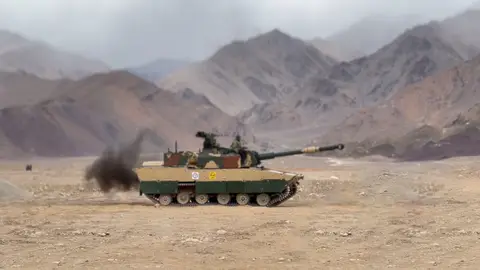
 DEFENCE INDUSTRYTata Zorawar light tank clears Army's L1 hurdle for Rs 20,000 crore contract
 DEFENCE INDUSTRYIndia Belgium Defence Deals Sealed As PM De Wever Visits Delhi
 DEFENCE INDUSTRYAero India 2027 Dates Confirmed for February 8 to 12 in Bengaluru
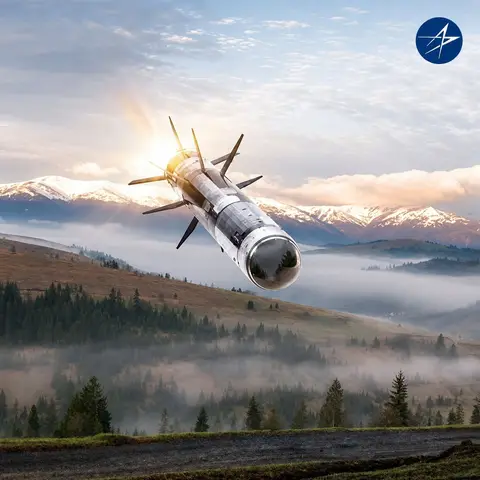 DEFENCE INDUSTRYJavelin missile co-production advances as Tata Advanced Systems signs Javelin Joint Venture pact
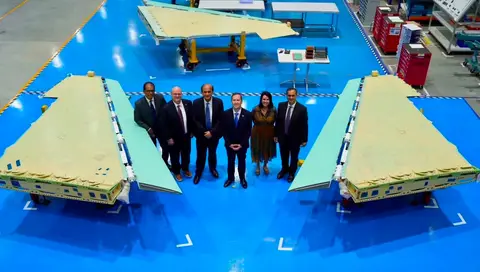 DEFENCE INDUSTRYTata Lockheed Martin MTA push gets a lift from US envoy's Hyderabad visit
S-400 Air Defence Fourth Squadron Arrives in India with AI-Enabled Targeting, Changing How the System Fights
India's fourth S-400 air defence squadron arrived from Russia in May, and what makes this delivery different from the three that came before it is not the hardware. It is what is running on top of the hardware. For the first time in Indian service, the S-400 will be integrated with AI-enabled decision-support capabilities that change how operators interact with the system during a live threat environment. The fourth squadron is not simply more of the same. It is the same platform operating in a fundamentally different way.
Three squadrons are already in service. The fourth is now in hand. The fifth is confirmed for 2027, completing a $5.43 billion contract signed between India and Russia in 2018 for five regimental systems. Deliveries had slipped because of disruptions caused by the Russia-Ukraine conflict, but officials confirmed the programme is back on schedule and the 2027 timeline for the final unit is firm. The contract is approaching its conclusion, and the fleet it is building is more capable with each unit that arrives.
How AI Is Changing the S-400 Air Defence System's Decision Loop
The AI-enabled layer being integrated into the fourth S-400 air defence squadron is not autonomous. It does not make engagement decisions. What it does is compress the time between a threat appearing on screen and an operator being ready to respond to it, and that compression matters enormously in the kind of aerial threat environment these systems are built for.
Senior defence officials described how the capability works. Every incoming aerial target is displayed to the operator as before. The AI layer analyses each target in real time, classifies it by threat category, and provides a prioritised recommendation for engagement based on the nature of what is incoming. The operator sees not just what is there but what the system judges to be the most urgent threat and why. The final call stays with the operator at every stage.
"AI-enabled targeting will assist operators in identifying and prioritising aerial threats. All incoming targets will be displayed on the system, and AI will provide recommendations based on the nature of the threat. However, the final engagement decision will remain with the operator," a senior official said.
The categories the AI layer is designed to distinguish between include ballistic missiles, combat aircraft, cruise missiles, and drones. Each of these threats has a different profile, a different flight path, a different speed, and demands a different interceptor response. In a scenario where several of these threat types are incoming simultaneously, an unaided operator faces a cognitive task that the time available may not permit. The AI layer sequences that task. It does not replace the operator's judgement. It gives the operator a head start.
The downstream effect, officials said, is more efficient use of interceptor missiles. A system that wastes interceptors on lower-priority threats while higher-priority ones close in is a system that loses engagements it should win. The AI-enabled targeting integration addresses exactly that failure mode. It is a software answer to a problem that more missiles alone cannot solve.
Operation Sindoor Showed What the S-400 Can Do and What More It Needs
The fourth squadron arrives after the S-400 was tested in conditions that no exercise can replicate. During Operation Sindoor, India's military response to the Pahalgam terrorist attack, the S-400 contributed directly to the country's air defence posture throughout the conflict. Officials said the platform was instrumental in countering aerial threats and demonstrated its long-range engagement capabilities under live operational pressure. That record now exists. The S-400 is no longer a system India operates in theory.
What Operation Sindoor also did was show planners exactly what the system's limitations look like under real conditions. Running three squadrons through an actual conflict produces a level of operational feedback that years of exercises cannot match. The decision to integrate AI-enabled targeting into the fourth squadron did not emerge from a procurement document written before the system was ever tested. It emerged from an understanding, sharpened by recent operational experience, of where the human decision-making loop under pressure is slowest and where technology can close that gap.
The performance during Operation Sindoor has reinforced confidence in the platform at the senior levels of the Air Force and the Ministry of Defence. The Defence Acquisition Council's approval of proposals to expand India's long-range air defence inventory reflects that confidence directly. The question after Operation Sindoor was not whether the S-400 was worth having. It was how to make the system that proved its worth even more capable for whatever comes next. The AI-enabled targeting integration in the fourth squadron is part of the answer to that question.
AI-Enabled Targeting: The Operational Edge in a Saturated Threat Environment
Air defence planners have long understood that the hardest problem in intercepting aerial threats is not finding the missiles to fire. It is knowing which threat to fire them at first, and knowing that fast enough. A saturated attack, where multiple threat types arrive from multiple directions within overlapping time windows, is designed to overwhelm exactly that decision process. The AI-enabled layer being integrated into India's S-400 air defence system is a direct response to that problem. By classifying and sequencing threats automatically, it gives Indian operators the decision quality of a well-rested analyst with unlimited time, delivered in the seconds that a live engagement actually allows. That is the operational edge the fourth squadron carries that the first three did not.
Sudarshan Chakra and the Indigenous Future Running in Parallel
The S-400 inductions are one track. Running alongside them is India's effort to build an indigenous integrated air defence ecosystem under the Sudarshan Chakra initiative. This programme represents India's long-term answer to the question of how the country sustains and eventually replaces its dependence on foreign-origin air defence systems. The Aatmanirbhar Bharat framework is the governing logic, and the government has been consistent in its commitment to the programme.
The two tracks are not in tension. Operating world-class imported systems is how India develops the institutional knowledge to design and build their replacements. The AI-enabled targeting integration now arriving with the fourth S-400 squadron is itself a data point for that process. Indian engineers and operators gaining experience with AI-assisted threat prioritisation on the S-400 are building expertise that will inform how Sudarshan Chakra's indigenous systems are designed. The imported platform teaches while it protects.
India's pattern in defence development has consistently followed this logic. Operate the foreign platform, absorb what it teaches, apply those lessons to the domestic programme. It has worked in other domains over time, and the air defence sector is following the same arc. The S-400 fleet is not the end state. It is a stage in a longer journey, and Sudarshan Chakra is where that journey is headed.
Fifth S-400 Air Defence Squadron Confirmed for 2027 as Contract Nears Completion
The $5.43 billion, five-squadron contract is one unit away from completion. The fourth S-400 air defence squadron is in India. The fifth is confirmed for 2027. Russia has maintained its delivery commitment through a period of considerable strain on its defence industrial base, and Indian officials have expressed confidence in the remaining timeline. When the fifth squadron arrives, India will hold a long-range air defence fleet of five units, all networked into a national air defence architecture, with AI-enabled decision-support running on the most recently inducted platforms.
The fleet that completion of this contract delivers is not just larger than what India had in 2018 when the agreement was signed. It is more capable in ways that were not part of the original specification. The AI-enabled targeting layer now arriving with the fourth S-400 air defence squadron represents exactly the kind of progressive enhancement that keeps a platform relevant as the threat environment evolves. India's air defence network is stronger today than it was last month, and 2027 will make it stronger still.
Details of the AI-enabled targeting integration and delivery timeline were reported by ET Manufacturing. Broader coverage of the S-400 induction programme has been carried by The Times of India. Background on India's indigenous defence development programmes is available through the Defence Research and Development Organisation.



COMMENTS
JOIN THE DISCUSSION