

 DEFENCE INDUSTRYBrahMos export orders: Vietnam deal worth about $100 million, Indonesia $200 million as Akash reaches Tajikistan, Turkmenistan
 DEFENCE INDUSTRYMahindra Embraer Nagpur facility to assemble C-390 if IAF picks the aircraft
 DEFENCE INDUSTRYSMPP Drone Manufacturing Push: Firm Shifts From Ammunition to Unmanned Warfare, Targets Integrated Defence Capabilities
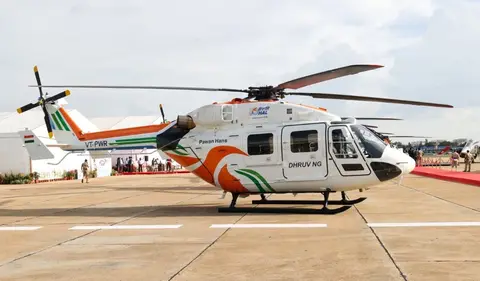 INDIA DEFENCEDhruv NG Helicopter Explained: What HAL Has Actually Put Into Pawan Hans Service
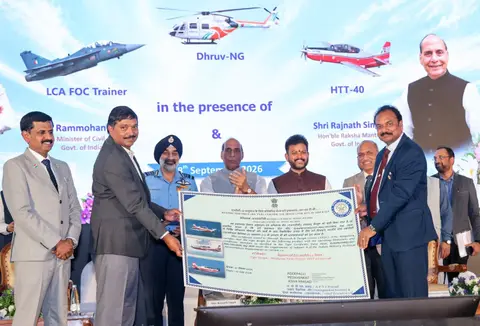 INDIA DEFENCELCA FOC Trainers Delivered With HTT 40 and Dhruv NG as Rajnath Singh Asks Engineers for Technologies That Do Not Exist
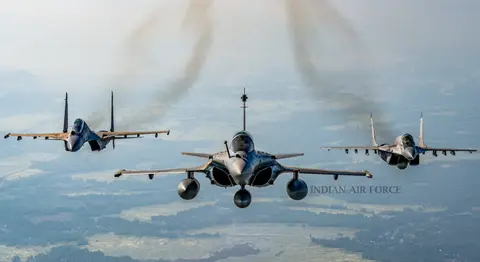
Exercise Pitch Black 2026 opens on 20 July, and the Indian Air Force will be flying in it. Canberra confirmed as much on Thursday, listing India among the twelve nations sending aircraft rather than the seven sending embedded personnel. That distinction is the whole story for an Indian reader. Ferrying fighters to the Northern Territory and sustaining them there for three weeks is a different order of commitment from putting a liaison officer in a planning cell at Darwin.
India has now made the trip four times in eight years.
What Exercise Pitch Black 2026 puts over the Top End
The exercise runs to 7 August across three bases, Darwin and Tindal in the Northern Territory and Amberley in Queensland. Up to 100 jets, more than 2,500 personnel, twenty nations by Canberra's Thursday count.
The company matters for what the IAF will be flying against. The United States, Japan, the Republic of Korea, Singapore, Germany, France and Spain are all sending aircraft, alongside Indonesia, the Philippines, Thailand and Papua New Guinea. Japanese Air Self-Defense Force F-35s appear at Pitch Black for the first time. So do Indonesian T-50I Golden Eagles. New Zealand, Fiji, Canada, Brunei, Malaysia, Finland and Sweden are sending people rather than airframes.
The RAAF's own exercise page still carries nineteen nations and over 100 aircraft against Thursday's twenty and up to 100, and lists the United Kingdom where the release lists Germany. Contingent lists move until the aircraft are on the ramp.
The 2018 package is the benchmark
The last time the IAF published a full account of what it took to Darwin, the numbers were these. One hundred and forty five air warriors, assembled at Air Force Station Kalaikunda. A Garud commando team among them. Four Su-30MKI. One C-130 and one C-17 carrying the induction and de-induction lift, because a fighter deployment at that distance is a transport problem before it is a flying problem. Gp Capt CUV Rao led it. The contingent staged through Indonesia on 19 July and flew day and night missions out of Darwin.
The Su-30MKI went back in 2024, staging through Halim again.
The tanking lesson
The most useful thing that happened in 2018 had nothing to do with air combat. Su-30MKI crews took fuel from a RAAF KC-30A for the first time, which for a fleet that had spent its entire service life plugging into Il-78s was a genuine first. Tanker interoperability is unglamorous and it is exactly the sort of thing that only gets sorted out at exercises like this one.
The IAF's own published exercise record shows Darwin has become a fixture rather than an experiment. India flew the 2018, 2022 and 2024 editions and returns for the fourth.
Melbourne put this exercise on paper
Pitch Black 2026 is the first edition to fall under the renewed Joint Declaration on Defence and Security Cooperation signed in Melbourne this month. The text names Pitch Black explicitly among the activities both sides want run at higher complexity, and commits India and Australia to expanding aircraft deployments from each other's territory.
Which is a commitment that gets tested at Darwin rather than in a communique. The declaration's language about expanded deployments only means something if what lands in the Northern Territory this month stretches beyond what landed there in 2018.
What the Northern Territory airspace buys
The draw is the sky. The Northern Territory training airspace has no equivalent available to the IAF at home, and the exercise takes its name from night operations flown over terrain with almost nobody living under it. Large force employment at that scale is not reproducible at Kalaikunda or Jodhpur.
Australia has been running this since 1983, when Mirage IIIs and F-111Cs flew the first iteration out of Darwin with the Americans. It has been biennial since 1988. More than twenty nations have made the trip over the exercise's life.
Air Cmde Matthew McCormack commands the exercise. Public flying displays follow at Mindil Beach on 23 July and RAAF Base Darwin on 1 August.
India's July is crowded
The Darwin deployment is not the only multinational commitment India is running this month. The Navy has a P-8I and its crew at Pearl Harbor for the sea phase of RIMPAC 2026, where an Indian officer is holding a theatre-level anti-submarine warfare task force role for the first time. Two services, two oceans, two sets of partners, inside the same four weeks.
The IAF also arrives at this edition with more in the shed than it had in 2018. The Netra AEW&C received Final Operational Clearance in June, giving the service an indigenous airborne early warning asset cleared for combat without limits. Eight years ago the Darwin package was fighters and transports.
The exercise was announced in May. Flying starts Monday.
COMMENTS
JOIN THE DISCUSSION