

 DEFENCE INDUSTRYTata Zorawar light tank clears Army's L1 hurdle for Rs 20,000 crore contract
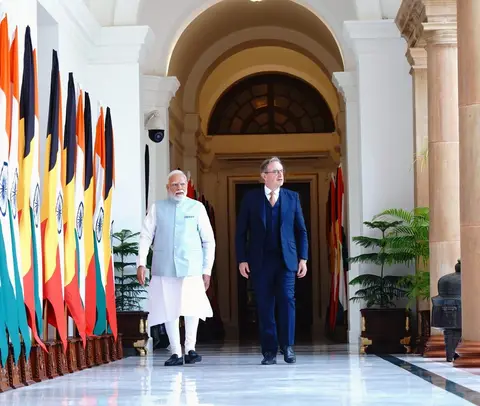 DEFENCE INDUSTRYIndia Belgium Defence Deals Sealed As PM De Wever Visits Delhi
 DEFENCE INDUSTRYAero India 2027 Dates Confirmed for February 8 to 12 in Bengaluru
 DEFENCE INDUSTRYJavelin missile co-production advances as Tata Advanced Systems signs Javelin Joint Venture pact
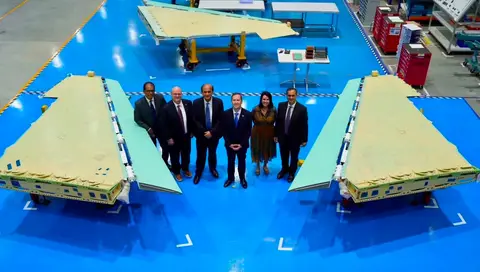 DEFENCE INDUSTRYTata Lockheed Martin MTA push gets a lift from US envoy's Hyderabad visit
The Vikram-1 orbital launch carried Skyroot Aerospace into low Earth orbit on Saturday, making the Hyderabad start-up the first private Indian company to put a rocket into orbit. The vehicle lifted off from the First Launch Pad at the Satish Dhawan Space Centre in Sriharikota and, about fifteen minutes later, injected its payloads into a roughly 450 kilometre orbit. Skyroot called the mission, named Aagaman, a grand success.
Mission Aagaman lifts off from Sriharikota
Liftoff came a little after noon. The flight had been set for 11.30 am and was held briefly when the count was stopped, then resumed, and Vikram-1 climbed away from the pad that has served India's national space programme for decades. Skyroot said the vehicle validated its propulsion, avionics, telemetry and guidance in flight while gathering data for future commercial missions.
Aagaman means arrival in Sanskrit. This was Test Flight-1, Skyroot's first bid for orbit and only its second launch of any kind, after the suborbital Vikram-S in 2022.
Chief executive Pawan Kumar Chandana, who co-founded Skyroot in 2018 with Naga Bharath Daka, both former ISRO engineers, said the team had done everything it could on the ground and wanted to see how the rocket behaved in real flight. After the mission he called it a historic moment for India and said reaching orbit on the first attempt still felt like a dream. Earlier in the year the company became the first Indian space firm to be valued at a billion dollars.
Skyroot first drew wide attention in 2022, when Vikram-S became the first privately developed Indian rocket to reach space on a suborbital hop. Chandana has said about 80 percent of the technologies flying on Vikram-1, from its carbon-composite structures to its avionics, were first proven on that earlier flight.
We’ll be watching this ignition on loop all day.
— Skyroot Aerospace (@SkyrootA) July 18, 2026
Kalam-1200 — Vikram-1's first stage, named for Dr. A.P.J. Abdul Kalam — roaring to life and lifting Vikram-1 off the pad, on a flight that reached orbit.#Vikram1 #MissionAagaman pic.twitter.com/ul9wlY8LzH
What the Vikram-1 orbital launch changes for private space
India opened its space sector to private launch companies in 2020. Six years on, the Vikram-1 orbital launch is the first time a privately developed Indian rocket has reached orbit rather than the edge of space.
Skyroot and the Indian Air Force both described the result as making India the third country in the world with a private orbital launch capability, a framing that wire agencies also carried. The company now wants to sell dedicated small-satellite launches, a market long held by a handful of foreign operators.
There is a commercial logic behind the celebration. Chandana has pointed again and again to a shortage of rockets against a lengthening queue of satellites waiting for a ride, and Skyroot means to build one orbital rocket a month from its two Hyderabad campuses.
How the rocket is built
Vikram-1 stands about 22 metres tall and is built largely from carbon composite. It uses three solid-fuel stages topped by a liquid-fuelled orbital adjustment module, whose engine is 3D printed, to place satellites precisely once the vehicle is in space. The launcher is designed to carry payloads of up to 350 kilograms to low Earth orbit, and is pitched as an on-demand ride for the small-satellite market.
The payloads on board
A test flight, but not an empty one. Aagaman carried a mix of customer satellites and hosted experiments. Skyroot flew its own SCOPE cubesat and a satellite from the Indian start-up Grahaa Space, while Germany's Dcubed sent up a technology demonstration and the Indian firm Cosmoserve Space contributed a robotic arm designed to capture debris in orbit.
Some of the cargo was there to be remembered rather than tested. Among the items flown to orbit were a floral artwork, a miniature 18-carat gold rocket honouring Indian scientific pioneers, and a handwritten Vande Mataram postcard from Prime Minister Narendra Modi.
The reforms behind the launch
The launch was authorised by IN-SPACe, the single-window agency the government created to clear and oversee private space activity, with support from ISRO, which opened its Sriharikota range and facilities to the company. It was IN-SPACe that first authorised a private Indian launch vehicle back in 2022, when Skyroot flew Vikram-S.
PM Modi congratulated the Skyroot team after the flight and, in the hours before it, had urged Indians to follow the mission. Skyroot thanked the Prime Minister in turn and credited the space-sector reforms for opening the door to private launch firms.
The government has set out large ambitions here, projecting India's space economy to grow from about 8 billion dollars today toward 40 to 45 billion dollars by 2030, and 100 billion by 2040. IN-SPACe has said it received more than 150 applications from private space entities in the years after it opened.
The Indian Air Force joins in
The Indian Air Force added its own message. In a post on X, the IAF congratulated Skyroot on the Vikram-1 launch and called it another step towards Aatmanirbhar Bharat.
https://x.com/IAF_MCC/status/2078417516158980432?ref_src=twsrc%5Etfw%7Ctwcamp%5Etweetembed%7Ctwterm%5E2078417516158980432%7Ctwgr%5E08e1c436c5ce141396e553bb00528ffdddef4d63%7Ctwcon%5Es1_c10&ref_url=https%3A%2F%2Fpublish.x.com%2F%3Furl%3Dhttps%3A%2F%2Ftwitter.com%2FIAF_MCC%2Fstatus%2F2078417516158980432





COMMENTS
JOIN THE DISCUSSION