

 DEFENCE INDUSTRYBrahMos export orders: Vietnam deal worth about $100 million, Indonesia $200 million as Akash reaches Tajikistan, Turkmenistan
 DEFENCE INDUSTRYMahindra Embraer Nagpur facility to assemble C-390 if IAF picks the aircraft
 DEFENCE INDUSTRYSMPP Drone Manufacturing Push: Firm Shifts From Ammunition to Unmanned Warfare, Targets Integrated Defence Capabilities
 INDIA DEFENCEDhruv NG Helicopter Explained: What HAL Has Actually Put Into Pawan Hans Service
 INDIA DEFENCELCA FOC Trainers Delivered With HTT 40 and Dhruv NG as Rajnath Singh Asks Engineers for Technologies That Do Not Exist
Gun Hill Expedition Honours the Gunners of Operation Vijay at Point 5140
The Gun Hill Expedition undertaken by the Indian Army on 13 July 2026 climbed Point 5140 above Dras, the feature the Regiment of Artillery helped wrest from Pakistani troops in the summer of 1999. The climb marked the 27th anniversary of Operation Vijay, and set out as a tribute to the courage, sacrifice and professional skill of the soldiers who fought the Kargil War.
Point 5140 sits about five kilometres from the Dras to Kargil stretch of National Highway 1, and looms over the town below.
Gun Hill Expedition retraces a hard-won summit
The peak the party climbed is no ordinary one. During Operation Vijay it stood as a dominating enemy stronghold and observation post, and its capture was the condition for restoring Indian control over Dras and for denying the enemy the heights around it. The fight for Point 5140 ranked among the most decisive of the Kargil War, the campaign the nation now marks every year as Kargil Vijay Diwas, and it turned on the weight and accuracy of Indian guns.
Before the main assault could go in, adjacent features had to be taken and a firm base built for the attack.
On the night of 13 and 14 June 1999, 18 GRENADIERS captured the feature known as Hump. Rocky Knob, another objective that had to fall first, was then assaulted and secured by 13 JAMMU AND KASHMIR RIFLES with the direct fire of two Bofors guns, one each from 108 Medium Regiment and 158 Medium Regiment, Self Propelled. Three enemy bunkers and sangars were destroyed by accurate gunfire, and Rocky Knob was in Indian hands by six in the evening on 14 June 1999.
The fire plan called SHATRUNASH
The final assault on Point 5140 went in on the night of 19 and 20 June 1999. Ahead of it, a comprehensive artillery fire plan named SHATRUNASH was executed to break the enemy defences, drawing on several fire units that included Bofors guns and Multi Barrel Rocket Launchers.
Guns were sited on both flanks so that Point 5140 could be engaged from the east and the west at the same time. The sustained fire tore into the enemy positions and stripped away much of their capacity to fight back well before a single infantryman began to move up the slope towards the crest.
The infantry goes in
Once the guns had done their work, the assaulting infantry battalions advanced on their objectives. Point 5140 was captured by 13 JAMMU AND KASHMIR RIFLES by five in the morning on 20 June 1999. Adjoining objectives fell in the same push, breaking a major enemy defensive position in the Dras Sector and opening the way for the operations that followed on the road to victory in Operation Vijay.
The methods that won that summit have since been rebuilt around guided and precision munitions, from the Pinaka rocket family now reaching ranges the 1999 gunners never had, to the long range loitering munitions the Regiment of Artillery has asked industry to build. The arm that broke Point 5140 has kept modernising through every change of command since, including the recent handover at the top of the Army, even as its guns have moved on from the Bofors that spoke at Dras to a newer generation of systems now entering service.
A capture with no loss of life
One detail from the battle has stayed with the gunners. For the first time in the history of high altitude warfare, the Army records, a heavily defended objective at about 17,000 feet was taken without the loss of a single Indian life. The Army credits the precision and the sheer effect of its artillery for that.
It is the reason the hill carries the name it does today.
Why Point 5140 became Gun Hill
Point 5140 was renamed Gun Hill in recognition of what the Regiment of Artillery did there, a christening the Ministry of Defence recorded as a tribute to the guns and the gunners of Operation Vijay. The name fixes the arm's contribution to the victory in the landscape itself.
Who made the climb
The 2026 Gun Hill Expedition was built to link the men who fought in 1999 with the soldiers who serve now. It comprised 25 personnel drawn from the units that took part in the artillery operations during Operation Vijay, a deliberate thread back to the formations that were on the guns through the war and a small group chosen precisely for that lineage.
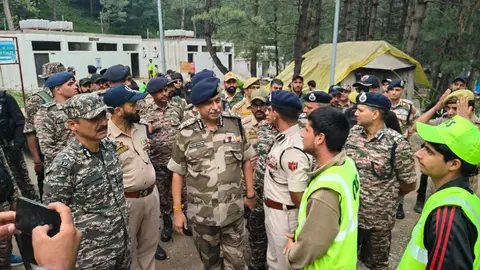
Another 101 personnel from local units joined the climb. Veterans and serving soldiers made the ascent together, the older men who had been there and the younger ones who had grown up on the story.



COMMENTS
JOIN THE DISCUSSION