

 INDIA DEFENCEDhruv NG Helicopter Explained: What HAL Has Actually Put Into Pawan Hans Service
 INDIA DEFENCELCA FOC Trainers Delivered With HTT 40 and Dhruv NG as Rajnath Singh Asks Engineers for Technologies That Do Not Exist
 DEFENCE INDUSTRYTata Zorawar light tank clears Army's L1 hurdle for Rs 20,000 crore contract
 DEFENCE INDUSTRYIndia Belgium Defence Deals Sealed As PM De Wever Visits Delhi
 DEFENCE INDUSTRYAero India 2027 Dates Confirmed for February 8 to 12 in Bengaluru
Gen Upendra Dwivedi Relinquishes Charge as Chief of the Army Staff
Gen Upendra Dwivedi relinquished the appointment of Chief of the Army Staff on 30 June 2026, superannuating after more than four decades in uniform. He handed charge to Gen Dhiraj Seth, who takes over as the new Army Chief. Earlier in the day Gen Upendra Dwivedi was presented a Ceremonial Guard of Honour at the South Block Lawns in New Delhi.
Guard of Honour at South Block
The outgoing Chief took the salute on a dais set against the sandstone facade of South Block, with a tri-Service turnout in attendance. The parade closed his term in command.
The Army's information service shared images of the ceremony on X, describing the parade at the South Block Lawns and paying tribute to a career spanning over four decades of service to the nation: ADG PI. The official release on the relinquishment was issued through the Press Information Bureau, which set out the markers of the tenure now ending.
Operational readiness under Gen Upendra Dwivedi
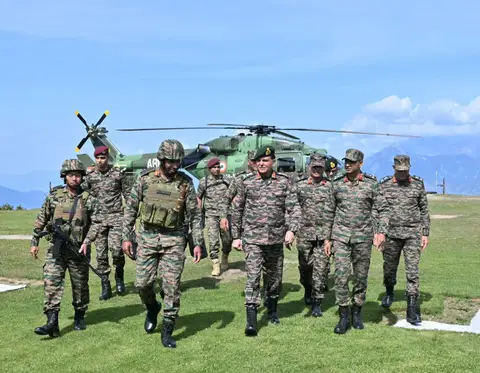
Through the tenure, Gen Upendra Dwivedi held operational readiness as the first priority across theatres. The Indian Army kept a vigilant posture along the Northern Borders under Operation Snow Leopard and discharged its tasks on the Western Front with restraint and professionalism. Operation Sindoor, the calibrated cross-border response of May 2025, was the defining operation of his time in command, and stands as the moment the force's preparedness, precision and reach were tested most openly.
The Decade of Transformation
Gen Dwivedi gave direction to the Army's ongoing Decade of Transformation. The programme runs across force restructuring, modernisation, technology absorption, jointness, systems reform and human resource management, with the stated aim of a leaner force able to fight across a contested electromagnetic spectrum and at longer ranges. Integrated structures and a move towards theatre-oriented thinking sat at the centre of that effort.
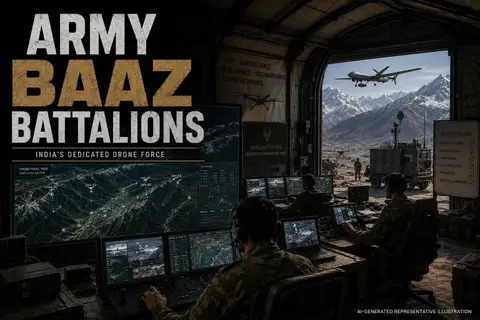
New formations gave the aim shape. The Rudra Brigades, Bhairav Battalions, Ashni Drone Platoons, Shaktibaan Regiments and Divyastra Batteries were progressed alongside Electronic Warfare Brigades and Integrated Battle Groups, each raised against a gap the force had identified in recent operations. The push to field indigenous strike systems ran in parallel, visible in inductions such as the SMPP loitering munition programme and the Prahar light machine gun handover to frontline units. The intent was to compress the distance between a stated requirement and a fielded system.
New formations across the force
Much of the restructuring drew on the post-Sindoor period, when the gap between tube artillery and long-range precision fires became a recognised priority. Guided rocket systems such as the Suryastra launcher and jet-powered strike drones were brought in at speed to close it, several through the emergency procurement route the Ministry has leaned on since the conflict. These were not standalone purchases but parts of a wider attempt to rewire how the Army generates and applies firepower.
Jointness and soldier welfare
Gen Upendra Dwivedi pressed for closer synergy among the three Services. He encouraged common operational thinking and tighter coordination between the Army, Navy and Air Force, in line with the requirements of future joint and theatre-oriented operations, and held that integration was no longer optional for a modern force.
The welfare of serving personnel, veterans, Veer Naris and families stayed a stated priority through the tenure. He steered measures to strengthen the Army's connect with its soldiers and veterans, including recognition of their contribution through the Veterans Achievers Award, and held that the Army's responsibility to its people extends beyond active service. The Ministry of Defence recorded these initiatives in its account of his term. Outreach to the families of those killed in operations and to the wider veteran community ran through several of these measures.
Strategic Security Guidelines @ 2047
The General also guided the framing of the Strategic Security Guidelines @ 2047, drawn from the Viksit Bharat Vision @ 2047 and the Armed Forces Vision @ 2047. The document sets a long-term outlook for the Army's preparedness and is meant to anchor planning across the next two decades. It was framed to align the Army's force development with the national goals set for the country's centenary.
Handover to Gen Dhiraj Seth
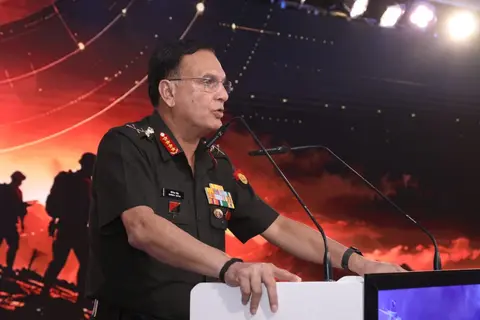
Speaking at the ceremony, Gen Upendra Dwivedi said, "Today, I am handing over this responsibility to General Dhiraj Seth. He is a seasoned soldier and a capable leader." He added that he was fully confident about the future of the Army, that it would remain rooted in its traditions, stay vigilant on current challenges and remain prepared for any situation that may arise. Gen Dhiraj Seth, earlier named as the next Army Chief, takes charge today.
For his illustrious service, Gen Upendra Dwivedi has been conferred the Param Vishisht Seva Medal and the Ati Vishisht Seva Medal.
COMMENTS
JOIN THE DISCUSSION