

 DEFENCE INDUSTRYBrahMos export orders: Vietnam deal worth about $100 million, Indonesia $200 million as Akash reaches Tajikistan, Turkmenistan
 DEFENCE INDUSTRYMahindra Embraer Nagpur facility to assemble C-390 if IAF picks the aircraft
 DEFENCE INDUSTRYSMPP Drone Manufacturing Push: Firm Shifts From Ammunition to Unmanned Warfare, Targets Integrated Defence Capabilities
 INDIA DEFENCEDhruv NG Helicopter Explained: What HAL Has Actually Put Into Pawan Hans Service
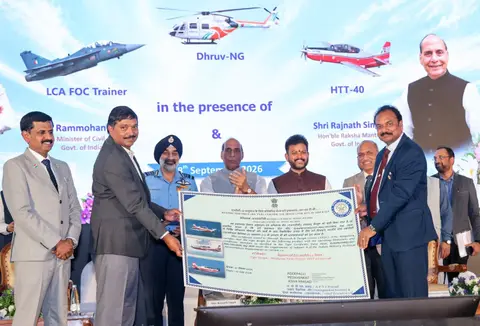 INDIA DEFENCELCA FOC Trainers Delivered With HTT 40 and Dhruv NG as Rajnath Singh Asks Engineers for Technologies That Do Not Exist
The IAF annual press conference ahead of the 94th Air Force Day opened on fighter numbers, with Air Chief Marshal AP Singh saying in New Delhi on Saturday that the force needs at least 36 to 40 aircraft every year over the next few years, and that the Multi-Role Fighter Aircraft (MRFA) contract could be signed this financial year if things go well.
The Chief of the Air Staff said no decision had been taken on Russia's offer of the Su-57, and that the Indian Air Force may have to look at another fifth-generation platform if the Advanced Medium Combat Aircraft (AMCA) programme faces delays. He also called for a decision on at least one India-made fighter engine.
IAF annual press conference puts fighter numbers first
Air power remains central to the country's overall military strength, he told the IAF annual press conference, and India needs to build it up further.
The briefing is held each year ahead of Air Force Day on October 8, when the IAF marks its raising in 1932. Last year the force marked its 93rd anniversary at Air Force Station Hindan in Ghaziabad.
“Everybody understands this fact that our numbers are decreasing, the aircraft that were supposed to come, on which we were relying, they have also come slow,” Air Chief Marshal Singh said. The IAF is looking to the Tejas Mk1A, the MRFA and the future LCA Mk2 to bridge existing and expected gaps.
A smaller fleet does not make the force weak, he said, but using its full capability needs more aircraft. If the procurement cases now under way are completed on time, the shortfall will begin to close. Any new case is taken up to make good attrition and goes through due process, with nothing in it that should cause much worry. All major aircraft programmes, he added, need a whole-of-nation approach to deliver on time.
MRFA contract hoped for this financial year
On the MRFA, the Air Chief Marshal said due process was being followed and he could not give a timeline. If things go well, the contract should be signed this financial year. That, he said, is his hope.
Negotiations run both ways, he said. The outcome does not rest only with the Acquisition Wing or the Ministry of Defence, and the other side has to come around too.
The 114-jet requirement is being pursued through a government-to-government route with France, which submitted its detailed technical and commercial proposal in August.
Air Chief Marshal AP Singh said on Saturday that the MRFA contract could be signed this financial year if things go well, calling it his hope.
— India Defence Wire (@IndiaDefWire) October 3, 2026
On timelines, the Air Chief Marshal said due process is being followed and he could not give a date. He added that negotiations are a… pic.twitter.com/gwzij5x68a
No decision on the Su-57 offer
If the AMCA programme faces delays, the IAF will have to look at some other fifth-generation platform to fill the gap, Air Chief Marshal Singh said. Russia has offered the Su-57 and has been pushing it. No decision has been taken on which platform to pick, or whether to go down that route at all, and that call rests with the Ministry of Defence.
The AMCA is being developed by the Aeronautical Development Agency through an industry partnership, under an execution model approved by the Defence Minister in May 2025 that opened the programme to public and private sector bidders on a competitive basis.
Decision sought on an Indian fighter engine
Self-reliance is central to overall combat readiness, the Air Chief Marshal said. “We need to take a decision on at least one India-made fighter jet engine,” he said.
He also said the force has to be built up with artificial intelligence. “We have to have an AI-augmented force,” he said.
Air Force not against theatre commands
On theatre commands, Air Chief Marshal Singh said he had made it clear every time that the Indian Air Force is not against them. He was speaking for the Air Force as a whole and not for himself, he said, adding that the IAF has been working towards the reform and has been part of the discussions throughout.
Operation Sindoor created a new situation. Discussions under way before it had to move in a slightly different direction afterwards, drawing on first-hand experience gained during the operation, and his only point was that all of it should be examined before a decision is taken.
The Chiefs of Staff Committee has already changed, with all three other members new, and he expected another new member within a month. Fresh minds will look at what kind of organisation is needed, in what sequence it should be built, and whether it should come in one go or in stages. The government will take those decisions once the options are put before it, he said.
No separate drone force for the IAF
Drones have been part of the IAF for decades and are now growing in number, type and capability, the Air Chief Marshal said. “Drones are not revolutionary to the Indian Air Force, but evolutionary. We are growing the number of drones and loitering munitions,” he said.
A separate drone force is not needed, in his view. Unmanned systems and loitering munitions have to operate together with other weapons to produce the desired effect. The force already has specialised units for these capabilities, and their numbers can be increased if required. Loitering munitions, he said, helped create chaos and take down some air defence assets.
Flydubai pilot praised for his resolve
Air Chief Marshal Singh also praised Capt Smit Machchhar, the Indian pilot of Flydubai Flight FZ1073 who was seriously injured in a mid-air attack on September 30. “What he did was exceptionally brave. He showed great physical and mental resolve. It is a lesson for us,” he said.
Manpower position reasonably comfortable
There are some shortages at the officer and airmen levels, though not very many, the Air Chief Marshal said. Numbers move up and down with exits and intake in a continuous process, and the IAF is reasonably comfortable as of now.
COMMENTS
JOIN THE DISCUSSION