

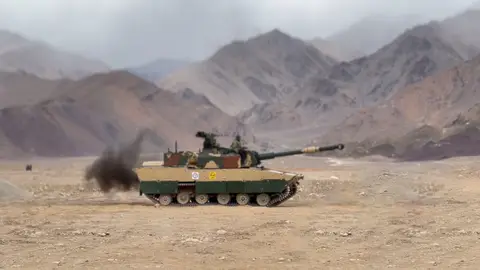
 DEFENCE INDUSTRYTata Zorawar light tank clears Army's L1 hurdle for Rs 20,000 crore contract
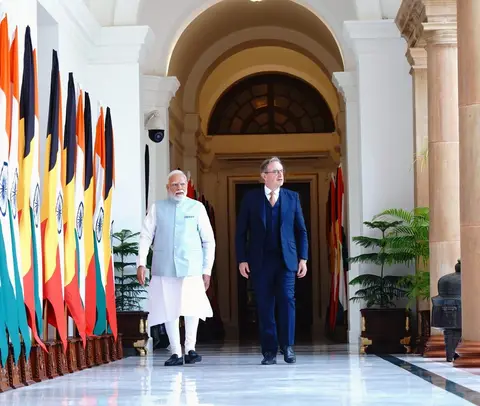 DEFENCE INDUSTRYIndia Belgium Defence Deals Sealed As PM De Wever Visits Delhi
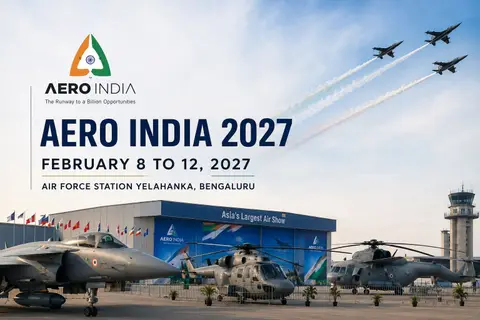 DEFENCE INDUSTRYAero India 2027 Dates Confirmed for February 8 to 12 in Bengaluru
 DEFENCE INDUSTRYJavelin missile co-production advances as Tata Advanced Systems signs Javelin Joint Venture pact
 DEFENCE INDUSTRYTata Lockheed Martin MTA push gets a lift from US envoy's Hyderabad visit
Tejas Mk1A engine supply took up most of Hindustan Aeronautics Limited's opening day at the Farnborough International Airshow, where the company's leadership sat down with GE Aerospace to work through a shortage that has left finished fighters standing without powerplants.
HAL Chairman and Managing Director Ravi K led the Indian side. Across the table was H. Lawrence Culp Jr, Chairman and Chief Executive Officer of GE Aerospace. HAL described the engagement as a meeting with the American firm's top leadership, held on 20 July as the show opened in Hampshire. The agenda was narrow and it was familiar.
Tejas Mk1A engine supply leaves 22 finished aircraft on the ground
Ravi put the position plainly in an interview with FlightGlobal at the show. HAL has completed 22 Mk1A aircraft. Not one of them can go to the Indian Air Force, because there are no engines to fit.
The F404-IN20 is the only powerplant the aircraft flies on. HAL contracted 99 of them from GE in 2021 against the first order of 83 Mk1A fighters, a deal reported at around 716 million dollars at the time. Deliveries began late and stayed slow. A follow-on agreement covers 113 more engines for the second batch of 97 aircraft, with those deliveries scheduled to run from 2027 to 2032. Reporting around the Farnborough meeting put arrivals against the first contract at roughly half a dozen so far.
The pace has already drawn ministerial attention. Defence Minister Rajnath Singh spent a session with HAL earlier this year going through the company's delivery timelines, and Indian reporting through the year has described HAL invoking penalty clauses against the American supplier over the slippage.
What GE told HAL at Farnborough
Ravi said the two companies have been talking for the past year, with GE pointing to supply chain trouble. HAL then went down the chain on its own account, opening conversations with GE's Tier One suppliers.
Castings were part of it. So were particular vendors further down the line. Ravi said GE's leadership told him at Farnborough that those problems are now behind the company, and that getting engines assembled and shipped is a question of time rather than capability. He came away from the meeting with a figure attached to that assurance. GE has promised HAL 22 engines this year.
Some reporting from the show has carried the number as 20 rather than 22.
A depot in India, and what it changes
Sustainment was the other half of the conversation. In April, GE Aerospace signed a contract with the Indian Air Force to help set up an in-country depot for the F404-IN20. The facility will be owned, operated and maintained by the IAF, with the American firm supplying technical inputs, training, support staff, spares and specialised equipment. Once it runs, F404 engines will no longer have to leave the country for overhaul.
Turnaround times fall accordingly. For a fleet already short of engines, keeping the ones inside India serviceable is not a small gain.
Three production lines waiting on powerplants
HAL has not stood still while the engines were held up. Ravi said he began adding capacity before taking the top job in May, having come to it from the board as director of operations. There are now three Mk1A production lines with a combined output of 24 aircraft a year. The company also built what he calls accessory divisions in house, and worked on lifting the capability of the Indian suppliers feeding the programme. That supplier base now reaches well beyond Bengaluru, with centre fuselage assemblies coming off a private line in Hyderabad and Mk1A wing work handled at Larsen and Toubro's Coimbatore facility.
All of that capacity sits against an Indian Air Force orderbook of 180 Mk1A aircraft.
One item on the list is HAL's own. The active electronically scanned array radar going into the Mk1A is built in house, and it still has flight testing ahead of it. Tejas Mk1A engine supply is the variable HAL cannot control. The radar is one it can.
Mk2 assembly continues, first flight placed in 2027
Ravi confirmed the follow-on aircraft is still moving. Assembly of the first LCA Mk2 prototype continues, and he put the first flight somewhere between March and July 2027. That is a firmer window than the programme has offered in a while. It is also later than the mid 2026 dates that were circulating a year ago.
The Mk2 is the aircraft meant to take over from the Jaguar and the Mirage 2000 fleets in the 2035 to 2040 timeframe. It is a heavier machine than the Mk1A, developed with the Aeronautical Development Agency, and it runs the F414 rather than the F404. That engine is the subject of a separate co-production line of work with GE Aerospace in India.
Exports are a later conversation
Ravi was asked about selling abroad. He put the domestic customer first. HAL needs to make products for the world, he said, but it has to satisfy the customers it already has before it can market anything outside the country.
The Mk1A has been flying with the IAF since the type made its first flight at Bengaluru in March 2024, carrying an AESA radar, an electronic warfare suite, beyond visual range missiles and air to air refuelling. The second batch of 97 aircraft, cleared at Rs 62,370 crore, covers 68 single seat fighters and 29 twin seat trainers.
HAL has 22 finished aircraft waiting at its end. GE has promised 22 engines before the year is out.

COMMENTS
JOIN THE DISCUSSION