

 DEFENCE INDUSTRYBrahMos export orders: Vietnam deal worth about $100 million, Indonesia $200 million as Akash reaches Tajikistan, Turkmenistan
 DEFENCE INDUSTRYMahindra Embraer Nagpur facility to assemble C-390 if IAF picks the aircraft
 DEFENCE INDUSTRYSMPP Drone Manufacturing Push: Firm Shifts From Ammunition to Unmanned Warfare, Targets Integrated Defence Capabilities
 INDIA DEFENCEDhruv NG Helicopter Explained: What HAL Has Actually Put Into Pawan Hans Service
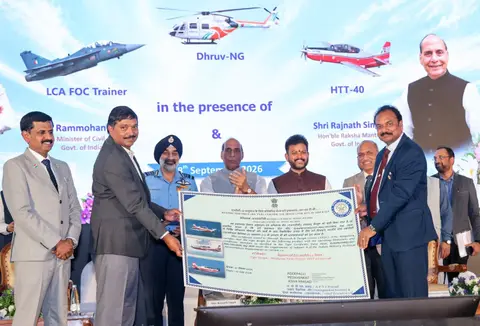 INDIA DEFENCELCA FOC Trainers Delivered With HTT 40 and Dhruv NG as Rajnath Singh Asks Engineers for Technologies That Do Not Exist
India Japan defence talks anchor the eighth Defence Policy Dialogue in Tokyo
India Japan defence talks reached their eighth formal round on Monday, when Defence Secretary Rajesh Kumar Singh and Japan's Vice Minister of Defence for International Affairs Kano Koji co-chaired the 8th India-Japan Defence Policy Dialogue in Tokyo. The two delegations went over the full run of defence cooperation built up since the last dialogue and recommitted to the India-Japan Special Strategic and Global Partnership.
The dialogue is the senior standing channel for India Japan defence talks, run at the level of India's Defence Secretary and Japan's Vice Minister for International Affairs.
https://x.com/SpokespersonMoD/status/2076596986581795045?ref_src=twsrc%5Etfw%7Ctwcamp%5Etweetembed%7Ctwterm%5E2076596986581795045%7Ctwgr%5Ec8c9dbd1e452a7815b55b009c1d5965d34e69b2f%7Ctwcon%5Es1_c10&ref_url=https%3A%2F%2Fpublish.x.com%2F%3Furl%3Dhttps%3A%2F%2Ftwitter.com%2FSpokespersonMoD%2Fstatus%2F2076596986581795045
What the eighth dialogue covered
Both sides worked through the whole spectrum of the defence relationship. That took in military-to-military exchanges, cooperation between the two joint headquarters, maritime cooperation, defence exercises, capacity building, and defence equipment and technology cooperation, including maritime technology. Enhanced institutional links rounded out the agenda.
The delegations also mapped out likely outcomes for the ministerial visits coming later this year, the 2+2 among them, according to the Ministry of Defence. Both sides wanted the high-level exchanges kept regular, and restated a shared commitment to a free, open, inclusive and rules-based Indo-Pacific anchored in international law.
Emerging domains got their own slice of the talks. Singh and Kano Koji discussed deepening work on defence industrial collaboration, technological innovation, cyber security and space, areas both governments now treat as central to the partnership.
Singh appreciated Japan's steady engagement with India on defence and pressed the case for turning the framework into practical cooperation. Kano Koji said Japan would keep expanding defence ties with India across priority areas. Both delegations recorded closer alignment on regional and global security and agreed to keep working together in the Indo-Pacific.
India Japan defence talks and the road to the 2+2
The eighth dialogue sits on a relationship that has moved quickly this year. At the 16th India-Japan Annual Summit in New Delhi on 2 July, Prime Minister Narendra Modi and Japanese Prime Minister Sanae Takaichi cleared the first India-Japan defence co-development project, the UNICORN integrated mast, with Bharat Electronics Limited set to build the system at home.
They also directed their foreign and defence ministers to hold the fourth 2+2 ministerial meeting in Tokyo before the year ends. The Tokyo dialogue began sketching what those ministerial visits should carry.
Japan welcomed the Make in India framework at that summit, and Modi welcomed Tokyo's review of the three principles that govern the transfer of Japanese defence equipment abroad. In April, Tokyo had already approved arms sales to friendly countries, India among them, a change of course for a state long wary of exporting finished military kit. The summit also produced a joint roadmap on economic security, tying supply chains in semiconductors and advanced materials to defence planning.
The maritime thread
Maritime cooperation runs through most of what the two sides do together, and it surfaced again in Tokyo. The Indian Navy and the Japan Maritime Self-Defense Force exercise every year under JAIMEX, and both join the wider Malabar and MILAN drills.
The 2 July summit had widened that naval agenda, with both navies agreeing to a fresh joint exercise pairing a Japanese destroyer with an Indian warship in the Indian Ocean. Freedom of navigation, secure sea lanes and a rules-based maritime order remain the shared refrain, and both capitals return to those themes often.
A call on Koizumi and a wreath
Before the dialogue, Singh called on Japan's Defence Minister Shinjiro Koizumi and passed on the greetings of Defence Minister Rajnath Singh. He also carried an invitation for Koizumi to visit India at an early date, in step with the ministerial visits both sides are planning this year.
Singh had opened the day at the Self-Defense Forces Memorial Stone in Tokyo, laying a wreath for Japanese personnel who died in service. The Ministry of Defence set the gesture within the same partnership framing.
The mechanisms behind the dialogue
The Defence Policy Dialogue is one of several standing bilateral channels India and Japan maintain. Alongside it run an Annual Defence Ministerial Mechanism, the 2+2 foreign and defence ministerial meeting, and a Maritime Affairs Dialogue, the last held in Tokyo in April 2025. The list has grown with the partnership.
The framework rests on older agreements. The 2015 accords covered defence equipment and technology cooperation and the protection of classified military information. A 2020 pact on reciprocal supplies and services between the two armed forces followed, first used during MILAN 2022.
Singh's Tokyo stop caps a busy stretch of defence diplomacy that has run from the Shangri-La Dialogue in Singapore to London and the Leh sector, one leg of a wider outreach this year.
A date for the fourth 2+2 in Tokyo has not been fixed. Both governments have said only that it will happen before the end of the year.
COMMENTS
JOIN THE DISCUSSION