

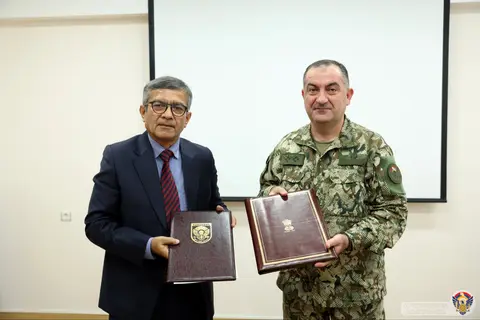
 DEFENCE INDUSTRYBrahMos export orders: Vietnam deal worth about $100 million, Indonesia $200 million as Akash reaches Tajikistan, Turkmenistan
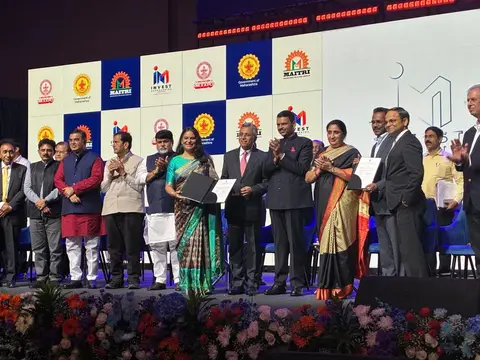 DEFENCE INDUSTRYMahindra Embraer Nagpur facility to assemble C-390 if IAF picks the aircraft
 DEFENCE INDUSTRYSMPP Drone Manufacturing Push: Firm Shifts From Ammunition to Unmanned Warfare, Targets Integrated Defence Capabilities
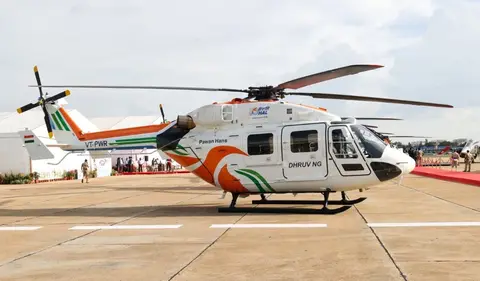 INDIA DEFENCEDhruv NG Helicopter Explained: What HAL Has Actually Put Into Pawan Hans Service
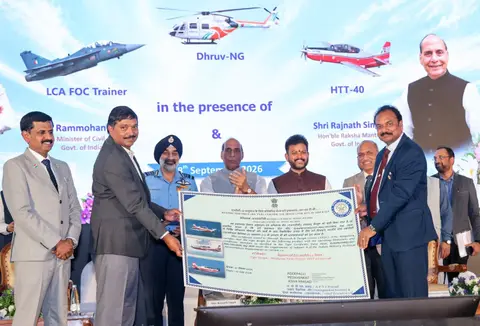 INDIA DEFENCELCA FOC Trainers Delivered With HTT 40 and Dhruv NG as Rajnath Singh Asks Engineers for Technologies That Do Not Exist
Indian Coast Guard conference brings shipyards to the table on future platforms
An Indian Coast Guard conference at Coast Guard Headquarters in New Delhi on 10 July brought the country's major shipyards and design houses into one room to work through what the service's next ships should be built to do. Director General Paramesh Sivamani, AVSM, PTM, TM, DGICG, inaugurated the one day event, themed Extending Capability for Distant Horizons.
The title is not decoration. Distant horizons is where the Coast Guard now spends its time.
Indian Coast Guard conference targets measurable specifications
The stated purpose was to develop quantifiable and future-ready technical specifications for upcoming Coast Guard shipbuilding projects. In the service's own words, the aim is a transition from broad qualitative requirements to measurable capability parameters. That distinction decides how a Request for Proposal is written, how competing bids are compared against each other, and how a yard is later held to what it promised on paper.
Qualitative language has always been the softest joint in Indian warship procurement. A requirement that asks for good sea keeping leaves the builder guessing and the evaluator arguing. A parameter that names the sea state, the sustained speed and the endurance in days does neither.
The yards and the design houses in the room
Garden Reach Shipbuilders and Engineers, Cochin Shipyard Limited and Goa Shipyard Limited were represented, as was L&T Shipbuilding. The design side was carried by TAI Engineers, SeaTech Solutions, Conceptia and SEDS. Coast Guard naval architects and technical officers sat across from them. The invitation list ran to eight firms in all.
Three defence public sector yards, one large private builder, four design houses.
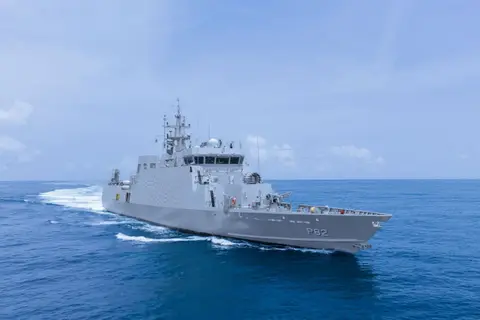
Between them the yards have delivered a large share of what the Coast Guard operates today, from offshore patrol vessels down to fast patrol craft and interceptor boats. Garden Reach Shipbuilders and Engineers alone counts Coast Guard hulls among the more than one hundred warships it has handed over, and the same yard has been running the Navy's Project 17A and Arnala class lines out of Kolkata. Goa Shipyard delivered the fast patrol vessel ICGS Akshay into the fleet on 27 June.
Digital validation enters the requirement
Discussion ran across emerging operational challenges, advanced ship design philosophies, digital validation and the adoption of modern technologies, with the operational effectiveness of future multi-role Coast Guard vessels as the common thread.
Digital validation is the newer entry on that list. Testing a hull form, a compartment layout or a propulsion fit in simulation before steel is cut moves the argument to a point where changing the answer is still cheap. Get it wrong after the keel is laid and the yard, the service and the exchequer all pay for it.
Writing an RFP for Special Role and Multi-role ships
What the Coast Guard wants out of all this is a quantifiable RFP for its future Special Role and Multi-role platforms. Multi-role is the workhorse category, the hull that has to do search and rescue on Monday and pollution response on Thursday. Special Role covers vessels configured for a narrower job.
Nothing in the Coast Guard's account names a class, a tonnage, a number of hulls or a timeline. No figures were put out.
Requirement definition is the stage that precedes the RFP, and it is the stage where a programme is quietly made or lost. A conference of this shape, held before the paperwork hardens, gives the yards a hearing while the specifications are still movable. The Indian Coast Guard conference was held at precisely that point in the cycle.
Indigenous capability and the Coast Guard's build record
The service said the conference reaffirmed its commitment to close collaboration with the Indian shipbuilding industry, to indigenous capability development, and to building technologically advanced, resilient and future-ready maritime platforms against evolving maritime security challenges.
That record is not thin. The Indian Coast Guard inducted its first indigenous air cushion vehicle, H-561, at Goa on 18 June, the lead craft of six ordered from Chowgule and Company. Coast Guard shipbuilding has run almost entirely through Indian yards for years now, under the wider Aatmanirbhar Bharat push in defence production that the Ministry of Defence has driven across the services.
The conference was a one day sitting at Coast Guard Headquarters. Commandant Amit Uniyal, Public Relations Officer of the Indian Coast Guard, issued the release.

COMMENTS
JOIN THE DISCUSSION