

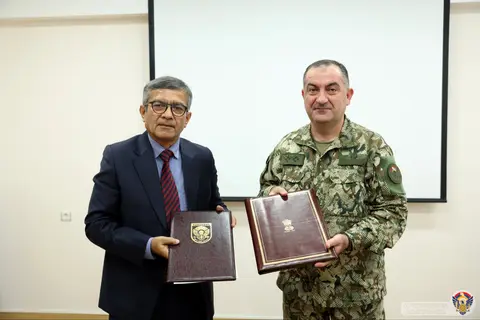
 DEFENCE INDUSTRYBrahMos export orders: Vietnam deal worth about $100 million, Indonesia $200 million as Akash reaches Tajikistan, Turkmenistan
 DEFENCE INDUSTRYMahindra Embraer Nagpur facility to assemble C-390 if IAF picks the aircraft
 DEFENCE INDUSTRYSMPP Drone Manufacturing Push: Firm Shifts From Ammunition to Unmanned Warfare, Targets Integrated Defence Capabilities
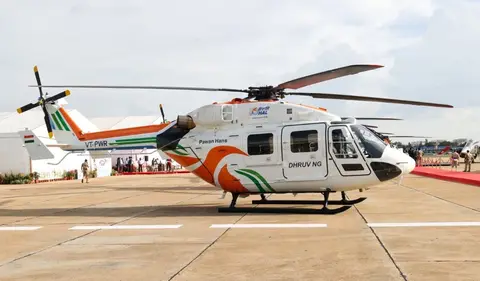 INDIA DEFENCEDhruv NG Helicopter Explained: What HAL Has Actually Put Into Pawan Hans Service
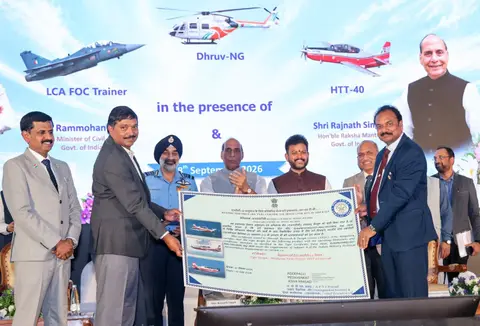 INDIA DEFENCELCA FOC Trainers Delivered With HTT 40 and Dhruv NG as Rajnath Singh Asks Engineers for Technologies That Do Not Exist
Indian Coast Guard rescue off Mumbai brings injured tanker sailor ashore
An Indian Coast Guard rescue off the Mumbai coast on Saturday brought a 30 year old sailor ashore for urgent treatment after he suffered serious eye injuries aboard the crude oil tanker MT Desh Shakti. The evacuation went ahead in weather that would have kept most aircraft on the ground, and it ended with the man in hospital care rather than stranded on a ship that could not turn back fast enough for him.
A Navy Seaking helicopter flew out, lifted him off, and turned for shore. That is the whole operation in a sentence. The work behind it took several agencies and a decision to fly in conditions most crews would refuse.
Inside the Indian Coast Guard rescue off Mumbai
The Maritime Rescue Coordination Centre at Mumbai, the cell the Indian Coast Guard runs to field distress at sea, took the case when word came in that a crewman aboard MT Desh Shakti had been hurt. The injuries were to his eyes. They were serious enough that waiting for the ship to make port was ruled out.
So the MRCC brought in the Navy.
Reaching a moving ship in foul weather is where these operations are won or lost. The Western Naval Command said a red alert was running because of incessant rain, that visibility was poor, and that the sea was rough. A Indian Navy Seaking, a maritime helicopter flown out of Mumbai, launched into exactly that.
The injured man could not step across to the aircraft. The crew put a rescue basket down to the deck and winched him up while the helicopter held position over the tanker, then stabilised him onboard before making for the coast, where he was handed to medical staff.
Four agencies, one call
The Coast Guard credited the outcome to coordination between its MRCC, the Indian Coast Guard, the Indian Navy and the Shipping Corporation of India, which operates MT Desh Shakti. On paper that is four organisations. In practice it is one continuous handoff, from the ship reporting the injury, to the MRCC logging it and tasking a response, to the Navy putting an aircraft and aircrew over the deck.
What the MRCC does
The MRCC sits at the centre of this. India runs these centres to answer distress at sea and to marshal whatever is closest and capable, a Coast Guard ship, a Navy helicopter, or a merchant vessel already nearby. For a casualty on a tanker off Mumbai, the nearest suitable aircraft was a Navy Seaking.
The service framed the whole thing as evidence of round the clock readiness. This time it had a completed mission behind the phrase.
Why the weather mattered
The southwest monsoon sits over the Arabian Sea through these months, and the waters off Mumbai turn heavy. Rain cuts visibility. Wind and swell make a hover over a ship's deck an unstable place to work, and a red alert is not a routine flying condition. The decision to launch in it, and to lower a basket to a pitching deck, is the part of this Indian Coast Guard rescue that a reader who knows the sea will notice.
None of the agencies named the aircrew, which is normal for a service MEDEVAC.
A pattern along the coast
The Navy has been busy at sea on other fronts too. Days earlier the frigate INS Trikand broke up a piracy attempt on the merchant vessel MV Golden Arsenal in the Gulf of Aden, a separate contingent had just landed in Honolulu for the RIMPAC 2026 exercise, and the Eastern Fleet had wrapped a port call in Thailand. A MEDEVAC off Mumbai is quieter work, but it draws on the same readiness.
The Desh Shakti case also came days after another Coast Guard rescue further south. On 29 June, the service took six fishermen off the fishing boat Manju Matha off Mangaluru. The Coast Guard ship Sachet had picked up a VHF distress call from a boat around 33 nautical miles off Suratkal, reporting severe flooding and hull damage in seas rough enough to endanger all six aboard.
Sachet diverted at once and reached the stricken boat inside 90 minutes, an interception run in heavy weather. All six men came off safely.
Two rescues in a week, one a crude oil tanker and one a small fishing boat, is a fair snapshot of what the Coast Guard's network handles when the monsoon is at its worst. The Coast Guard set out the Desh Shakti evacuation in a post on its official X account, crediting the MRCC, the Navy and the Shipping Corporation of India. The injured sailor was ashore and in medical hands by the time it posted.
COMMENTS
JOIN THE DISCUSSION