

 DEFENCE INDUSTRYBrahMos export orders: Vietnam deal worth about $100 million, Indonesia $200 million as Akash reaches Tajikistan, Turkmenistan
 DEFENCE INDUSTRYMahindra Embraer Nagpur facility to assemble C-390 if IAF picks the aircraft
 DEFENCE INDUSTRYSMPP Drone Manufacturing Push: Firm Shifts From Ammunition to Unmanned Warfare, Targets Integrated Defence Capabilities
 INDIA DEFENCEDhruv NG Helicopter Explained: What HAL Has Actually Put Into Pawan Hans Service
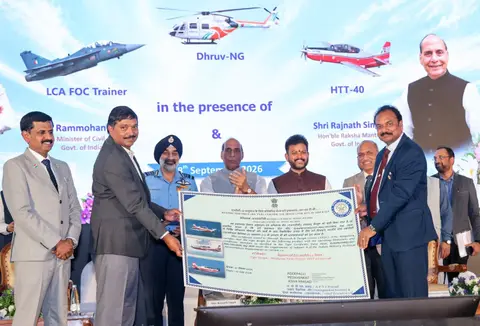 INDIA DEFENCELCA FOC Trainers Delivered With HTT 40 and Dhruv NG as Rajnath Singh Asks Engineers for Technologies That Do Not Exist
Indian Navy RIMPAC 2026 sea phase opens with a first in anti-submarine warfare
The Indian Navy RIMPAC 2026 contingent has moved into the sea phase of the exercise off Hawaii, and it does so carrying a task the service has never held before. For the first time since India began sending forces to the Rim of the Pacific exercise, an Indian officer is discharging the role of Deputy Commander Task Force for theatre-level anti-submarine warfare.
The Navy announced it on X.
Its P-8I long range maritime reconnaissance aircraft and the personnel deployed alongside it spent the run-up to the sea phase in mission planning, technical preparations, operational briefings and professional exchanges with partner navies. Photographs released by the service place the contingent at the K. Mark Takai Pacific Warfighting Center at Joint Base Pearl Harbor Hickam, lined up with officers from a dozen other flags.
https://x.com/indiannavy/status/2075194630514360457?ref_src=twsrc%5Etfw%7Ctwcamp%5Etweetembed%7Ctwterm%5E2075194630514360457%7Ctwgr%5Eea1d44623a735bc71b5c0f6ad38363d90ab93fb5%7Ctwcon%5Es1_c10&ref_url=https%3A%2F%2Fpublish.x.com%2F%3Furl%3Dhttps%3A%2F%2Ftwitter.com%2Findiannavy%2Fstatus%2F2075194630514360457
Indian Navy RIMPAC 2026 command slot changes the register
The Indian Navy RIMPAC 2026 record until now was one of participation. India has sent ships, aircraft and observers to Hawaii since 2014, and they have flown or steamed the missions asked of them. What has not happened before is an Indian officer sitting inside the combined task force structure with responsibility for how the anti-submarine campaign is run across the exercise theatre.
That is what the Deputy Commander Task Force appointment means in practice. The holder helps direct the sensors, the aircraft and the submarines hunting each other across a training area covering a large stretch of the central Pacific.
The Navy has not named the officer.
Why the P-8I earns the seat
The Boeing-built P-8I is the aircraft the Indian Navy relies on to watch the Indian Ocean. Long range sensors, an anti-submarine suite and the endurance to stay airborne for hours have made it the backbone of Indian maritime patrol, and the type has been the service's standing answer to submarine activity in its own waters. At RIMPAC it flies alongside American, Japanese, Australian and Korean maritime patrol aircraft in an environment no Indian exercise can reproduce: five submarines, more than thirty surface ships and over 206 aircraft working the same water and airspace.
Sonobuoys behave the same everywhere. Coalition procedure does not.
The value of a month in Hawaii sits in the second half of that. Radio discipline, data link handling, the sequence in which a contact is passed from one nation's aircraft to another nation's frigate, the shorthand a Japanese controller uses that an Indian crew has to read correctly the first time. None of it is exotic. All of it decides whether a coalition anti-submarine screen holds or leaks.
The exercise around it
RIMPAC 2026 is the thirtieth edition of a series that began in 1971. It opened at Joint Base Pearl Harbor Hickam on 24 June and runs to 31 July, hosted by Commander, US Pacific Fleet. Thirty nations, more than thirty surface ships, five submarines, fifteen national land forces, more than 206 aircraft and about 30,000 personnel are involved.
The programme runs across amphibious operations, gunnery and missile firings, anti-submarine warfare, air defence, military medicine, humanitarian assistance and disaster response, counter-piracy, mine countermeasures, explosive ordnance disposal, and diving and salvage. This year's theme is Partners: Integrated and Prepared.
Who runs it
Vice Adm Jeff Jablon of the US Navy commands the combined task force. Cdre Andres Howard of the Chilean Navy is his deputy. Rear Adm Takuo Kobayashi of the Japan Maritime Self-Defense Force is vice commander, Rear Adm In-Ho Kim of the Republic of Korea Navy holds the maritime component, and Brig Gen J.S. Davis of the Royal Canadian Air Force runs the air component. Beneath that layer sit the functional task forces, and it is at that level that the Indian appointment falls.
Vice Adm Jablon called the exercise the premier multinational maritime training event at its opening on 24 June, and said training together in complex scenarios sharpens the interoperability nations need to work alongside one another.
Reading the deployment from Delhi
The Navy's framing when the P-8I landed in Honolulu was the familiar one: a free, open, inclusive and rules-based Indo-Pacific, better interoperability, better maritime domain awareness, closer operational cooperation with partner navies. Delhi repeats versions of it in settings far from the Pacific, and attaches it equally to sail training deployments such as INS Sudarshini's arrival in New York.
What has changed is the seniority of the task. A country that sends an aircraft is a participant. A country handed a slice of the command structure for the most sensor-intensive part of a naval exercise is being treated as a navy whose judgement other navies will act on. That distinction is not decorative. Anti-submarine warfare is where trust between navies is cheapest to talk about and most expensive to build, because it requires one nation to accept another's contact classification and then act on it before the contact is gone. The same logic runs under India's bilateral work, including the defence pact signed with Indonesia this month.
The sea phase runs to 31 July. The P-8I and the contingent stay with it.
COMMENTS
JOIN THE DISCUSSION