

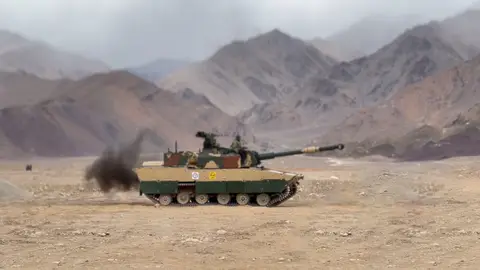
 DEFENCE INDUSTRYTata Zorawar light tank clears Army's L1 hurdle for Rs 20,000 crore contract
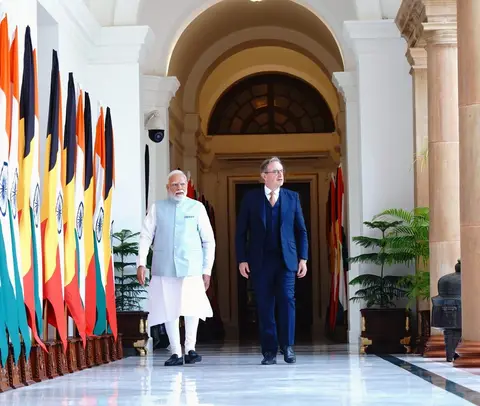 DEFENCE INDUSTRYIndia Belgium Defence Deals Sealed As PM De Wever Visits Delhi
 DEFENCE INDUSTRYAero India 2027 Dates Confirmed for February 8 to 12 in Bengaluru
 DEFENCE INDUSTRYJavelin missile co-production advances as Tata Advanced Systems signs Javelin Joint Venture pact
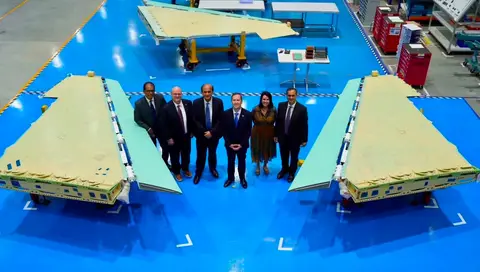 DEFENCE INDUSTRYTata Lockheed Martin MTA push gets a lift from US envoy's Hyderabad visit
Myanmar India Defence Cooperation at the Heart of President Hlaing's New Delhi Visit
Myanmar India defence cooperation is the centrepiece of President Min Aung Hlaing's first official visit to New Delhi since assuming the presidency, with talks scheduled to cover border security, connectivity infrastructure, economic engagement and access to critical mineral deposits that have taken on growing importance for both nations. The visit marks a deliberate step by both governments to deepen a bilateral relationship that has direct consequences for India's northeastern security environment and for Myanmar's efforts to broaden its international engagement at a period of considerable internal difficulty.
President Hlaing arrived in India on Sunday accompanied by a high-level delegation comprising Cabinet ministers, senior government officials and business representatives. He is scheduled to hold talks with Prime Minister Narendra Modi and participate in a business forum designed to expand commercial ties between the two countries. The Ministry of External Affairs confirmed that discussions would span the full breadth of the bilateral relationship, with no issue considered off the table.
"Myanmar lies at the confluence of India's Neighbourhood First, Act East and MAHASAGAR policies. The official visit of President U Min Aung Hlaing to India is expected to further strengthen and deepen the multi-faceted relations between the two countries," the Ministry of External Affairs said in a statement released ahead of the visit.
Myanmar India Defence Cooperation and the Border Security Imperative
Security cooperation along the shared border is among the most urgent items on the agenda. India's northeastern states share a long and difficult frontier with Myanmar, and the instability generated by armed conflict within Myanmar's interior has for years created pressure on border management and provided operational space to non-state armed groups with interests on both sides. Cross-border insurgent activity and illegal trafficking networks have tested the administrative and military capacity of Indian security forces in the region across successive governments.
Enhanced coordination between Indian and Myanmar security establishments is widely seen in New Delhi as essential to reducing these pressures. This includes intelligence sharing, coordinated patrolling arrangements and joint mechanisms to limit the movement of armed factions that exploit porous stretches of the border. The Army and India's paramilitary forces operating in the northeast have long sought more systematic engagement with their counterparts in Naypyidaw, and any formal agreements emerging from the current visit in this area would carry direct operational value.
The timing matters. Internal conflict in Myanmar has in recent years intensified in border-adjacent areas, displacing populations and creating conditions that complicate India's own security management. Keeping open and functional lines of communication with Myanmar's security leadership is not simply a diplomatic preference but a practical necessity for the Indian side.
Critical Minerals and India's Resource Security Agenda
Myanmar holds substantial deposits of rare earth elements and other minerals that have risen sharply in strategic importance as major economies compete to secure supply chains for advanced manufacturing, electronics and defence production. India's own industrial ambitions, including the push to expand domestic defence manufacturing under the Ministry of Defence's Aatmanirbhar Bharat framework, depend in part on access to reliable upstream mineral inputs that cannot currently be sourced entirely from within Indian territory.
Rare earth elements are essential to guided munitions, communication systems, electric vehicle platforms, semiconductors and a wide range of other high-technology applications that sit at the intersection of industrial and defence capability. The global scramble to diversify supply chains away from concentrated sources has pushed resource diplomacy to the top of the agenda for countries that lack sufficient domestic reserves. Myanmar's deposits represent an accessible and geographically proximate opportunity for India to reduce that dependence.
The business forum component of President Hlaing's visit is expected to address these resource-based opportunities directly. Indian and Myanmar private sector representatives will explore frameworks for investment and joint development, with the government-to-government discussions providing the political context within which commercial partnerships can be structured. Whether formal agreements are signed during this visit or whether it establishes the basis for more detailed negotiations in subsequent rounds, the direction of travel is clearly toward deeper resource engagement.
Connectivity Projects and the Act East Policy
India's Act East policy has consistently identified Myanmar as the essential link between South Asia and Southeast Asia, and the connectivity projects routed through Myanmar are central to New Delhi's ambitions in the wider region. The Kaladan Multi-Modal Transit Transport Project, which aims to connect India's northeastern states to Myanmar's Sittwe port and onward to Southeast Asian markets, represents one of the flagship infrastructure undertakings in this corridor. Progress has been uneven over the years, affected by both financial constraints and security conditions in Myanmar's Rakhine State, but Indian commitment to the project has not wavered.
The India-Myanmar-Thailand Trilateral Highway, another major initiative, has similarly moved at a pace shaped by practical difficulties on the ground. When completed, these corridors would dramatically reduce the logistical cost of trade between India's landlocked northeastern states and markets further east, delivering an economic dividend that complements the security rationale for engagement. Both sides are expected to review implementation timelines during the current visit and discuss ways to accelerate progress, with the Press Information Bureau expected to carry official readouts following the summit-level meetings.
For India's northeastern states, these connectivity projects are not abstract strategic constructs but potential transformers of local economies that have long been disadvantaged by geography and inadequate infrastructure links to the rest of the country and to regional markets. Keeping Myanmar as a cooperative partner in this effort is therefore a domestic development priority as much as a foreign policy one.
India's Positioning Among Competing Regional Powers
India's engagement with Myanmar does not occur in isolation. Myanmar has long maintained close ties with China, which remains one of its largest investors and infrastructure partners. Beijing's presence in Myanmar's economy is extensive, spanning projects under the China-Myanmar Economic Corridor as well as energy infrastructure, agricultural investment and arms supply. Naypyidaw has considerable leverage in managing its external relationships and is not dependent on any single partner, which means India cannot take its position for granted.
New Delhi has historically pursued an approach that does not frame its Myanmar engagement as a direct competition with Chinese influence, preferring instead to position India as a complementary partner that offers connectivity westward, investment in different sectors and a security relationship grounded in shared border interests. That framing has practical logic but requires sustained effort to translate into tangible outcomes that Myanmar's leadership finds valuable.
Other regional actors including Japan, Thailand and several Association of Southeast Asian Nations members have also maintained various degrees of engagement with Myanmar's current leadership. India occupies a distinctive position among them by virtue of the shared land border, the civilisational and cultural ties that predate modern statehood, and the direct security implications of Myanmar's internal stability for Indian territory. Those factors give New Delhi both a greater stake in the relationship and more immediate leverage than most other external partners.
Myanmar India Defence Cooperation and the Diplomatic Context
Myanmar has faced significant isolation in multilateral forums following the events of February 2021, which removed the elected government of Aung San Suu Kyi and triggered broad international condemnation. In the years since, the country has confronted internal armed conflict, economic contraction and reduced access to multilateral financial institutions. Against that backdrop, bilateral relationships with countries that have maintained engagement carry particular diplomatic weight for the Myanmar leadership.
The choice of India for President Hlaing's first official overseas visit since assuming the presidency is in this context a signal of where Naypyidaw places the relationship in its order of priorities. For India, the visit affirms the logic of its sustained engagement posture, which has drawn some criticism from observers who argue that normal diplomatic dealings provide a measure of legitimacy to an administration that came to power in disputed circumstances. The Indian government has consistently responded to such criticism by pointing to the practical imperatives of managing a shared border, protecting Indian nationals and investments in Myanmar, and ensuring that connectivity infrastructure critical to northeastern development remains functional. These are not positions that can be sacrificed to symbolic gestures without concrete cost to Indian interests.
MEA spokesperson Randhir Jaiswal confirmed ahead of the visit that all issues forming part of the bilateral relationship would be discussed during the high-level meetings, a formulation that signals willingness to engage across the full spectrum without pre-emptively closing off any subject.
For India's defence establishment, the outcomes of this visit will be assessed carefully against the specific benchmarks that matter most: progress on border security cooperation, any movement on critical minerals access, and the state of connectivity project implementation. Myanmar India defence cooperation has been a work in progress across many years and many governments, but the current visit, conducted at the level of head of state and head of government, carries the political weight needed to move stalled items forward and set the direction of the relationship for the period ahead.
COMMENTS
JOIN THE DISCUSSION