

 DEFENCE INDUSTRYTata Zorawar light tank clears Army's L1 hurdle for Rs 20,000 crore contract
 DEFENCE INDUSTRYIndia Belgium Defence Deals Sealed As PM De Wever Visits Delhi
 DEFENCE INDUSTRYAero India 2027 Dates Confirmed for February 8 to 12 in Bengaluru
 DEFENCE INDUSTRYJavelin missile co-production advances as Tata Advanced Systems signs Javelin Joint Venture pact
 DEFENCE INDUSTRYTata Lockheed Martin MTA push gets a lift from US envoy's Hyderabad visit
India Australia Defence Pact Gains Momentum as Joint Production Talks Begin
India Australia defence pact discussions have moved into a more concrete phase, with New Delhi and Canberra agreeing to begin work on a Memorandum of Understanding covering the supply of defence articles and defence services. The decision was taken at the second India Australia Defence Ministers Dialogue held in New Delhi, where both governments made clear that they want a formal framework to anchor a relationship that has widened rapidly over the past few years. Officials on both sides view the proposed agreement as the foundation for closer industrial cooperation, including the joint development and production of military equipment, and as a sign that the partnership is maturing into something more durable than periodic consultations.
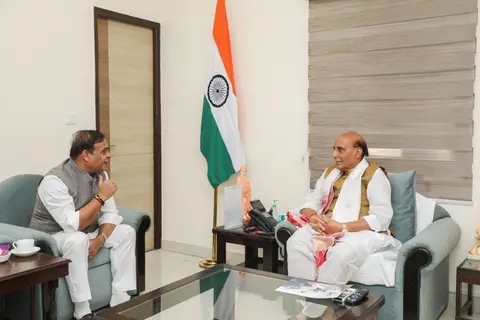
Defence Minister Rajnath Singh hosted Australia's Deputy Prime Minister and Defence Minister Richard Marles for the talks, which reviewed the ground covered since the first such dialogue was held in Australia in October 2025. The pace of engagement since then has been brisk, and the meeting in the Indian capital was used to settle the next set of deliverables rather than simply restate good intentions. For New Delhi the conversation fits into a wider effort to build dependable partnerships with like minded maritime democracies, while keeping domestic manufacturing firmly at the centre of every new arrangement.
A Second Dialogue That Built On Early Promises
The format of an annual ministerial dialogue is itself a recent feature of the relationship, and the fact that the two sides have now met for a second round points to a steady institutional rhythm taking hold. In a joint statement issued after the talks, both ministers reaffirmed their support for the long term vision set out by Prime Minister Narendra Modi and Australian Prime Minister Anthony Albanese. They also welcomed efforts to renew and strengthen the bilateral Joint Declaration on Defence and Security Cooperation, a document that has served as the broad political umbrella for the practical work now under way.
That political backing matters because defence cooperation between countries rarely advances on goodwill alone. It needs clear mandates, funded programmes and a shared reading of the strategic environment. The New Delhi meeting suggested that all three are now in place. Both governments have concluded that the Indo Pacific is entering a more contested period, and that resilient defence ties between trusted partners are now a priority for both capitals. The proposed Memorandum of Understanding is the first attempt to translate that shared assessment into a binding commercial and industrial channel between the two capitals.
India Australia Defence Pact and the Drive for Joint Production
The India Australia defence pact now taking shape is being watched closely by the domestic defence industry, which sees in it an opening to both supply and absorb advanced capability. Beyond simply easing the flow of defence articles and services between the two countries, the proposed agreement is expected to encourage greater industrial collaboration. The aim, as described by officials familiar with the discussions, is to align Australia's defence requirements with India's expanding manufacturing base, allowing Indian firms to take part in supply chains that have until now been dominated by a small number of Western suppliers.
This fits with the government's sustained push for self reliance in defence production under the Aatmanirbhar Bharat framework, promoted by the Ministry of Defence. Indian policymakers have spent the better part of a decade trying to move the country away from its position as one of the world's largest arms importers and towards a model in which design, development and manufacturing happen at home. A partner such as Australia, which combines high technology demand with a relatively open procurement system, offers Indian manufacturers a credible export market and a route into joint programmes that carry genuine technological weight.
For Canberra the calculation is equally pragmatic. Australia faces its own pressures to diversify defence supply chains and to reduce its dependence on a narrow set of sources at a time when global demand for munitions and platforms has surged. India's large industrial capacity, competitive costs and growing private defence sector make it an attractive partner, particularly in areas where the two countries field similar equipment or face similar operating conditions across the Indian Ocean and the wider region.
Maritime Security Moves to the Front
Maritime security featured prominently throughout the dialogue, reflecting the geography that binds the two nations. India and Australia reviewed progress on a Joint Maritime Security Collaboration Roadmap and agreed to deepen cooperation on maritime domain awareness, including activities involving maritime patrol aircraft. With both countries operating the P 8 family of patrol aircraft, there is a natural fit in sharing procedures, data and operating experience over the vast expanses of the Indian Ocean.
The two sides also agreed to explore ways to strengthen undersea domain awareness, an area that has gained urgency as submarine activity in the region has increased. Tracking what moves beneath the surface of the Indian Ocean is among the most demanding tasks any navy can undertake, and pooling sensors, research and analysis offers both countries a better picture than either could build alone. The ministers further encouraged closer working ties between the Indian Coast Guard and Australia's Maritime Border Command, and restated their support for a free, open, inclusive and rules based Indo Pacific.
Technology Cooperation and Joint Research
Defence technology cooperation received clear attention during the talks, with both sides agreeing to explore joint research in emerging and futuristic technologies. The dialogue reviewed the science and technology engagement already in progress and identified fresh avenues for collaboration between defence research institutions and industry on both sides. The intent is to move beyond buyer and seller transactions towards genuine partnership in research and development, where laboratories and companies in India and Australia work on problems together from an early stage rather than at the point of sale.
Military to Military Ties Deepen
The two governments also agreed to expand engagement between their armed forces through exercises, professional exchanges and greater interoperability under existing arrangements, building on the close ties maintained with Australia's Department of Defence. The inaugural Joint Staff Talks are expected to take place later this year, a step that will bring planners from both militaries into the same room to map out future activity in a structured way. Regular contact of this kind tends to pay off slowly but steadily, building the familiarity and trust that allow two forces to operate side by side when it matters.
Exercises have already grown in scale and complexity, and Indian and Australian units now train together with increasing confidence across air, land and sea. Each round of activity adds to a stock of shared procedures and personal relationships that no formal document can replace. The professional exchanges that accompany these exercises, covering everything from logistics to specialist training, quietly widen the base on which the larger partnership rests and make future cooperation easier to plan.
What the Agreement Means for the Indo Pacific
The outcomes of the New Delhi meeting point to real momentum in the relationship rather than the cautious incrementalism of earlier years. With both countries increasingly aligned on regional security and on the need for resilient defence supply chains, the proposed Memorandum of Understanding could become a central pillar of a partnership that spans manufacturing, maritime security and advanced technology. For India it represents another step towards a foreign policy that mixes strategic autonomy with close cooperation among trusted partners, and for the region it adds another stabilising link in an increasingly crowded security map.
For now the intent shown in New Delhi has to be turned into a workable text, and officials acknowledge that the India Australia defence pact still faces months of negotiation before the Memorandum of Understanding is signed. Longer still will pass before the first jointly produced equipment leaves a production line. The direction, however, is settled, and on the evidence of this dialogue both governments appear determined to carry it through.

COMMENTS
JOIN THE DISCUSSION