

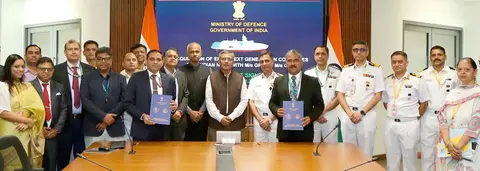
 MINISTRY OF DEFENCENext Generation Corvettes contracts worth Rs 53,866.50 crore signed with GRSE and GSL
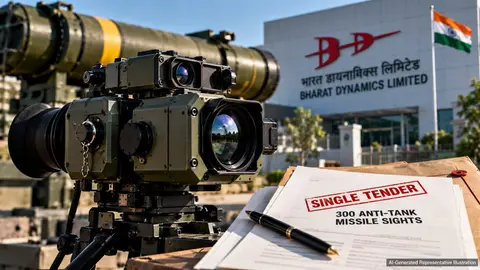 MINISTRY OF DEFENCEBDL single tender for anti-tank missile sights goes to firm set up by former CMD Siddharth Mishra
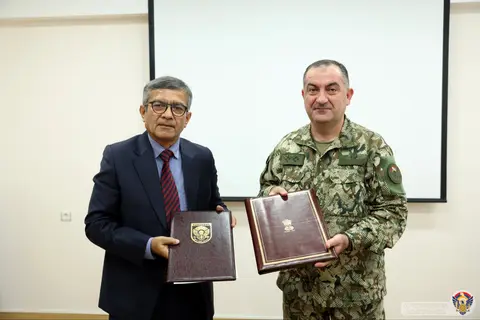 DEFENCE INDUSTRYBrahMos export orders: Vietnam deal worth about $100 million, Indonesia $200 million as Akash reaches Tajikistan, Turkmenistan
 DEFENCE INDUSTRYMahindra Embraer Nagpur facility to assemble C-390 if IAF picks the aircraft
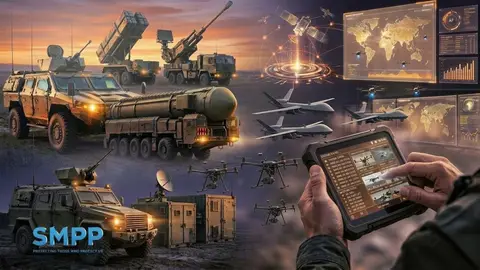 DEFENCE INDUSTRYSMPP Drone Manufacturing Push: Firm Shifts From Ammunition to Unmanned Warfare, Targets Integrated Defence Capabilities
Rajnath Singh in Jaisalmer on Tuesday told Members of Parliament that India aims to reach defence production of Rs 3 lakh crore and defence exports of Rs 50,000 crore by 2029. The Defence Minister was chairing a meeting of the Consultative Committee of the Ministry of Defence on the modernisation of the Defence Forces.
The government's work rests on three areas, he said: budget and self-reliance, technology, and human capital. Adequate funds are essential, the Defence Minister added, but so are their effective use and a clear focus on the most critical needs of the Services.
"We aim to achieve defence production worth Rs 3 lakh crore and defence exports worth Rs 50,000 crore by 2029," he said, according to the Ministry of Defence.
Defence production reaches a record Rs 1.78 lakh crore
Defence production stood at Rs 46,429 crore in 2014-15. It has since climbed to a record Rs 1.78 lakh crore in 2025-26, nearly four times the earlier level. The 2029 goal is about Rs 1.22 lakh crore above the current figure.
Exports have moved faster, from below Rs 2,000 crore in 2014 to approximately Rs 40,000 crore, he said. The recorded figure for 2025-26 was an all-time high of Rs 38,424 crore.
Budget for 2026-27 stands at Rs 7.85 lakh crore
The money behind this push is also at a record level. The defence budget for 2026-27 is Rs 7.85 lakh crore, and Rs 2.19 lakh crore of that is capital outlay for modernisation and new purchases. The capital allocation is 21.84 percent higher than the Budget Estimates of the previous year.
Purchases are moving as well. The Defence Acquisition Council last week cleared proposals worth about Rs 2.12 lakh crore, with around 82 percent to be sourced from Indian industry.
Rajnath Singh in Jaisalmer backs wider private sector role
Technology is now central to the changing character of conflict, he said. The Defence Minister cited the advanced weapons, missiles and systems developed by DRDO, and said the government is giving private firms a level playing field. That opening extends from MSMEs to large corporations.
He called this a 'whole-of-the-nation' approach and expressed satisfaction at the growing contribution of private industry.
The meeting identified artificial intelligence, autonomous systems, unmanned platforms, cyber, space, electronic warfare and advanced communications as the technologies that will shape future conflicts. It also called for closer work among the Defence Forces, DRDO, Defence Public Sector Undertakings, private industry and academic institutions, so that new ideas reach the troops faster as working capabilities.
Self-reliance ran through the discussion. The aim, the Defence Minister said, is a strong domestic defence ecosystem that links technology development to military needs and reduces strategic dependence on foreign sources. He has made the same case for India's strategic autonomy at earlier forums.
Army's new formations proving effective, says Defence Minister
Rajnath Singh in Jaisalmer also turned to personnel. A military's strength is decided not only by technology and money, he told the committee, but also by the capability and preparedness of its people.
"The rapidly evolving nature of warfare necessitates that our Defence Forces remain aligned with the changing requirements of modern warfare. Keeping this in mind, all three Services have continuously refined their structures and formations. The Indian Army's new formations, including the 'Asani', 'Bhairav' and 'Shaktiban' platoons, are proving highly effective in addressing contemporary operational requirements and adapting to the changing dynamics of the battlefield," he said.
Each Bhairav light commando battalion has seven officers, 27 Junior Commissioned Officers and 230 other ranks, according to the ministry's annual report for 2025-26, which records orders for fifteen such battalions. Ashni, the usual Army spelling, is a drone platoon being added to infantry battalions in phases. Shaktibaan regiments are artillery units reorganised from existing Medium Regiments.
Consultative Committee discussions yield roadmap for modernisation
Members of both the Lok Sabha and the Rajya Sabha offered suggestions. The same committee met in New Delhi in August to review the Territorial Army's mandate and record.
Minister of State for Defence Sanjay Seth, Defence Secretary Rajesh Kumar Singh, Secretary (Defence Production) Sanjeev Kumar, Secretary (Ex-servicemen Welfare) Sukriti Likhi and Secretary (Defence Finance) Vishvajit Sahay attended, along with senior civil and military officials.
Six focus areas came out of the talks: force modernisation, jointness, indigenous manufacturing, emerging technologies, defence research, and better use of resources with clear milestones. On jointness, the emphasis fell on tri-service integration, joint operational planning and the combined use of capabilities across multiple domains.
Modernisation goes beyond buying new weapons and equipment, the Defence Minister said. It also means raising operational preparedness, equipping the forces with modern technology and building Indian capability for the long term. He described it as a continuous process.
The roadmap from the meeting gives priority to critical capabilities, better coordination among stakeholders and simpler acquisition and development processes, with progress to be checked periodically against set objectives.
The work will follow a structured, phased approach. The objective is a military able to answer conventional, sub-conventional and multi-domain security challenges.

COMMENTS
JOIN THE DISCUSSION