

 INDIA DEFENCEDhruv NG Helicopter Explained: What HAL Has Actually Put Into Pawan Hans Service
 INDIA DEFENCELCA FOC Trainers Delivered With HTT 40 and Dhruv NG as Rajnath Singh Asks Engineers for Technologies That Do Not Exist
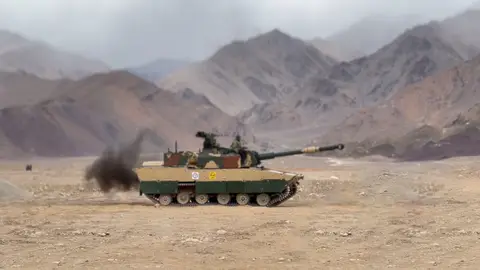 DEFENCE INDUSTRYTata Zorawar light tank clears Army's L1 hurdle for Rs 20,000 crore contract
 DEFENCE INDUSTRYIndia Belgium Defence Deals Sealed As PM De Wever Visits Delhi
 DEFENCE INDUSTRYAero India 2027 Dates Confirmed for February 8 to 12 in Bengaluru
HAL Airport in Bengaluru has become the first airport in India to operationalise the RNP CAT H approach, a satellite-guided precision navigation procedure designed exclusively for helicopters. The Required Navigation Performance, Category H, system lets rotary-wing aircraft fly tightly defined, optimised flight paths instead of relying on conventional radar vectoring shared with fixed-wing traffic.
It cuts the approach time to HAL Airport from about 12 minutes to roughly four.
How the RNP CAT H approach works
Conventional approaches route helicopters onto the same corridors used by fixed-wing aircraft, often adding holding time and longer track miles around a city's terrain and buildings. RNP CAT H is built around the helicopter's own performance envelope instead. It defines a satellite-guided path shaped for a rotary-wing aircraft's descent profile, allowing a more direct line to touchdown while staying clear of high ground and urban obstacles along the way.
The result holds up in low visibility.
The Airports Authority of India, HAL and the regulator describe the RNP CAT H approach as enabling all-weather access, not simply a faster line on a clear day. Bengaluru's monsoon months bring the kind of low cloud that closes visual routes into the city, the exact condition a satellite-guided procedure is meant to fly through instead.
A path written for rotorcraft, not adapted from one
That distinction matters operationally. Fixed-wing RNP procedures already exist at Indian airports, but a helicopter descending into a mixed civil-military campus like HAL Airport carries different obstacle clearance and turn-radius requirements than a jet coming in to land on a long runway. RNP CAT H is purpose-built for that profile, drawn up for rotary-wing performance from the outset rather than a fixed-wing chart repurposed for helicopter traffic.
HAL's official post on the launch carries cockpit imagery, including the flight display readouts guiding the aircraft down toward the runway at HAL Airport, taken during a validation flight rather than a staged demonstration afterward.
https://x.com/HALHQBLR/status/2085653077080814038?ref_src=twsrc%5Etfw%7Ctwcamp%5Etweetembed%7Ctwterm%5E2085653077080814038%7Ctwgr%5E0e0c87f4a03fab38ce9f02c224527674143239b8%7Ctwcon%5Es1_c10&ref_url=https%3A%2F%2Fpublish.x.com%2F%3Furl%3Dhttps%3A%2F%2Ftwitter.com%2FHALHQBLR%2Fstatus%2F2085653077080814038
Built by AAI, tested by HAL, cleared by DGCA
The Airports Authority of India developed the procedure. HAL's own test pilots flew the validation trials that proved it out. The Directorate General of Civil Aviation gave the final clearance that let it enter service, the standard three-step route any new instrument procedure has to clear in Indian airspace.
Ravi K, CMD, HAL, said the launch marks a milestone for the country's aviation ecosystem, calling it a step that widens what Indian helicopter operators can safely fly into. He added that the procedure enhances the safety, efficiency and accessibility of helicopter operations, and that HAL Airport's experience could now serve as a template for similar approaches at other Indian airports.
The same test-flying arm has spent the past year putting HAL's own production aircraft through trial flying out of the same airfield, including the Tejas Mk1A, whose engine supply talks with GE Aerospace and whose delivery pace reviewed with the Defence Minister have both run through HAL Airport this year.
What the four-minute figure is standing in for
A shorter approach is the headline number, but the RNP CAT H approach is aimed at more than shaving minutes off a single flight.
AAI and HAL point to gains in airspace capacity and to cleaner separation between rotary and fixed-wing movements sharing the same terminal area, since helicopters descending on their own defined path spend less time mixed into fixed-wing sequencing overhead. There is a noise dimension too, one that has nothing to do with how fast the aircraft gets down. A tighter, more direct descent path means less time spent low over residential neighbourhoods under the approach, which HAL frames as a reduced noise footprint over the city rather than a purely operational gain for pilots and controllers.
For time-critical flying, principally air ambulance and rescue sorties, the same logic runs in reverse. A faster, more reliable approach in poor weather can be the difference between a helicopter making a landing window at HAL Airport and holding outside it until conditions clear enough to try again.
Fifty helicopter movements a day
HAL Airport handles close to 50 helicopter movements daily, a volume that includes HAL's own test and production flying alongside other rotary-wing traffic using the field.
DGCA's clearance applies to that live traffic from the point of operationalisation, not as a trial running alongside the old approach. Most Indian airports with regular helicopter movements still route that traffic through procedures built for fixed-wing aircraft, with no dedicated satellite approach of their own to fall back on.
HAL Airport is the first site to get the RNP CAT H approach, not necessarily the last. Whether it reaches other busy helicopter airports will depend on obstacle surveys and DGCA clearance carried out site by site, not on a blanket national timeline.





COMMENTS
JOIN THE DISCUSSION