

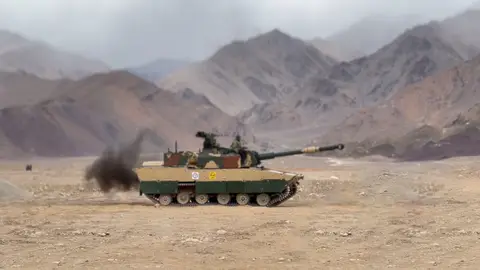
 DEFENCE INDUSTRYTata Zorawar light tank clears Army's L1 hurdle for Rs 20,000 crore contract
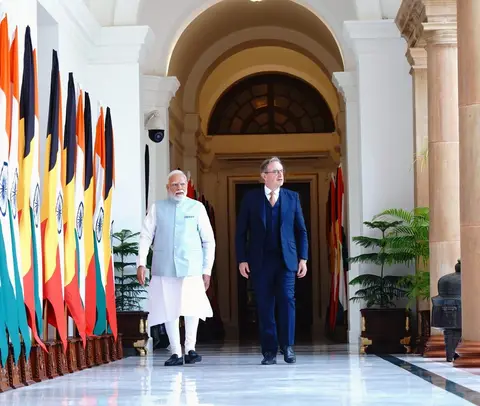 DEFENCE INDUSTRYIndia Belgium Defence Deals Sealed As PM De Wever Visits Delhi
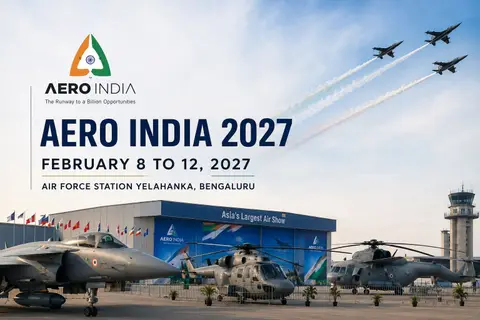 DEFENCE INDUSTRYAero India 2027 Dates Confirmed for February 8 to 12 in Bengaluru
 DEFENCE INDUSTRYJavelin missile co-production advances as Tata Advanced Systems signs Javelin Joint Venture pact
 DEFENCE INDUSTRYTata Lockheed Martin MTA push gets a lift from US envoy's Hyderabad visit
Tejas Mk1A delivery timelines reviewed as Rajnath Singh presses HAL on pace
Tejas Mk1A delivery timelines were the central concern when Defence Minister Rajnath Singh sat down with senior officials of Hindustan Aeronautics Limited on Monday to take stock of the company's major programmes. The meeting at Kartavya Bhavan brought together officials from the Ministry of Defence, the armed forces and HAL, and the message from the minister was direct. He told HAL Chairman and Managing Director K. Ravi to hold firmly to delivery schedules across every ongoing project, and he singled out the platforms that matter most to the modernisation of the armed forces.
The timing of the review tells its own story. The Light Combat Aircraft Tejas Mk1A has become the platform the Indian Air Force is counting on to refill a fighter fleet that has thinned over the past decade, and the slippages in its production have been a source of frustration inside the government. By calling the review and by naming timely execution as the priority, Rajnath Singh signalled that the patience shown so far has limits.
Tejas Mk1A delivery delays bring HAL under sharper scrutiny
Officials familiar with the discussions said the Ministry of Defence is weighing penalties on HAL for the delays in handing over the Tejas Mk1A aircraft already contracted for the Air Force. That is no small step. Penalty clauses sit in most large defence contracts, but the readiness to actually invoke them against the country's flagship aerospace manufacturer shows how seriously the government views the gap between what was promised and what has been delivered.
The reasons for the delay are not entirely of HAL's making. The programme ran into disruptions in the global supply chain, and the most stubborn bottleneck has been the supply of GE F404 engines from the United States. Without engines there is no aircraft to hand over, and for many months the airframes coming off the line in Bengaluru had nowhere to go. That dependence on a single foreign engine source has been one of the harder lessons of the programme.
Engine supply from the United States begins to ease
There is now reason for cautious optimism. Six GE F404 engines needed for the programme have already reached India, and officials say roughly eighteen Tejas Mk1A airframes are ready and waiting. With the engine pipeline opening up again, the expectation within the government is that deliveries can finally pick up speed and that the first aircraft could reach the Air Force before the end of the year.
That sequence matters because it changes the nature of the problem. When the holdup was the absence of engines, HAL could point to a supplier on another continent. As engines arrive in larger numbers, the responsibility for keeping the line moving shifts squarely back to the manufacturer, and this is precisely the pressure the minister applied during the review. The government has made clear that it wants the recovery in engine supply matched by a recovery in the rate of finished aircraft leaving the factory.
Production lines expand to lift output
HAL has not been idle on capacity. The company has set up three dedicated Tejas production lines, two of them in Bengaluru and a third in Nashik. The Nashik facility is the newer addition and is meant to take some of the load off the Bengaluru plants, which have carried the programme since its earliest days. Three lines running in parallel give HAL the physical room to build aircraft faster, provided the inputs keep flowing.
Why the third line in Nashik matters
The decision to open a line in Nashik was about more than floor space. It spreads the industrial base for the Tejas beyond a single city, builds a second pool of skilled labour and supervisory talent, and gives the programme resilience if one site faces a disruption. For a fighter that the Air Force intends to operate in large numbers for decades, that kind of redundancy in manufacturing is worth having. It also fits the wider push to deepen indigenous aerospace capacity rather than concentrate it in one place.
An order book that anchors the indigenous fighter push
The scale of the commitment behind the Tejas Mk1A is what makes the delivery question so important. The Indian Air Force has already ordered 83 Mk1A fighters under a contract valued at more than Rs 48,000 crore. On top of that, the government has cleared the purchase of a further 97 aircraft, a decision that roughly doubles the planned fleet and turns the Mk1A into the single largest indigenous combat aircraft order the country has placed.
That order book is a vote of confidence in domestic manufacturing, and it is also a test of it. Every aircraft built in India for the Air Force is money that stays in the country, skills that develop at home and a step away from dependence on imports. The Aatmanirbhar Bharat push in defence rests heavily on programmes like this one delivering on their promise, which is why the slippages have drawn the attention they have at the highest levels of the ministry.
For the Air Force the arithmetic is straightforward. The service has watched older squadrons retire faster than new ones have come in, and the Tejas Mk1A is the most immediate answer available from an Indian factory. Every aircraft that slips to the right on the calendar is a gap the service has to manage with ageing platforms, which is why the Air Force has pressed as hard as the ministry for the programme to find its rhythm. The interest shown at Monday's review came from the operational side as much as from the political leadership.
The Tejas family has grown into a small fleet of variants. The Mk1 is already operational with the Air Force, the Mk1A is the improved version now in production, and the Mk2, a larger and more capable fighter, is still under development. Alongside these sit trainer and naval versions, giving the programme a reach across roles that few indigenous projects have achieved.
What the Mk1A brings to the cockpit
The Mk1A is a meaningful step up from the original Mk1. It carries an Active Electronically Scanned Array radar, which gives the pilot a sharper and more flexible picture of the airspace, along with upgraded electronic warfare systems to protect the aircraft against modern threats. It adds beyond visual range missile capability, air to air refuelling to extend its reach, and design measures to reduce its radar signature. Taken together these changes turn a capable light fighter into one the Air Force can field with confidence in a contested environment.
For the men and women who will fly and maintain these aircraft, the upgrades are not abstract. A better radar and stronger electronic protection change what the aircraft can do on an operational sortie, and the ability to refuel in the air widens the map of where it can be sent. These are the qualities the Air Force was promised, and they are the reason the service has been willing to commit to such a large order despite the delays.
Defence Secretary Rajesh Kumar Singh, Chief of Defence Staff General Anil Chauhan, Air Chief Marshal A.P. Singh, HAL Chairman K. Ravi and other senior officials took part in Monday's review. The presence of the service chief and the top uniformed and civilian leadership of the ministry in one room underlined how closely the government is now tracking the programme. The clear takeaway from the meeting is that the government expects the improving engine position to translate quickly into faster Tejas Mk1A delivery, and that HAL will be judged on whether it can convert ready airframes into aircraft in Air Force colours.

COMMENTS
JOIN THE DISCUSSION