

 DEFENCE INDUSTRYBrahMos export orders: Vietnam deal worth about $100 million, Indonesia $200 million as Akash reaches Tajikistan, Turkmenistan
 DEFENCE INDUSTRYMahindra Embraer Nagpur facility to assemble C-390 if IAF picks the aircraft
 DEFENCE INDUSTRYSMPP Drone Manufacturing Push: Firm Shifts From Ammunition to Unmanned Warfare, Targets Integrated Defence Capabilities
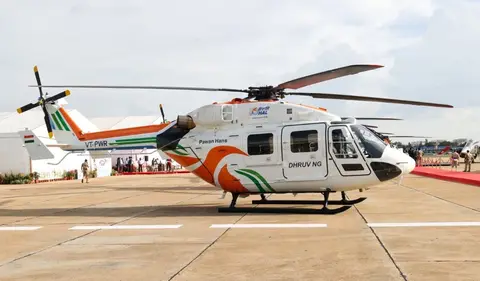 INDIA DEFENCEDhruv NG Helicopter Explained: What HAL Has Actually Put Into Pawan Hans Service
 INDIA DEFENCELCA FOC Trainers Delivered With HTT 40 and Dhruv NG as Rajnath Singh Asks Engineers for Technologies That Do Not Exist
Sir Creek amphibious boats are now formally on the table, with the Ministry of Defence issuing a Request for Proposal for nearly a dozen rigid hull craft that can run at speed on water, crawl across marsh and then climb out onto firm ground without stopping to be lifted. Seven are earmarked for the Army in Kutch. Four go to the Navy, at Mumbai and Port Blair.
The tender is Buy (Indian), with a floor of 60 per cent indigenous content. Bids close in three months, deliveries inside 24 months of signature.
Operating them in the creek sector will fall to the Army's Corps of Engineers, whose sapper units have worked that tidal ground for decades and know exactly why it defeats ordinary equipment.
What Sir Creek amphibious boats are being asked to do
A source put the problem in plain terms. Conventional boats run aground in the creeks once the tide drops, and wheeled vehicles bog down in the slush. The new platforms, the source said, will let troops patrol, intercept and insert small teams across mudflats and shallow channels without a break in mobility.
The specification is built for fighting as much as for moving. Weapon mounts fore and aft. Ballistic protection for the crew.
At sea the boats are required to exceed 40 knots on anti infiltration patrol while carrying 12 combat loaded soldiers and a payload above 1,500 kg. On land they switch to hydraulically operated retractable legs driving all four wheels, making 10 to 15 kmph and climbing 15 degree gradients. They must also move by road on heavy tank transporters and go by air in an IL-76 or a C-17 for swift inter theatre deployment. That last requirement is the one that turns a creek patrol boat into a national asset rather than a regional one.
Why the creek defeats everything else
Sir Creek is a 96 km tidal estuary that opens into the Arabian Sea between Kutch and Pakistan's Sindh province. Pakistan claims the entire creek, right up to its eastern bank. India holds that the boundary runs mid channel. Neither side has moved in decades, and the argument has done more than freeze a line on a map: the maritime boundary beyond the creek mouth and the exclusive economic zones that follow from it remain undelimited because of it.
The un-demarcated marshlands there, and the adjoining Harami Nala, have long carried smugglers, drug couriers and Pakistani fishing boats.
What the western seaboard can cost when it is left thin was demonstrated in November 2008, when the 26/11 attackers came in by sea after hijacking an Indian fishing trawler. Intelligence assessments last year added a fresh layer, flagging new Pakistani forward posts, fortified bunkers and infrastructure coming up in the sector after Operation Sindoor.
What the Defence Minister said at Bhuj
Rajnath Singh put the sector on notice from Bhuj last October. Any Pakistani misadventure in Sir Creek, the Defence Minister said, would draw a response that changed "both history and geography".
He then made the geography explicit. One route to Karachi runs through the creek, and Karachi sits barely 200 km away. That is the arithmetic that turns a smuggling channel into a corps level problem, worth holding while reading a tender for eleven small boats.
The gap in the current grid
Holding the creek today is largely a Border Security Force job, done with floating border outposts, fast patrol boats and all terrain vehicles, and backed by the force's Creek Crocodile commandos, who work the Harami Nala stretch on foot and by boat. The wider border grid the BSF anchors has grown steadily.
But those assets are either boats or vehicles. Not one of them crosses from water to land under its own power, and every transition means a halt, a transfer, or a detour to a hard point. In a place where the tide redraws the ground twice a day that is not a small tax. It is the gap the RFP is written against.
The Navy's half of the buy
For the Navy the four boats answer a different geography. The Andaman and Nicobar Command is spread across hundreds of widely dispersed islands, and moving small parties between them quickly, without a jetty waiting at the other end and often with no prepared landing point at all, is a standing problem.
That theatre is being progressively strengthened as a forward outpost against China's expanding footprint in the Indian Ocean Region. Port Blair gets boats. Mumbai gets the balance, on a coastline that runs alongside the same creek approaches the Army will be patrolling.
The indigenous condition
The 60 per cent floor is standard practice now, not a concession. Recent naval contracting has run the same way, including the Rs 425 crore marine gas turbine generator order on Bharat Forge.
An amphibious craft of this description is not a simple hull. Retractable legs that carry a loaded boat up a gradient, ballistic protection that does not wreck the power to weight ratio, and a 40 knot waterborne speed on top of it, all inside a package a C-17 will accept, is a demanding brief for an Indian yard. The Ministry of Defence has set the bar and given industry three months to answer.
Eleven boats is a small number. Enough to change how the creek is patrolled and how the island chains are worked, not enough to change either theatre's order of battle. The Indian Army takes seven of them into Kutch.



COMMENTS
JOIN THE DISCUSSION