

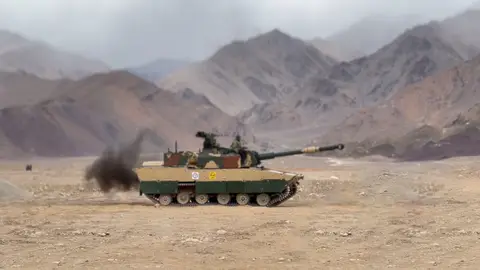
 DEFENCE INDUSTRYTata Zorawar light tank clears Army's L1 hurdle for Rs 20,000 crore contract
 DEFENCE INDUSTRYIndia Belgium Defence Deals Sealed As PM De Wever Visits Delhi
 DEFENCE INDUSTRYAero India 2027 Dates Confirmed for February 8 to 12 in Bengaluru
 DEFENCE INDUSTRYJavelin missile co-production advances as Tata Advanced Systems signs Javelin Joint Venture pact
 DEFENCE INDUSTRYTata Lockheed Martin MTA push gets a lift from US envoy's Hyderabad visit
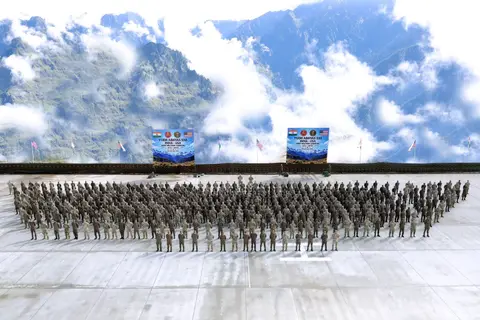
Yudh Abhyas 2026 got underway on Wednesday, marking the 22nd iteration of what the United States Army and the Indian Army describe as the two nations' largest bilateral training exercise. The exercise runs through Sept. 28, bringing Arctic-trained soldiers from the U.S. Army's 11th Airborne Division to high-altitude terrain in India for three weeks of combined training.
This year's edition is built around the deployment of the 3rd Multi-Domain Task Force, a formation that brings long-range precision fires and integrated command-and-control systems into the Yudh Abhyas framework for the first time.
Locations have not been officially confirmed by either army in the announcement itself, but defence sources place this year's training across Rajasthan and Uttarakhand, terrain the exercise has used before at Auli and the Mahajan Field Firing Range in earlier editions.
Senior leadership from both sides is scheduled to attend key training events over the three weeks. U.S. Ambassador to India Sergio Gor and Lt Gen Joel "JB" Vowell, Deputy Commanding General for U.S. Army Pacific, are among those expected on the ground, a level of attendance that reflects how far Yudh Abhyas has moved from its original company-level footing.
"Yudh Abhyas shows just how strong the U.S.-India defense partnership has become," Gor said. "Our soldiers are training together, learning from each other, and building the trust and capabilities that make both of our countries stronger and more secure."
Lt Gen Vowell framed the exercise in more operational terms, pointing to the reach it builds rather than the ceremony around it. "Yudh Abhyas is about building trust, sharing expertise, and demonstrating our commitment to a free and open Indo-Pacific," he said. "Every year, our partnership with the Indian Army grows stronger, and together we are ready to meet any challenge."
Command post to live fire
The exercise combines a command post exercise with a field training exercise, building toward a combined live-fire demonstration that closes out the training. That demonstration showcases the digital integration of American and Indian long-range and precision fires and rocket systems.
Command post work typically runs parallel to the field exercise in Yudh Abhyas, with planning staffs from both armies rehearsing joint decision-making before troops on the ground execute the scenarios that planning produces. The live-fire finale is the point where that planning gets tested against actual rounds downrange rather than a map exercise.
Long-range fires enter the picture
The 3rd Multi-Domain Task Force is a relatively new formation within the U.S. Army, built to field long-range precision fires alongside space, cyber and electronic warfare capabilities as a single integrated package. Its inclusion in Yudh Abhyas 2026 gives Indian planners a direct look at how the U.S. Army is organising those capabilities for the Indo-Pacific theatre, rather than reading about the formation secondhand.
Integrated command-and-control is the other half of the equation. Fires only travel as far as the data feeding them, and this year's exercise gives both sides a chance to test whether American and Indian systems can talk to each other under exercise conditions.
A counter-drone first for Yudh Abhyas 2026
Yudh Abhyas 2026 is operating under the framework of Operation Pathways, the U.S. Army's umbrella construct for exercises across the Indo-Pacific. Under that framework, this iteration carries a first.
The Mobile Low, Slow, Small Unmanned Aircraft Integrated Defeat System, or MLIDS, is deploying to India for the first time, giving both armies a shared counter-drone system to train against low, slow and small aerial threats together rather than separately. Small drones have become a fixture of modern battlefields well beyond South Asia, and MLIDS is one of the systems the U.S. Army has built specifically to knock them down.
Arctic soldiers on Indian terrain
The American contingent draws on the 11th Airborne Division, based at Fort Wainwright, Alaska, and organised specifically around Arctic and cold-weather warfare. Sending Arctic-trained soldiers to train at Indian high altitudes plays to a specialisation that has anchored the U.S. side of Yudh Abhyas for years, since cold-weather and high-altitude skills overlap even when the terrain sits on opposite sides of the planet.
Two decades of Yudh Abhyas
Yudh Abhyas has run annually since 2004, alternating between locations in India and the United States. Last year's 21st edition was hosted by the U.S. Army at Fort Wainwright, Alaska, with soldiers from the Indian Army and the 11th Airborne Division training on Arctic terrain there. Past editions have ranged from UN peacekeeping scenarios to high-altitude cold-weather drills, with recent iterations leaning increasingly on Indo-Pacific interoperability over the exercise's original peacekeeping-only mandate.
The exercise sits alongside a broader run of India-U.S. defence engagement this year, from the IN-USN EOD Exercise at Kochi to the delivery of MH-60R Seahawk helicopters to the Indian Navy, part of a partnership both sides have also framed through venues such as the Shangri-La Dialogue talks earlier this year.
Coverage of Yudh Abhyas 2026, including further imagery, is being tracked by the 11th Airborne Division on official social media platforms under the hashtag #YA26 and on the Defense Visual Information Distribution Service.



COMMENTS
JOIN THE DISCUSSION