

 MINISTRY OF DEFENCEDelhi Defence Dialogue 2026: Self-reliance means no hostage to outside suppliers, says Rajnath Singh
 MINISTRY OF DEFENCENext Generation Corvettes contracts worth Rs 53,866.50 crore signed with GRSE and GSL
 MINISTRY OF DEFENCEBDL single tender for anti-tank missile sights goes to firm set up by former CMD Siddharth Mishra
 DEFENCE INDUSTRYBrahMos export orders: Vietnam deal worth about $100 million, Indonesia $200 million as Akash reaches Tajikistan, Turkmenistan
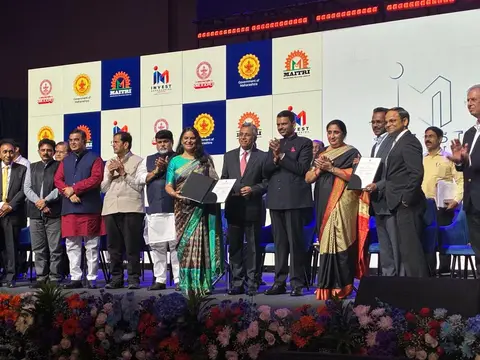 DEFENCE INDUSTRYMahindra Embraer Nagpur facility to assemble C-390 if IAF picks the aircraft
The Union Cabinet chaired by Prime Minister Narendra Modi on Wednesday approved a two-year Agniveer tenure extension, called a Second Tour of Duty, and created a pathway into regular service for all willing Agniveers who meet the selection criteria.
The 75 percent of Agniveers who were to leave after four years will now be offered two more years in uniform. All those willing will then be offered enrolment, subject to selection criteria.
The first 25 percent stays as it was. These Agniveers will continue to enter the regular forces on merit at the end of four years, Chief of Defence Staff General NS Raja Subramani said at a briefing in New Delhi, where he appeared alongside Union Minister Ashwini Vaishnaw. They go on to serve a further 15 years in the regular cadre.
"The Cabinet has created a pathway for all Agniveers to be absorbed into the Indian Defence Forces," General Subramani said.
Armed forces recommended the Agniveer tenure extension
The proposal came from the forces themselves. The Agnipath scheme was introduced on June 14, 2022, with a promise of continuous performance evaluation and periodic review, and the first batch is now close to completing its four years.
A centralised database tracked Agniveers across all three Services and their performance was reviewed every year, the CDS said. Those reviews returned very positive feedback, and the forces recommended the extension to the Government on that basis. Discussions ran for the past three to four months before the Cabinet gave its approval. The aim, according to the Government, was to align the aspirations of Agniveers with organisational efficiency.
"When the Agnipath scheme was first introduced, we emphasised that it was not set in stone," General Subramani said.
Agnipath scheme will continue with four-year entry
The CDS was clear that the entry model is not going away. "First of all, I wish to state that the Agnipath scheme in its current form, that is, the first four years, will continue. The Agnipath scheme has not been discontinued," he said.
The second engagement period is meant for those who were not selected in the first four years. Selection at that stage is relative, General Subramani explained, and missing out does not reflect poorly on an Agniveer.
"It's not that they are bad; it's relative," he said. "So this is a win-win situation for both."
Defence Minister Rajnath Singh thanked the Prime Minister for the decision and described it as a continuation of long-term structural reform aimed at a younger, fitter, technologically equipped and future-ready military.
"It is not merely a recruitment policy; it is a way forward to prepare India's military for the changing character of warfare," he said.
Government lists recruitment, fitness and skills gains from Agnipath
An objective assessment of organisational requirements and operational efficiency brought out the outstanding performance of Agniveers in skills, motivation levels, physical fitness and technological prowess, the Government said on Wednesday.
The achievements it listed after four years of the scheme include a wider recruitment footprint across the country's districts and a more standardised and transparent recruitment process. It also cited very high levels of physical fitness, morale, motivation, competitive spirit and discipline, along with better skills, technological adaptability and education in service. Various branches of the Defence Forces have opened up for women as well.
Higher pay and enhanced Seva Nidhi for six-year Agniveers
The Agniveer tenure extension also brings higher pay. Agniveers on the Second Tour of Duty will draw a fixed monthly package of Rs 43,500 in the first year and Rs 47,500 in the second, plus applicable allowances, according to details of the decision. The package under the original term rises to Rs 40,000 in the fourth year.
The Government's contribution to the Seva Nidhi goes up to 70 percent of the monthly package for these two years, from around 30 percent under the original terms. Each Agniveer leaving after the Second Tour of Duty will receive Rs 10.92 lakh as Seva Nidhi, excluding interest, and the amount will be exempt from income tax. The four-year Seva Nidhi under the 2022 terms of the Agnipath scheme stands at around Rs 11.71 lakh with interest.
The second engagement period will carry seniority benefits as well, the Government said.
No reservation after six years
An Agniveer who is not retained even after six years will not get reservation in any government job, official sources said, since the government will by then have given every opportunity to stay on. Detailed eligibility rules are to follow in formal guidelines.
Several States, including Uttar Pradesh, Haryana and Maharashtra, have announced reservations for former Agniveers in police and other services for those leaving after four years.
First batch of Agniveers gets the decision before release
Around 24,400 Agniveers joined in the first intake, roughly 19,000 of them in the Indian Army, 2,850 in the Indian Air Force and the rest in the Indian Navy. More than 18,000 were due to leave by the end of this year.
The Air Force has already absorbed 712 from that batch into its regular cadre, and the Navy has places for around 550.
Agniveers have also earned recognition in the field. Three were honoured on the eve of Independence Day last year, two with the Sena Medal (Gallantry) and one with a Mention-in-Despatches. The Services have also reported satisfaction with their work across operational and functional roles. In Nepal, young hopefuls and Gorkha veterans rallied in Pokhara in August to ask that Agniveer recruitment be reopened for them.
Around 3.18 lakh Agniveers are now serving across the three Services, according to reports. The Navy's first cohort completes its four years on November 21, the Air Force's on December 21 and the Army's on December 31.


COMMENTS
JOIN THE DISCUSSION