

 DEFENCE INDUSTRYBrahMos export orders: Vietnam deal worth about $100 million, Indonesia $200 million as Akash reaches Tajikistan, Turkmenistan
 DEFENCE INDUSTRYMahindra Embraer Nagpur facility to assemble C-390 if IAF picks the aircraft
 DEFENCE INDUSTRYSMPP Drone Manufacturing Push: Firm Shifts From Ammunition to Unmanned Warfare, Targets Integrated Defence Capabilities
 INDIA DEFENCEDhruv NG Helicopter Explained: What HAL Has Actually Put Into Pawan Hans Service
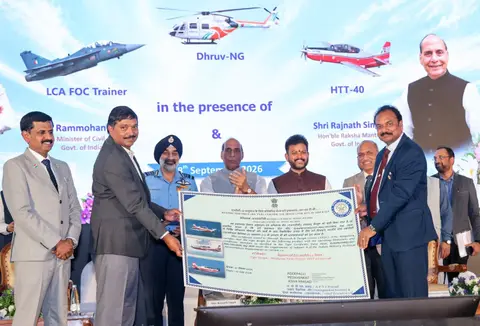 INDIA DEFENCELCA FOC Trainers Delivered With HTT 40 and Dhruv NG as Rajnath Singh Asks Engineers for Technologies That Do Not Exist
The BIMSTEC National Security Chiefs met in New Delhi on 16 July and came away with two documents that matter more than the usual communique language: a set of guidelines for the maritime component of humanitarian assistance and disaster relief, and a set of guiding principles covering how the region's maritime law enforcement agencies behave when they run into each other at sea.
National Security Adviser Ajit Doval hosted. Bangladesh, Bhutan, Myanmar, Nepal, Sri Lanka and Thailand sent their National Security Advisers or heads of delegation, which is full attendance for the seven-member grouping.
It is the fifth edition of a mechanism India launched in this city in 2017, and the first held here since.
What the BIMSTEC National Security Chiefs signed off on
The maritime HADR guidelines are the more immediately usable of the two. The Bay of Bengal absorbs cyclones on a schedule, and relief in the first seventy-two hours has historically been improvised over bilateral phone calls. The Ministry of External Affairs said the guidelines will let member states mount relief operations expeditiously.
The second document is quieter and will take longer to show its worth. The chiefs endorsed guiding principles on the conduct of maritime law enforcement agencies during interactions at sea, with the stated purpose of setting reference points that increase predictability and promote safety when coast guards and fisheries patrols from member states meet on the water.
That is a coast guard code of conduct in everything but name. It does not carry treaty weight. It gives crews a shared script.
Beyond the two texts, the agenda ran along familiar lines. Terrorism and organised crime. Security in the cyber, maritime and energy domains. Connectivity. Disaster management. New and emerging threats, the catch-all that in practice means drones, undersea cables and whatever the technology cycle produces next.
The BIMSTEC Secretary General opened proceedings with an overview of where security-sector cooperation currently stands, and briefed the member states on progress across sectors.
Doval on a challenging global landscape
Doval's opening remarks were unusually blunt about the environment the grouping is operating in.
"We are meeting today in the backdrop of a challenging global landscape; we are witnessing conflicts and geopolitical uncertainties," he said. He added that the region faces multi-domain security threats amplified by rapid technological advancement, and that disruptions in global supply chains have produced economic hardship across member states.
His prescription was collaboration and decisive action for mutual benefit, arrived at through discussion rather than imposed.
The case he made for the grouping
Doval put the arithmetic on the table. BIMSTEC covers 1.7 billion people, close to 22 per cent of the world's population, with a combined GDP of nearly US$ 5 trillion. The seven are united by the Bay of Bengal, he said, and by civilisational legacies built over a millennium.
He listed what the grouping has already done together: fighting terrorism, combating transnational organised crime, cyber threats, maritime challenges. Then he placed BIMSTEC inside India's own policy vocabulary, calling it an expression of Neighbourhood First, of the Act East commitment, and of the MAHASAGAR vision for mutual and holistic advancement for security and growth across regions.
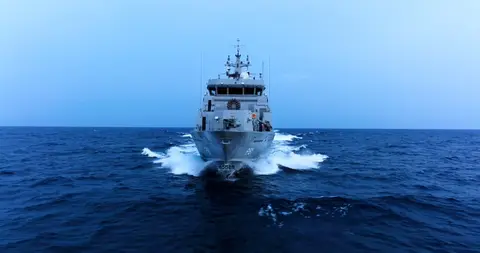
MAHASAGAR is not a slogan the Navy invented for shore visits. It is the frame under which Indian warships have been running relief stores and training capsules across the Indian Ocean, seen most recently when INS Tarkash worked with the Mauritius National Coast Guard at Port Louis before sailing on for the South West Indian Ocean. The HADR guidelines adopted on Thursday sit on that same track, one deck further up.
The bilaterals that ran alongside
Doval spent Wednesday working the margins before the plenary opened.
He met AVM Sampath Thuyacontha, Sri Lanka's Defence Secretary, and Chatchai Bangchuad, Secretary General of Thailand's National Security Council. The Thailand conversation covered intelligence and law enforcement cooperation, connectivity, and new institutional mechanisms.
He also met U Tin Aung San, Myanmar's National Security Adviser, for a review of bilateral security cooperation and an exchange on regional security. India has kept that channel warm through a difficult period; Doval and Tin Aung San last sat down together in Moscow in May, on the sidelines of the International Security Forum.
Bangladesh, which currently chairs BIMSTEC, sent Brig Gen (Retd) AKM Shamsul Islam, Defence Adviser to the Prime Minister. Doval met him on Wednesday as well. Dhaka's participation had been read closely in the run-up, given the friction of recent months, and the delegation travelled.
Where the mechanism sits now
BIMSTEC turns thirty next year. The Bangkok Declaration of 6 June 1997 created it as BIST-EC, with four members; Myanmar joined that December, Bhutan and Nepal in February 2004. The permanent secretariat in Dhaka came only in 2014, seventeen years after the founding, and India funds nearly a third of it.
The security track is younger still. This is the fifth meeting of the chiefs in nine years.
Against that history, the anniversary language in the outcome document reads less like ceremony than a deadline. The advisers reiterated their resolve to enhance collaboration and knowledge-sharing, to build resilience, and to raise institutional capacity against a widening threat set. For New Delhi, the grouping has become the working vehicle for a neighbourhood policy that no longer runs through SAARC, and the security chiefs' round is where that gets tested. India leads on counter-terrorism and transnational crime within the grouping's sectoral structure, alongside transport, tourism and disaster management.
Doval's own multilateral calendar has been heavy this summer. He chaired the BRICS National Security Advisers' round in this city in June, where he reviewed West Asia with Iran's Ghadir Nezamipour on the sidelines.
COMMENTS
JOIN THE DISCUSSION