

 DEFENCE INDUSTRYBrahMos export orders: Vietnam deal worth about $100 million, Indonesia $200 million as Akash reaches Tajikistan, Turkmenistan
 DEFENCE INDUSTRYMahindra Embraer Nagpur facility to assemble C-390 if IAF picks the aircraft
 DEFENCE INDUSTRYSMPP Drone Manufacturing Push: Firm Shifts From Ammunition to Unmanned Warfare, Targets Integrated Defence Capabilities
 INDIA DEFENCEDhruv NG Helicopter Explained: What HAL Has Actually Put Into Pawan Hans Service
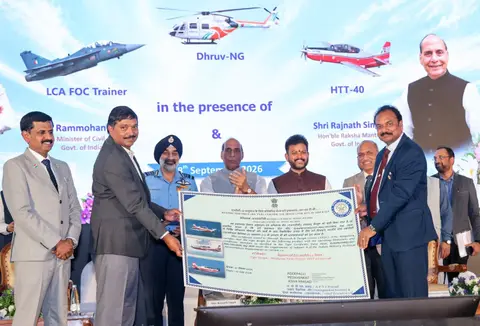 INDIA DEFENCELCA FOC Trainers Delivered With HTT 40 and Dhruv NG as Rajnath Singh Asks Engineers for Technologies That Do Not Exist
The BrahMos missile Operation Sindoor deployment was central to the mission’s success, and the man who built it wants that on record.
Sudhir Kumar Mishra, former Director General of the Defence Research and Development Organisation (DRDO), said Thursday that the supersonic cruise missile did not merely support the mission. It transformed its outcome.
Transformed is a harder word than helped. Mishra chose it deliberately, and he is not a man given to imprecision.
BrahMos Missile Operation Sindoor: What the DRDO Chief Confirmed
Mishra’s authority on this subject is not secondhand. He oversaw the BrahMos missile through design, development, and serial production for the Indian Air Force, Army, and Navy.
“It has been successfully used in Operation Sindoor, and we have transformed the result of this operation through its usage,” he said.
He went further, describing the operation as delivering a “convincing defeat” of Pakistan. That word, convincing, coming from a technocrat with four decades inside the system rather than a minister at a podium, is not standard post-operation language. It is a specific claim from someone who understands what the data behind it looks like. His assessment of the BrahMos missile Operation Sindoor outcome carries weight that no post-operation briefing document can replicate.
BrahMos Led. The Other Systems Held.
Mishra acknowledged the wider weapons ecosystem that performed during the operation, citing anti-drone platforms and the Akash surface-to-air missile system as meaningful contributors.
His emphasis, however, kept returning to BrahMos. In his framing, the supporting systems secured the operational environment. BrahMos determined the result.
That hierarchy carries implications well beyond this operation. India’s defence export pitch is accelerating, and a missile system with confirmed combat performance is a categorically different proposition from one with exercise credentials only. Buyers in Southeast Asia and the Middle East will have noted the distinction.
A Procurement Warning Wrapped in Plain Language
Mishra used the occasion to make a strategic argument that deserves more attention than it will probably receive.
“It has never happened in history that so many major powers are simultaneously engaged in conflicts,” he said. “If we are not self-sufficient in defence, who will come to our rescue?”
Read that as a supply chain argument. When the United States, Russia, France, and others are simultaneously managing wartime industrial demand, India’s access to foreign platforms, spare parts, and replenishment ammunition becomes structurally uncertain regardless of what any bilateral agreement says on paper.
Mishra spent decades navigating exactly those dependencies from inside DRDO. His public confidence that India has now crossed a meaningful self-reliance threshold is significant precisely because he knows the distance the country has travelled to get there.
Rajnath Singh, Two Weeks Prior, Used Stronger Words
Defence Minister Rajnath Singh covered the same ground on March 13, addressing a gathering in Lucknow with considerably less technical restraint.
BrahMos had “wreaked havoc” on terrorist camps inside Pakistan, Singh said. The warning that followed was unambiguous: “If they attempt anything again, they will receive such a response that they will never recover from it.”
Singh was in Lucknow to mark the establishment of a BrahMos integration and testing facility in the city. He described it as embedding Lucknow within India’s emerging defence industrial corridor, generating employment for local youth while feeding directly into the Make in India manufacturing programme.
DefenceChronicles.com coverage of Make in India defence milestones
The messaging was constructed carefully. The city that houses the facility. The facility that produces the missile. The missile that performed in combat. Singh stood at the first point in that chain and let the logic run forward.
Mach 3, Three Services, One Conflict
Developed through BrahMos Aerospace, a joint venture between India’s DRDO and Russia’s NPO Mashinostroyeniya, the BrahMos is a supersonic cruise missile with an operational speed of approximately Mach 2.8 to 3.0, ranking it among the fastest anti-ship and land-attack cruise missiles in active service anywhere in the world.
Its architecture is platform-agnostic by design. Land-based mobile launchers, naval surface vessels, submarines, and air-launched variants integrated onto Su-30MKI fighters have all been operationalised across the three services. That breadth of deployment is what makes it structurally difficult to anticipate and tactically harder to counter.
The BrahMos missile Operation Sindoor record now stands as its most significant combat deployment to date, confirming what years of exercises could only suggest.
Conclusion
The BrahMos missile Operation Sindoor deployment has set a new benchmark for indigenous weapons in combat. Two senior figures have now stated publicly that BrahMos performed decisively in a live operation against a nuclear-armed neighbour. One built the system. One commands the ministry that deploys it.
Governments do not typically confirm specific weapons performance in named operations this quickly or this explicitly. The fact that both men did, through separate events and separate language, suggests the confidence is real rather than coordinated optics.
The harder question now belongs to India’s defence industry. Not whether BrahMos worked in this operation, but whether the production base, supply chains, and maintenance infrastructure can sustain that performance level if the next crisis runs longer than a few days.
Mishra built the missile across three decades. His public tone suggests he has already done that calculation.
COMMENTS
JOIN THE DISCUSSION