

 DEFENCE INDUSTRYBrahMos export orders: Vietnam deal worth about $100 million, Indonesia $200 million as Akash reaches Tajikistan, Turkmenistan
 DEFENCE INDUSTRYMahindra Embraer Nagpur facility to assemble C-390 if IAF picks the aircraft
 DEFENCE INDUSTRYSMPP Drone Manufacturing Push: Firm Shifts From Ammunition to Unmanned Warfare, Targets Integrated Defence Capabilities
 INDIA DEFENCEDhruv NG Helicopter Explained: What HAL Has Actually Put Into Pawan Hans Service
 INDIA DEFENCELCA FOC Trainers Delivered With HTT 40 and Dhruv NG as Rajnath Singh Asks Engineers for Technologies That Do Not Exist
India is officially weighing whether to join one of Europe’s two sixth-generation fighter jet programs, in what would mark a landmark shift in how the country plans its long-term air power strategy.
The Ministry of Defence revealed to Parliament’s Standing Committee on Defence that the Indian Air Force is actively exploring collaboration with either the UK-Italy-Japan Global Combat Air Programme (GCAP) or the France-Germany-Spain Future Combat Air System (FCAS). The message from planners is clear: India does not want to be left behind as the world’s major air powers race to define the next era of combat aviation.
What Is a Sixth-Generation Fighter, and Why Does It Matter?
To understand why this matters, it helps to know what “sixth generation” actually means.
Current top tier jets like the American F 22, F 35 and China’s J 20 are fifth generation aircraft, built around stealth, advanced sensors and networked communication. Sixth generation fighters take that foundation and push it dramatically further. Think AI assisted decision making, swarms of autonomous drone wingmen, directed-energy weapons, adaptive engines that deliver more power with less fuel, and stealth capabilities that make today’s aircraft look conspicuous by comparison.
These are not incremental upgrades. They represent a fundamental reimagining of what an air force can do in a contested warzone, and several countries are already deep into developing them.
The Global Race Is Already Underway
The United States is developing the Boeing F 47 to eventually replace the F 22. China is widely believed to have at least two sixth generation platforms already in testing. Europe, meanwhile, has split into two separate programs.
GCAP – the Global Combat Air Programme, unites the UK, Italy and Japan, and is targeting an operational aircraft by the mid-2030s,which would make it potentially the first sixth generation fighter in service anywhere in the world.
FCAS – the Future Combat Air System, brings together France, Germany and Spain with similar ambitions, though the program has faced delays due to disagreements between the industrial partners involved.
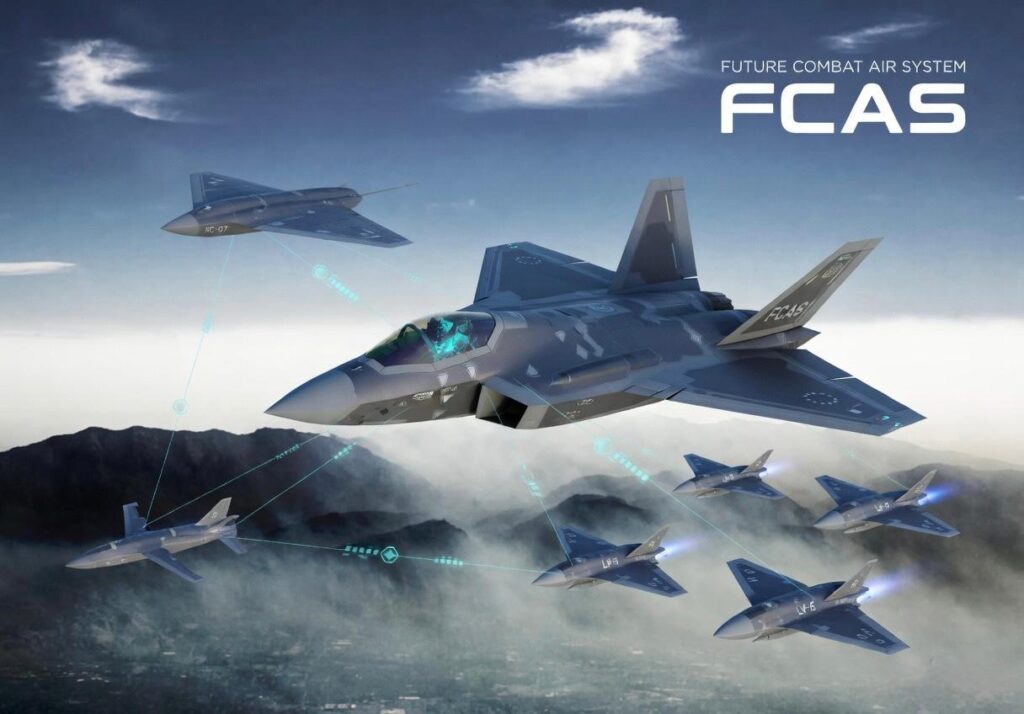
Both programs share a common vision: a next generation stealth fighter supported by unmanned “remote carrier”aircraft, all linked through a powerful shared digital network often described as a “combat cloud”.
Why India Is Paying Attention Now
India’s immediate air power priorities are closer to home. The IAF is still waiting on deliveries of its fourth generation Tejas Mk1A fighters, and the homegrown Advanced Medium Combat Aircraft, a fifth generation stealth jet, is the country’s headline program, expected to enter service within the next decade.
But the MoD’s disclosure to Parliament signals that Indian defence planners are already thinking past the AMCA. Joining a sixth-generation program now, even at an early stage, could give Indian engineers, scientists and defence firms a seat at the table while the most critical design decisions are still being made. That kind of early access to next generation propulsion, AI systems, sensor technology and advanced materials would otherwise cost India decades and enormous sums to develop independently.
The urgency is not purely theoretical, either. The ongoing war in Iran has demonstrated, in real time, how modern air warfare is evolving. While cheap drones like the Shahed have grabbed headlines for their ability to overwhelm air defences, US and Israeli stealth aircraft have remained essential for penetrating defended airspace, gathering intelligence and coordinating precision strikes. Sixth Generation fighters are being designed specifically to dominate the kind of dense, electronically contested battlespace that future conflicts are expected to feature.
Which Program Will India Choose?
Both European consortia have reasons to want India on board, and India has reasons to lean in different directions.
France is making a direct push for India to join FCAS, pointing to the existing and deepening Rafale relationship as a natural bridge. With a deal for 114 Rafale jets reportedly in the pipeline, Paris argues that FCAS would be the logical next step for India within the French aerospace ecosystem.
GCAP, on the other hand, offers India proximity to British and Japanese aerospace expertise, and the program is generally considered to be on a tighter, more advanced development timeline.
A final decision, if one comes, will depend as much on geopolitics and technology transfer terms as on technical merit. India has historically been cautious about agreements that limit its strategic autonomy or restrict domestic production rights.
What It Would Mean For India’s Place In Global Aviation
If India joins one of these programs, it would become one of a very small number of countries actively shaping what the next generation of air combat looks like, rather than simply buying the result decades later.
That is a significant ambition for a country still working to get its domestic fighter production on track. But the MoD’s statement to the parliamentary panel suggests the government sees this not as overreach, but as strategic necessity. In a world where air power is evolving faster than ever, falling a generation behind could take decades to recover from.
India, it seems, intends not to let that happen.



COMMENTS
JOIN THE DISCUSSION